
Experimental characterization for aging effects of polymers and fibers, and material selection for environmental performance - P178
| Experimental characterization for aging effects of polymers and fibers, and material selection for environmental performance | |||||||
|---|---|---|---|---|---|---|---|
| Practice document | |||||||

| |||||||
| Document Type | Practice | ||||||
| Document Identifier | 178 | ||||||
| Themes | |||||||
| Tags | |||||||
| Objective functions |
| ||||||
| MSTE workflow | Development | ||||||
Introduction[edit | edit source]
The aging process in fiber and polymer materials occurs by different factors, as it is mentioned in the Article on Influence of aging mechanisms on material properties - A428 . Therefore, this article enters in the same area as Aging mechanisms in fibers and polymer materials - A427.
Significance[edit | edit source]
Understanding material aging is essential for readers because it directly affects the performance, safety, and reliability of products over time, as it was mentioned in Aging mechanisms in fibers and polymer materials - A427. It helps readers make informed decisions about material selection, design, and protective measures to extend service life and prevent premature failures with fundamental knowledge. Therefore, to choose the suitable experimental method for evaluating aging effects is crucial to ensure cost-effective, durable, and safe designs in future structures or composite materials.
Scope[edit | edit source]
This document describes the experimental methods for evaluating aging effects in the fiber and polymer constituents will be explained. Techniques such as mechanical testing to assess changes in mechanical properties, and thermal analyses (e.g., differential scanning calorimetry (DSC) and thermogravimetric analysis (TGA)) to measure changes in thermal properties, will be discussed. Microscopic methods will also be described for the study of material morphology, e.g., microcrack formation and surface degradation. Moreover, this document presents the above subject matter in the context of the engineering design process. Before committing to any material systems, it is essential to identify, screen and verify constituent materials for their compatibility with the service conditions involving challenging environments. Corresponding analyses can be conducted using accelerated aging tests to simulate long-term effects.
Background[edit | edit source]
Aging phenomena in polymeric materials and their fiber constituents represent a critical challenge for modern engineering applications. Fiber-reinforced polymer composites are widely adopted across industries such as aerospace, automotive, oil and gas, and renewable energy due to their high strength-to-weight ratio, corrosion resistance, and long-term performance potential. However, their durability is strongly influenced by the degradation processes occurring in both the polymer matrix and reinforcing fibers during service life. These processes can be driven by thermal, mechanical, chemical, and environmental factors, which collectively alter material morphology and properties. Over time, such changes may result in cracking, embrittlement, swelling, or even catastrophic failure.
The study of aging is fundamental for predicting service life, optimizing material selection, and ensuring safety in design. Physical aging in polymers and fibers remains an active research area, with numerous unresolved questions regarding time-dependent relaxation, molecular mobility, and thermomechanical performance[1]. Therefore, the characterization of time-aging relationships is required for constructing predictive frameworks that enable long-term property extrapolation[2][3][4][5][6]. This document synthesizes these perspectives into a structured overview of experimental methods for evaluating aging effects in fiber and polymer constituents, discussing first mechanical testing approaches and thermal characterization techniques, followed by microscopic evaluation of morphological changes, and finally accelerated aging protocols for lifetime prediction. The analysis concludes by situating these methodologies within the engineering design process, where pre-screening and validation of materials under realistic service conditions are required.
Mechanical testing approaches[edit | edit source]
Mechanical properties such as tensile strength, modulus, fracture toughness, and fatigue resistance are among the most sensitive indicators of material degradation. As fibers and polymers age, chain scission, oxidation, or interfacial debonding can diminish load transfer capabilities and reduce structural integrity. Repeated cyclic stresses may accelerate crack initiation, while long-term creep introduces permanent deformation. Evaluating these changes through standardized testing provides critical insight into residual performance.
Tensile and flexural testing[edit | edit source]
Tensile testing is widely used to monitor reductions in stiffness and strength. Aging often leads to increased brittleness, resulting in lower strain-to-failure values[7][8][9][10]. Similarly, flexural testing highlights changes in modulus, which are particularly relevant for fiber-dominated composites[11]. Mechanical curves shift over aging time, reinforcing the need for time-aging models to predict long-term mechanical behavior.
Fatigue and creep tests[edit | edit source]
Cyclic fatigue testing identifies how repeated stress applications degrade polymers and fibers[12][13][14][15]. Polymer chains undergoing relaxation or oxidation exhibit reduced fatigue life, with cracks forming more easily along aged interfaces. Complementarily, creep experiments reveal long-term deformation under sustained load[16]. Physical aging restricts free volume in polymers, slowing chain mobility but paradoxically reducing resistance to creep fracture.
Fracture and impact resistance[edit | edit source]
Aging often results in microcracks, which lower fracture toughness and impact resistance. Charpy and Izod impact tests[17][18], as well as fracture mechanics–based approaches allow quantification of this effect. These mechanical indicators are especially relevant for safety-critical sectors such as aerospace, where accidental impacts during service can compromise aged materials more severely than pristine ones.
Thermal Analysis Techniques[edit | edit source]
Polymers and fibers are susceptible to thermal degradation, either due to environmental heat exposure or self-heating under cyclic loading. Thermal analyses provide a window into changes in polymer chemistry, crystallinity, and chain relaxation mechanisms.
Differential scanning calorimetry (DSC)[edit | edit source]
DSC measures heat flow associated with transitions such as glass transition (Tg), crystallization, or melting. Aging typically shifts Tg upwards due to reduced chain mobility[1]. By quantifying enthalpic relaxation, DSC directly links aging processes with molecular-level changes[2][3].
Thermogravimetric analysis (TGA)[edit | edit source]
TGA tracks weight loss under controlled heating, providing insight into thermal stability and oxidative degradation. Aged materials generally exhibit earlier onset of decomposition, reflecting weakened molecular bonds[3].
Dynamic mechanical analysis (DMA)[edit | edit source]
DMA evaluates storage modulus, loss modulus, and damping factor as functions of frequency and temperature. It is uniquely suited to capturing time–temperature–aging superposition effects. DMA helps to demonstrate how artificial aging alters viscoelastic behavior, with significant implications for vibration-sensitive applications[3][4].
Microscopic and morphological characterization[edit | edit source]
Microscopic techniques enable direct visualization of morphological changes induced by aging. These methods are indispensable for correlating mechanical property losses with physical features such as microcrack density, void formation, or fiber–matrix interface degradation.
Optical and scanning electron microscopy (SEM)[edit | edit source]
Optical microscopy reveals surface-level defects, including discoloration, crazing, or surface roughening. SEM extends this to micro- and nanoscale features, exposing crack propagation paths or debonded fiber regions. SEM is categorized as a fundamental technique for tracking polymer microstructural evolution from initial defects to catastrophic failure[3][19][20].
Transmission electron microscopy (TEM) and atomic force microscopy (AFM)[edit | edit source]
TEM provides higher-resolution imaging of nanoscale structures, particularly useful for studying nanocomposites[3]. On the other hand, AFM complements this by measuring surface topography and modulus variations, which can indicate local plasticization or embrittlement due to environmental exposure[3].
Spectroscopic techniques[edit | edit source]
Fourier-transform infrared spectroscopy (FTIR)[3][19][20] and Raman spectroscopy[3] detect chemical changes in aged polymers, such as oxidation or hydrolysis. These methods, when combined with microscopic imaging, give a comprehensive view of both morphological and chemical degradation.
Accelerated aging and lifetime prediction[edit | edit source]
Real-time aging studies are impractical for engineering design, as service lifetimes may span decades. Accelerated aging tests artificially replicate environmental exposures, such as elevated temperature, humidity, UV radiation, or chemical immersion, allowing extrapolation to realistic conditions.
Thermal and hydrothermal accelerated tests[edit | edit source]
Elevated-temperature ovens often combined with cyclic humidity, replicate thermal and hydrothermal aging conditions that accelerate chain scission and swelling[3][19][20][21][22][23][24].
UV and oxidative exposure[edit | edit source]
UV chambers simulate sunlight-driven degradation, especially critical for outdoor structures. Oxidative tests, often conducted at high oxygen concentrations, reveal susceptibility to chain scission and surface cracking[3][25][26][27].
Chemical and mechanical accelerated tests[edit | edit source]
Immersion in acids, bases, or solvents replicates corrosive environments. Simultaneous mechanical loading under such exposures evaluates environmental stress cracking, one of the most dangerous aging mechanisms[3][4][5][6][28][29][30][31].
Predictive Modeling[edit | edit source]
Accelerated test data are frequently extrapolated using Arrhenius-type models, where degradation rate constants are related to temperature. By fitting accelerated test results to predictive frameworks, engineers can estimate service lifetimes under specified environmental conditions[2][5][6][19][20].
Integration into the Engineering Design Process[edit | edit source]
Pre-Screening and Material Selection[edit | edit source]
Before committing to a material system, engineers must identify, screen, and verify polymer and fiber constituents for compatibility with anticipated service conditions. This process demands an integrated approach combining mechanical, thermal, microscopic, and accelerated aging data[2][5][6][19][20][21].
Design Under Uncertainty[edit | edit source]
Physical aging introduces uncertainties in performance over time. Incorporating probabilistic design frameworks that account for time-dependent degradation ensures safer and more reliable structures[1][5][6].
Validation and Standards[edit | edit source]
Standardized accelerated aging protocols[32][33][34] are critical for benchmarking materials across industries. Current standards often underestimate the complexity of coupled aging mechanisms, calling for more refined test procedures[3][4].
Long-Term Monitoring[edit | edit source]
Beyond laboratory evaluation, in-service monitoring techniques such as acoustic emission (AE)[35][36] or embedded sensors can provide real-time feedback on degradation. Integrating these with laboratory-based methods ensures a continuous assessment of reliability[2][5][6][37][38].
Conclusion[edit | edit source]
The evaluation of aging effects in fiber and polymer constituents requires a combination of experimental approaches. Mechanical testing reveals performance degradation; thermal analyses capture molecular-level changes; microscopic methods visualize morphological defects; and accelerated tests enable lifetime prediction. Together, these methodologies form a comprehensive toolkit for understanding and mitigating material aging. The field is advancing rapidly, with ongoing efforts to refine testing techniques and predictive models. However, significant challenges remain, particularly in replicating complex real-world environments and coupling different degradation modes. For end-users, the message is clear: thorough pre-screening and validation of fiber and polymer systems are required to ensure safe and reliable performance under demanding service conditions.
Related pages[edit | edit source]
- Aging mechanisms in fibers and polymer materials - A427
- Influence of aging mechanisms on material properties - A428
- Hydrothermal Aging of Fibers and Polymers - Mechanisms and Experimental Insights - C130
- Thermal behaviour - A232
- Polymer (matrix) structure - A236
- Reinforcement properties - A213
Related pages
References
- ↑ 1.0 1.1 1.2 [Ref] Empty citation (help)
- ↑ 2.0 2.1 2.2 2.3 2.4 [Ref] Empty citation (help)
- ↑ 3.00 3.01 3.02 3.03 3.04 3.05 3.06 3.07 3.08 3.09 3.10 3.11 3.12 [Ref] Empty citation (help)
- ↑ 4.0 4.1 4.2 4.3 [Ref] Empty citation (help)
- ↑ 5.0 5.1 5.2 5.3 5.4 5.5 [Ref] Empty citation (help)
- ↑ 6.0 6.1 6.2 6.3 6.4 6.5 [Ref] Empty citation (help)
- ↑ [Ref] Empty citation (help)
- ↑ [Ref] Empty citation (help)
- ↑ [Ref] Empty citation (help)
- ↑ [Ref] Empty citation (help)
- ↑ [Ref] Empty citation (help)
- ↑ [Ref] Empty citation (help)
- ↑ [Ref] Empty citation (help)
- ↑ [Ref] Empty citation (help)
- ↑ [Ref] Empty citation (help)
- ↑ [Ref] Empty citation (help)
- ↑ [Ref] Empty citation (help)
- ↑ [Ref] Empty citation (help)
- ↑ 19.0 19.1 19.2 19.3 19.4 [Ref] Empty citation (help)
- ↑ 20.0 20.1 20.2 20.3 20.4 [Ref] Empty citation (help)
- ↑ 21.0 21.1 [Ref] Empty citation (help)
- ↑ [Ref] Empty citation (help)
- ↑ [Ref] Empty citation (help)
- ↑ [Ref] Empty citation (help)
- ↑ [Ref] Empty citation (help)
- ↑ [Ref] Empty citation (help)
- ↑ [Ref] Empty citation (help)
- ↑ [Ref] Empty citation (help)
- ↑ [Ref] Empty citation (help)
- ↑ [Ref] Empty citation (help)
- ↑ [Ref] Empty citation (help)
- ↑ [Ref] Empty citation (help)
- ↑ [Ref] Empty citation (help)
- ↑ [Ref] Empty citation (help)
- ↑ [Ref] Empty citation (help)
- ↑ [Ref] Empty citation (help)
- ↑ [Ref] Empty citation (help)
- ↑ [Ref] Empty citation (help)
 |
 |
| About | Help |

Welcome
Welcome to the CKN Knowledge in Practice Centre (KPC). The KPC is a resource for learning and applying scientific knowledge to the practice of composites manufacturing. As you navigate around the KPC, refer back to the information on this right-hand pane as a resource for understanding the intricacies of composites processing and why the KPC is laid out in the way that it is. The following video explains the KPC approach:
Understanding Composites Processing
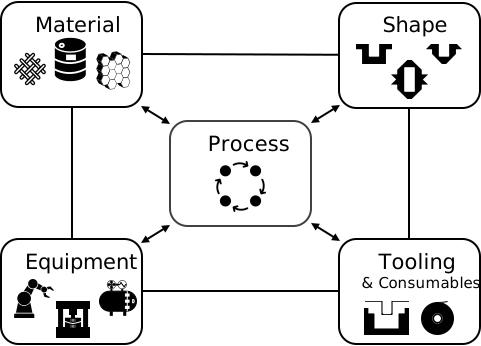
The Knowledge in Practice Centre (KPC) is centered around a structured method of thinking about composite material manufacturing. From the top down, the heirarchy consists of:
- The factory
- Factory cells and/or the factory layout
- Process steps (embodied in the factory process flow) consisting of:
The way that the material, shape, tooling & consumables and equipment (abbreviated as MSTE) interact with each other during a process step is critical to the outcome of the manufacturing step, and ultimately critical to the quality of the finished part. The interactions between MSTE during a process step can be numerous and complex, but the Knowledge in Practice Centre aims to make you aware of these interactions, understand how one parameter affects another, and understand how to analyze the problem using a systems based approach. Using this approach, the factory can then be developed with a complete understanding and control of all interactions.
Interrelationship of Function, Shape, Material & Process
Design for manufacturing is critical to ensuring the producibility of a part. Trouble arises when it is considered too late or not at all in the design process. Conversely, process design (controlling the interactions between shape, material, tooling & consumables and equipment to achieve a desired outcome) must always consider the shape and material of the part. Ashby has developed and popularized the approach linking design (function) to the choice of material and shape, which influence the process selected and vice versa, as shown below:
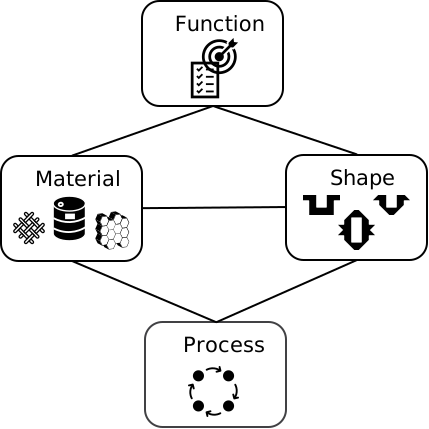
Within the Knowledge in Practice Centre the same methodology is applied but the process is more fully defined by also explicitly calling out the equipment and tooling & consumables. Note that in common usage, a process which consists of many steps can be arbitrarily defined by just one step, e.g. "spray-up". Though convenient, this can be misleading.

Workflows
The KPC's Practice and Case Study volumes consist of three types of workflows:
- Development - Analyzing the interactions between MSTE in the process steps to make decisions on processing parameters and understanding how the process steps and factory cells fit within the factory.
- Troubleshooting - Guiding you to possible causes of processing issues affecting either cost, rate or quality and directing you to the most appropriate development workflow to improve the process
- Optimization - An expansion on the development workflows where a larger number of options are considered to achieve the best mixture of cost, rate & quality for your application.
To use this website, you must agree to our Terms and Conditions and Privacy Policy.
By clicking "I Accept" below, you confirm that you have read, understood, and accepted our Terms and Conditions and Privacy Policy.

