
Influence of aging mechanisms on material properties - A428
| Influence of aging mechanisms on material properties | |
|---|---|
| Foundational knowledge article | |
| Document Type | Article |
| Document Identifier | 428 |
| Tags | |
| Prerequisites | |
Introduction[edit | edit source]
The aging process in fiber and polymer materials occurs by different factors, as it is mentioned in the previous article. Therefore, this article enters in the same area as Aging mechanisms in fibers and polymer materials.
Significance[edit | edit source]
Understanding material aging is crucial for readers because it directly affects the performance, safety, and reliability of products over time, as it was mentioned in Aging mechanisms in fibers and polymer materials. It helps readers make informed decisions about material selection, design, and protective measures to extend service life and prevent premature failures with fundamental knowledge. Therefore, this information may be useful for ensuring cost-effective, durable, and safe designs in future structures or composite materials.
Scope[edit | edit source]
This article discusses the influence of aging on material properties, such as changes in modulus and strength, increased ductility/brittleness, surface degradation, dimensional instability, reduced moisture resistance, and color changes.
Effect of aging mechanisms of polymers on material properties[edit | edit source]
Polymers are widely used in engineering applications because of their low density, processability, and adjustable properties. Despite their advantages, polymer performance changes over time as environmental and operational factors induce aging processes that alter their chemical structure, morphology, and overall behaviour. Understanding these influences is essential for predicting service life, ensuring safety, and guiding material selection.
Thermal aging[edit | edit source]
Exposure to elevated temperatures accelerates chain scission, oxidation, and unintended crosslinking reactions, and as the temperature approaches or exceeds the glass transition temperature (Tg), increased molecular mobility further facilitates degradation[1][2][3]. As a result, mechanical properties such as strength and modulus are typically reduced due to chain breakage and loss of molecular weight, while ductility may initially increase because of plasticization associated with chain scission but subsequently decreases at more advanced stages of degradation. In addition, dimensional stability is adversely affected, with polymers exhibiting shrinkage, softening, or permanent deformation when Tg is exceeded[1][2][3].
Hydrothermal and moisture-induced aging[edit | edit source]
Water molecules diffuse into the polymer matrix, causing swelling and plasticization and, in some cases, inducing hydrolysis of susceptible chemical bonds[3][4]. This moisture ingress leads to a reduction in mechanical properties, with stiffness and strength decreasing, particularly in hygroscopic polymers such as polyamides[3][4]. While plasticization effects may be partially or fully reversible upon drying, hydrolysis-driven chain scission results in permanent degradation of the polymer network[3][4]. In addition, moisture exposure compromises surface integrity, as evidenced by the formation of microcracks, voids, and cavities observed under scanning electron microscopy (SEM), which in turn diminishes fatigue resistance[3][4].
Oxidative and UV-induced aging[edit | edit source]
Exposure to oxygen and ultraviolet (UV) radiation initiates free-radical reactions that cause polymer chain scission and unintended crosslinking, which are photo-oxidation processes particularly critical in outdoor applications[3][5][6]. As a result, noticeable changes in color and appearance may occur, including yellowing, chalking, and loss of gloss. Surface properties can be adversely affected, with embrittlement and microcracking developing and promoting crack initiation. These molecular-level degradations progressively reduce mechanical performance, leading to declines in tensile strength and elongation at break due to the reduction in molecular weight[3][5][6].
Chemical and environmental stress cracking[edit | edit source]
Environmental stress cracking results from the synergistic action of specific chemicals, such as solvents, acids, and bases, combined with sustained mechanical stresses, which together promote crack initiation and subcritical crack growth[7]. This degradation mechanism adversely affects material performance by reducing fracture resistance through the formation of crack initiation sites, diminishing long-term durability under load-bearing conditions, and compromising reliability, as environmental stress cracking often appears as an unexpected failure mode in polymers exposed to aggressive environments[7].
Mechanical loading and fatigue aging[edit | edit source]
Repeated cyclic stresses progressively induce creep, fatigue, and microcrack growth, leading to cumulative damage over time[8][9]. As a result, permanent deformation can occur even under moderate loading due to creep and stress relaxation, while fatigue life is reduced as cracks nucleate and propagate. In addition, degradation of dynamic properties, particularly changes in damping behavior and reductions in modulus, adversely affects the vibration performance of the material[8][9].
Physical aging[edit | edit source]
Below the glass transition temperature (Tg), amorphous polymers undergo a gradual structural relaxation toward thermodynamic equilibrium, a phenomenon commonly referred to as physical aging[1][2][3][4][5][6]. This process is accompanied by an increase in stiffness as the polymer structure densifies, a concurrent reduction in ductility that promotes more brittle fracture behavior, and subtle changes in dimensional stability, including slight shrinkage and a reduction in free volume within the material[1][2][3][4][5][6].
Combined effects and engineering implications[edit | edit source]
Real-world conditions usually involve multiple aging mechanisms simultaneously (e.g., heat + moisture + load). This leads to synergistic degradation effects, complicating lifetime predictions. The influence of aging on polymers is multifaceted, altering mechanical, thermal, and surface properties. Degradation mechanisms such as thermal scission, hydrolysis, oxidation, and physical aging reduce stiffness, toughness, and dimensional stability, while accelerating crack initiation and growth. These property changes have direct implications for the design, durability, and safety of polymer-based structures, highlighting the importance of aging studies in materials engineering[1][2][3][4][5][6][7][8][9].
Effects of aging mechanisms of reinforcement elements (e.g., fibers) on material properties[edit | edit source]
Fibers (glass, carbon, basalt, etc.) are key load-bearing constituents in advanced materials and composites. Their performance over time is strongly influenced by environmental and mechanical aging mechanisms. These processes gradually alter the microstructure, surface chemistry, and intrinsic strength of fibers, which in turn impact their stiffness, toughness, durability, and overall reliability in engineering applications. The main aging mechanisms affecting fibres are outlined below.
Thermal aging[edit | edit source]
Prolonged exposure of polymer composites to elevated temperatures induces degradation mechanisms such as molecular chain scission, reductions in polymer crystallinity, and oxidative reactions at fiber surfaces. In glass fibers, thermal exposure can promote relaxation of network bonds, whereas carbon fibers may undergo surface oxidation at high temperatures[10]. These mechanisms result in a reduction in tensile strength and elastic modulus, accompanied by dimensional instability and increased embrittlement. As degradation progresses, the fibers lose their effectiveness in load transfer, leading to an overall weakening of the composite system[10].
Hydrothermal and moisture-induced aging[edit | edit source]
Moisture exposure affects reinforcing fibers through several degradation mechanisms, as water molecules penetrate fiber surfaces, dissolve leachable constituents, or disrupt existing chemical bonds. Glass and basalt fibers are particularly susceptible to hydrolysis under such conditions, whereas aramid fibers primarily absorb moisture due to the presence of hydrogen-bonding sites within their molecular structure[11][12]. These interactions lead to measurable property changes, including reductions in stiffness and strength caused by swelling, material dissolution, or stress corrosion cracking, while a resulting increase in fiber surface roughness promotes microcrack initiation and accelerates damage evolution[11][12].
Chemical and environmental aging[edit | edit source]
Contact with acids, alkalis, solvents, or other corrosive environments alters the surface composition of reinforcing fibers, while exposure to oxidative species and ultraviolet radiation further intensifies degradation mechanisms[13][14][15]. These chemically and environmentally driven processes lead to surface cracking and discoloration, promote a reduction in interfacial shear strength, and ultimately increase the susceptibility of the material to mechanical failure under applied stress[13][14][15].
Mechanical fatigue and stress-assisted aging[edit | edit source]
Cyclic or sustained mechanical loading leads to the development of microcracks, creep deformation, and fatigue-induced defects within the material, while simultaneous chemical exposure under applied stress further accelerates environmental stress cracking[16]. As a consequence of these coupled mechanisms, the material experiences a progressive reduction in tensile strength and fatigue life, accompanied by the accumulation of microstructural damage and a corresponding decrease in reliability during long-term service[16].
Combined effects and engineering implications[edit | edit source]
Often, fibers experience multiple degradation modes simultaneously. For instance, moisture uptake accelerates stress corrosion cracking in glass fibers, while elevated temperature enhances oxidation in carbon fibers. Such coupled mechanisms amplify property loss more severely than individual processes. These effects have relevant engineering implications, such as durability concerns as fibre degradation reduces stiffness, strength, and load-bearing capacity of fiber-based systems. In addition, material selection must consider for specific environmental exposures. Protective coatings, sizings, or chemical treatments can mitigate aging effects. Finally, changes in reliability due to aging mechanisms directly affects long-term service life predictions, structural safety, and maintenance costs[10][11][12][13][14][15][16].
References
- ↑ 1.0 1.1 1.2 1.3 1.4 [Ref] Empty citation (help)
- ↑ 2.0 2.1 2.2 2.3 2.4 [Ref] Empty citation (help)
- ↑ 3.00 3.01 3.02 3.03 3.04 3.05 3.06 3.07 3.08 3.09 3.10 [Ref] Empty citation (help)
- ↑ 4.0 4.1 4.2 4.3 4.4 4.5 4.6 [Ref] Empty citation (help)
- ↑ 5.0 5.1 5.2 5.3 5.4 [Ref] Empty citation (help)
- ↑ 6.0 6.1 6.2 6.3 6.4 [Ref] Empty citation (help)
- ↑ 7.0 7.1 7.2 [Ref] Empty citation (help)
- ↑ 8.0 8.1 8.2 [Ref] Empty citation (help)
- ↑ 9.0 9.1 9.2 [Ref] Empty citation (help)
- ↑ 10.0 10.1 10.2 [Ref] Empty citation (help)
- ↑ 11.0 11.1 11.2 [Ref] Empty citation (help)
- ↑ 12.0 12.1 12.2 [Ref] Empty citation (help)
- ↑ 13.0 13.1 13.2 [Ref] Empty citation (help)
- ↑ 14.0 14.1 14.2 [Ref] Empty citation (help)
- ↑ 15.0 15.1 15.2 [Ref] Empty citation (help)
- ↑ 16.0 16.1 16.2 [Ref] Empty citation (help)

Welcome
Welcome to the CKN Knowledge in Practice Centre (KPC). The KPC is a resource for learning and applying scientific knowledge to the practice of composites manufacturing. As you navigate around the KPC, refer back to the information on this right-hand pane as a resource for understanding the intricacies of composites processing and why the KPC is laid out in the way that it is. The following video explains the KPC approach:
Understanding Composites Processing
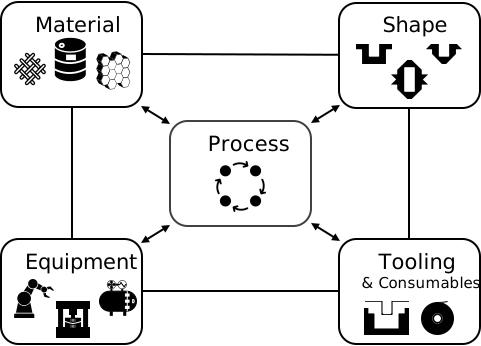
The Knowledge in Practice Centre (KPC) is centered around a structured method of thinking about composite material manufacturing. From the top down, the heirarchy consists of:
- The factory
- Factory cells and/or the factory layout
- Process steps (embodied in the factory process flow) consisting of:
The way that the material, shape, tooling & consumables and equipment (abbreviated as MSTE) interact with each other during a process step is critical to the outcome of the manufacturing step, and ultimately critical to the quality of the finished part. The interactions between MSTE during a process step can be numerous and complex, but the Knowledge in Practice Centre aims to make you aware of these interactions, understand how one parameter affects another, and understand how to analyze the problem using a systems based approach. Using this approach, the factory can then be developed with a complete understanding and control of all interactions.
Interrelationship of Function, Shape, Material & Process
Design for manufacturing is critical to ensuring the producibility of a part. Trouble arises when it is considered too late or not at all in the design process. Conversely, process design (controlling the interactions between shape, material, tooling & consumables and equipment to achieve a desired outcome) must always consider the shape and material of the part. Ashby has developed and popularized the approach linking design (function) to the choice of material and shape, which influence the process selected and vice versa, as shown below:
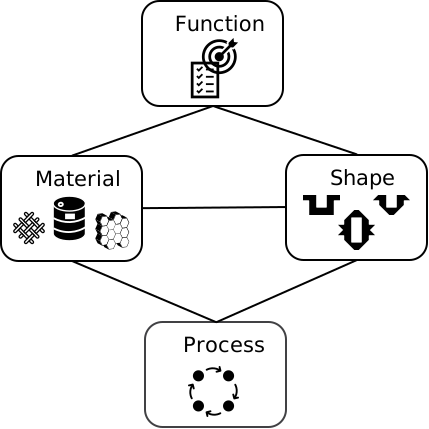
Within the Knowledge in Practice Centre the same methodology is applied but the process is more fully defined by also explicitly calling out the equipment and tooling & consumables. Note that in common usage, a process which consists of many steps can be arbitrarily defined by just one step, e.g. "spray-up". Though convenient, this can be misleading.

Workflows
The KPC's Practice and Case Study volumes consist of three types of workflows:
- Development - Analyzing the interactions between MSTE in the process steps to make decisions on processing parameters and understanding how the process steps and factory cells fit within the factory.
- Troubleshooting - Guiding you to possible causes of processing issues affecting either cost, rate or quality and directing you to the most appropriate development workflow to improve the process
- Optimization - An expansion on the development workflows where a larger number of options are considered to achieve the best mixture of cost, rate & quality for your application.
To use this website, you must agree to our Terms and Conditions and Privacy Policy.
By clicking "I Accept" below, you confirm that you have read, understood, and accepted our Terms and Conditions and Privacy Policy.

