
Aging mechanisms in fibers and polymer materials - A427
| Aging mechanisms in fibers and polymer materials | |
|---|---|
| Foundational knowledge article | |
| Document Type | Article |
| Document Identifier | 427 |
| Tags | |
| Prerequisites | |
Introduction[edit | edit source]
The aging of fiber and polymer materials is a gradual process influenced by multiple environmental and mechanical factors. Continuous exposure to heat, moisture, chemical agents, and sustained mechanical loading progressively alters their internal structure and surface characteristics. Over time, these influences can result in microcracking, swelling, and embrittlement, which reduce both the strength and flexibility of the materials. Moisture, for example, can act as a plasticizer, softening the polymer matrix, while chemical exposure accelerates degradation through oxidation or hydrolysis. As a consequence, aged materials lose their original performance capabilities, making them more prone to failure under service conditions.
Significance[edit | edit source]
The aging of fibers and polymers significantly affects the safety, reliability, and lifetime of products and structures. Readers must understand the degradation of materials under mechanical loading, heat, moisture and chemical elements to determine their performance over a long time. Therefore, this important knowledge is very useful for the readers in failure mitigation, material selection, product design and maintenance.
Scope[edit | edit source]
This document will cover important information about different aging mechanisms. Starting with (1) heat, which leads to thermal degradation, reduced strength and chain breaking. Therefore, high temperatures near or above the glass transition temperature (Tg) causes modifications in dimensions and material softening. Other mechanisms such as (2) absorption of water or other fluids may induce swelling, softening, and hydrolysis, thereby compromising the material's molecular integrity. Water may function as a plasticizer, diminishing stiffness and strength, whereas exposure to oils and solvents undermines durability. On the other hand, oxidative reactions, UV exposure, and contact with acids or bases can lead to (3) chemical degradation, resulting in discoloration, surface cracking, and mechanical failure. Environmental stress cracking can arise when chemical exposure interacts with mechanical stress. Finally, (4) mechanical loading facilitates aging through creep, fatigue, and stress release, resulting in deformation, microcracks, and failure.
Aging mechanisms of polymer materials[edit | edit source]
Polymers undergo aging processes that gradually change their structure and properties, reducing durability and performance. These mechanisms include thermal, chemical, environmental, mechanical, and physical effects, each acting alone or in combination. Understanding them is essential for predicting service life and improving material design.
Thermal Aging[edit | edit source]
Exposure to elevated temperatures is one of the most common aging mechanisms in polymers. When subjected to heat, especially temperatures approaching or exceeding the glass transition temperature (Tg), polymers may undergo thermal degradation, which manifests as molecular chain scission, oxidative reactions, and volatilization of low-molecular-weight components. These changes result in reduced tensile strength, embrittlement, loss of elasticity, and in some cases, complete structural failure. Additionally, prolonged thermal exposure can cause dimensional instability, such as warping or shrinkage, and material softening, which compromises the polymer's load-bearing capability. Polymers with poor thermal stability may also experience unintended crosslinking or, conversely chain scission and depolymerization, altering their original morphology and performance characteristics[1][2][3].
Fluid Absorption and Moisture-Induced Degradation[edit | edit source]
Polymers are often sensitive to the uptake of moisture, solvents, and other fluids from the environment. Water absorption can cause swelling, softening, and hydrolysis of susceptible polymer bonds (e.g., ester, amide, or carbonate linkages), particularly in hydrophilic or partially polar polymers. Moisture can act as a plasticizer, increasing chain mobility and thereby reducing stiffness, modulus, and strength. The infiltration of fluids such as oils, fuels, or aggressive solvents can lead to polymer dissolution, chemical attack, or interfacial weakening in composite systems. In addition, leaching of additives or fillers may occur, further degrading the polymer’s performance. These effects are particularly pronounced under fluctuating environmental conditions, which may accelerate fluid diffusion and increase susceptibility to damage[3][4][5].
Chemical Degradation and Environmental Attack[edit | edit source]
Polymers are also vulnerable to various forms of chemical degradation caused by exposure to oxidizing agents, ultraviolet (UV) radiation, ozone, and corrosive chemicals such as acids or bases. Oxidative degradation, often accelerated by heat and light, leads to the formation of free radicals that initiate chain scission or unintended crosslinking, resulting in discoloration, brittleness, surface embrittlement, and loss of mechanical integrity. Photodegradation, primarily due to UV exposure, causes photo-oxidative reactions, especially in outdoor applications, leading to cracking, chalking, and fading. The presence of stress (mechanical or residual) combined with aggressive chemicals can result in environmental stress cracking (ESC), a failure mode in which fine surface cracks propagate rapidly under relatively low loads. ESC is especially critical in amorphous thermoplastics and can lead to premature brittle fracture[3][6][7].
Mechanical Loading and Stress-Induced Degradation[edit | edit source]
Repeated or sustained mechanical loading contributes significantly to polymer aging. Mechanisms such as creep (time-dependent deformation under constant load), fatigue (damage accumulation under cyclic loading), and stress relaxation (decline in stress under constant strain) progressively degrade the material. These effects are influenced by temperature, loading frequency, and polymer morphology (e.g., degree of crystallinity or orientation). Over time, mechanical loading can cause microcrack initiation, crazing, and void formation, which act as stress concentrators and significantly reduce the material's fatigue life and structural integrity. In composite polymers, differential strain between the matrix and reinforcement phases may also contribute to interfacial debonding and progressive delamination under repeated stress[1][2][3][4][6][7][8][9].
Aging mechanisms of fibers[edit | edit source]
Fibers are critical load-bearing elements whose long-term performance is affected by thermal, chemical, moisture, and mechanical degradation. These aging mechanisms can cause hydrolysis, dissolution, chain scission, or surface erosion, ultimately reducing tensile strength and reliability. Recent work on glass, basalt, and carbon fibers highlights the importance of studying these processes independently to improve lifetime prediction and durability modeling[10][11][12][13][14][15][16].
Thermal Aging[edit | edit source]
Exposure to elevated temperatures can lead to thermal degradation in fibers, particularly when temperatures approach or exceed the glass transition temperature (Tg) or decomposition threshold of the material. This process may cause chain scission, reduced tensile strength, embrittlement, and irreversible dimensional changes. For polymeric fibers (e.g., aramid, nylon, or polyester), heat may result in molecular relaxation, cross-linking, or oxidation, while for inorganic fibers (e.g., glass or carbon), prolonged high-temperature exposure can deteriorate interfacial bonding or alter surface chemistry. Repeated thermal cycling may also introduce microcracks due to differential expansion and contraction[10].
Moisture and Fluid Absorption[edit | edit source]
Fibers are susceptible to aging due to the absorption of water or other fluids, which may penetrate the fiber structure or fiber/matrix interface. For hydrophilic fibers such as natural fibers or certain polymers, moisture absorption can induce swelling, plasticization, softening, and even hydrolytic degradation. This process undermines molecular cohesion and disrupts load transfer within composites. Additionally, exposure to oils, fuels, or solvents may lead to fiber swelling, leaching of stabilizers, or chemical interaction that compromises fiber integrity and mechanical properties[11][12].
Chemical Degradation[edit | edit source]
Chemical exposure, such as to acids, bases, oxidizing agents, or UV radiation, can initiate degradation pathways in fibers. For instance, UV exposure can break molecular bonds, resulting in chain scission, discoloration, surface chalking, and loss of mechanical strength. Oxidative degradation, particularly in oxygen-rich or high-temperature environments, can accelerate embrittlement and surface erosion. Acidic or alkaline environments can particularly damage glass fibers through leaching or ion exchange processes, leading to pitting and strength reduction. Environmental stress cracking may occur when fibers under mechanical stress are simultaneously exposed to aggressive chemicals, leading to crack formation and premature failure[13][14][15].
Mechanical Loading and Fatigue[edit | edit source]
Repeated or sustained mechanical loading contributes to fiber aging through processes such as creep, fatigue, and stress relaxation. Over time, these effects manifest as progressive deformation, fiber microbuckling, matrix-fiber debonding, or crack propagation along fiber interfaces. Cyclic loading may induce internal damage accumulation, reducing the overall strength and leading to failure under sub-critical loads. Even under static conditions, long-term stress can lead to fiber reorientation, pull-out, or structural fatigue, especially in materials subjected to variable loading environments[16].
References
- ↑ 1.0 1.1 [Ref] Empty citation (help)
- ↑ 2.0 2.1 [Ref] Empty citation (help)
- ↑ 3.0 3.1 3.2 3.3 [Ref] Empty citation (help)
- ↑ 4.0 4.1 [Ref] Empty citation (help)
- ↑ [Ref] Empty citation (help)
- ↑ 6.0 6.1 [Ref] Empty citation (help)
- ↑ 7.0 7.1 [Ref] Empty citation (help)
- ↑ [Ref] Empty citation (help)
- ↑ [Ref] Empty citation (help)
- ↑ 10.0 10.1 [Ref] Empty citation (help)
- ↑ 11.0 11.1 [Ref] Empty citation (help)
- ↑ 12.0 12.1 [Ref] Empty citation (help)
- ↑ 13.0 13.1 [Ref] Empty citation (help)
- ↑ 14.0 14.1 [Ref] Empty citation (help)
- ↑ 15.0 15.1 [Ref] Empty citation (help)
- ↑ 16.0 16.1 [Ref] Empty citation (help)

Welcome
Welcome to the CKN Knowledge in Practice Centre (KPC). The KPC is a resource for learning and applying scientific knowledge to the practice of composites manufacturing. As you navigate around the KPC, refer back to the information on this right-hand pane as a resource for understanding the intricacies of composites processing and why the KPC is laid out in the way that it is. The following video explains the KPC approach:
Understanding Composites Processing
The Knowledge in Practice Centre (KPC) is centered around a structured method of thinking about composite material manufacturing. From the top down, the heirarchy consists of:
- The factory
- Factory cells and/or the factory layout
- Process steps (embodied in the factory process flow) consisting of:
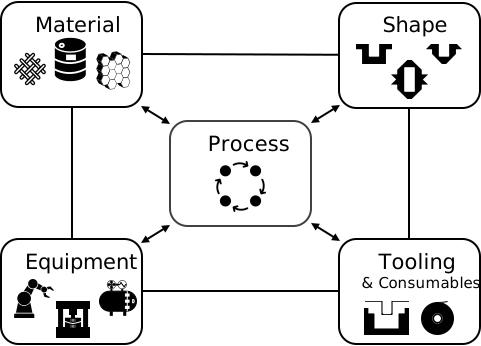
The way that the material, shape, tooling & consumables and equipment (abbreviated as MSTE) interact with each other during a process step is critical to the outcome of the manufacturing step, and ultimately critical to the quality of the finished part. The interactions between MSTE during a process step can be numerous and complex, but the Knowledge in Practice Centre aims to make you aware of these interactions, understand how one parameter affects another, and understand how to analyze the problem using a systems based approach. Using this approach, the factory can then be developed with a complete understanding and control of all interactions.
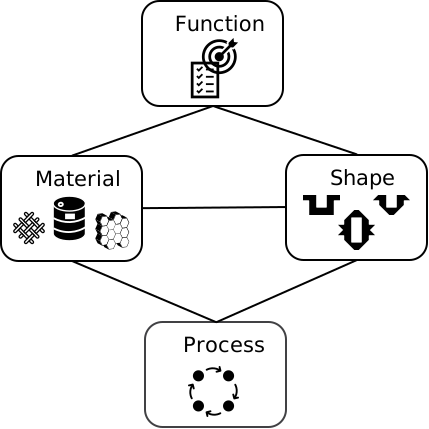
Interrelationship of Function, Shape, Material & Process
Design for manufacturing is critical to ensuring the producibility of a part. Trouble arises when it is considered too late or not at all in the design process. Conversely, process design (controlling the interactions between shape, material, tooling & consumables and equipment to achieve a desired outcome) must always consider the shape and material of the part. Ashby has developed and popularized the approach linking design (function) to the choice of material and shape, which influence the process selected and vice versa, as shown below:
Within the Knowledge in Practice Centre the same methodology is applied but the process is more fully defined by also explicitly calling out the equipment and tooling & consumables. Note that in common usage, a process which consists of many steps can be arbitrarily defined by just one step, e.g. "spray-up". Though convenient, this can be misleading.

Workflows
The KPC's Practice and Case Study volumes consist of three types of workflows:
- Development - Analyzing the interactions between MSTE in the process steps to make decisions on processing parameters and understanding how the process steps and factory cells fit within the factory.
- Troubleshooting - Guiding you to possible causes of processing issues affecting either cost, rate or quality and directing you to the most appropriate development workflow to improve the process
- Optimization - An expansion on the development workflows where a larger number of options are considered to achieve the best mixture of cost, rate & quality for your application.
To use this website, you must agree to our Terms and Conditions and Privacy Policy.
By clicking "I Accept" below, you confirm that you have read, understood, and accepted our Terms and Conditions and Privacy Policy.

