
Ply Draping Modelling for Structural Analysis and Manufacturing - P174
| Ply Draping Modelling for Structural Analysis and Manufacturing | |||||||
|---|---|---|---|---|---|---|---|
| Practice document | |||||||

| |||||||
| Document Type | Practice | ||||||
| Document Identifier | 174 | ||||||
| Themes | |||||||
| Tags | |||||||
| Objective functions |
| ||||||
| MSTE workflow | Development | ||||||
"Expression error: Unrecognized punctuation character ","." is not a number.
Overview[edit | edit source]
This article will provide an introduction to ply draping modelling that is used to aid structural analysis and manufacturing. It will provide information on the difference between developable and undevelopable surfaces and how the type of surface affects fibre orientation. It will also discuss the importance of a material’s lock angle when using kinematic draping modelling to predict potential wrinkling. This will be followed by a discussion on the parameters that affect the draping results and how the results of the analysis can be used to produce a flat pattern. Finally, an example of how the choice of draping strategy affects the structural performance of a part will be presented.
Introduction[edit | edit source]
Ply draping modelling can support structural analysis and manufacturing of composite components. This article includes information on how to perform the modelling, as well as information on how it can improve the accuracy of finite element analysis results and be used to aid in manufacturing.
Significance[edit | edit source]
It is important for practitioners who are planning on performing FEA of composite structures to understand how ply draping affects fibre orientation and subsequently, how fibre orientation affects the accuracy of the results. The reader will also learn how ply draping modelling can be used to create flat patterns that can be used manually or with automated ply cutters to improve the quality and consistency of ply layups.
Practice[edit | edit source]
The following items should be considered when simulating ply draping:
Developable and Undevelopable Surfaces[edit | edit source]
Part geometry is a critical parameter when performing ply draping modelling and can dramatically affect fibre orientation. The fibre orientation of flat or singly curved surfaces remains practically constant across the surface as shown in Figure 1. This type of geometry is referred to as a developable surface as the surface can be flattened onto a plane without distortion.

For a doubly curved surface, like that shown in Figure 2, the ply must deform to follow the surface. This is called an undevelopable surface. This deformation occurs by in-plane shearing of the fabric and results in changes in the fibre orientation across the surface.

Lock Angle[edit | edit source]
During draping of a woven fabric over an undevelopable surface the fibres undergo in-plane shearing. With enough deformation the fibres begin to rub against each other preventing further in-plane deformation. At this point the shear force increases dramatically and results in out-of-plane deformation of the fibres. This results in wrinkling of the layup. For a woven fabric the angle between the warp fibres (primary direction) and weft fibres (secondary direction) is typically 90°. As the part deforms the fibres do not change length so the angle between the warp and weft fibres changes. The shear angle is the difference between the original angle (90°) and the distorted angle. The lock angle, as shown in Figure 3, defines the maximum measured in-plane shear angle before the fabric begins to deform out-of-plane. When a fabric reaches its lock angle the ply begins to wrinkle or bridge.

Kinematic Draping Model[edit | edit source]
Most commercial software uses some form of kinematic draping theory when performing ply draping modelling. In this theory the ply is idealized using the pin-jointed net model. The model assumes the fibres are inextensible and each crossover point acts like a pin joint with no slippage. The deformation takes place by pure rotation of the fibres around the pins. It also assumes uniform surface contact. These assumptions allow the model to calculate the location of each crossover point on the surface of the part.
There are two primary methods that different types of software use to apply kinematic draping theory to a particular geometry. The first method is the geodesic line method. In this method two intersecting fibres are constrained to the surface. They are defined by geodesic paths that intersect at the point of initial contact between the ply and the geometry. The geodesics end at the edges of the part. Many geodesics may be created until the whole geometry is draped.
The second method is the energy method. Elements are laid one by one on the surface of the model from the defined starting location and in the defined draping direction. The elements are laid on the part surface until the part edge is reached. The elements are then laid in the direction perpendicular to the primary direction. Draping elements continue to be created until the surface is completely covered. For each element the search algorithm calculates the node locations based on minimizing the shear strain energy. During draping of a woven
Parameters that Affect Draping Results[edit | edit source]
When the draping simulation is completed, the results will provide information on the fibre orientation of each element and the shear distortion between the warp and weft fibres. If elements exceed the lock angle of the fabric the analyst can make adjustments to improve the results. This includes varying the draping starting point, changing the initial ply orientation, or adding darts to the fabric.
Starting Location[edit | edit source]
Changing the starting location of the ply draping process can alter the maximum observed shear angle and change the fibre orientations across the part. The part shown below was draped using a woven solver with two different starting points as indicated in Figure 4. The fibres were initially oriented in the longitudinal and transverse directions of the part.

Figure 5 shows that for the first starting location the shear angle remains close to 0° in the wider cross-section of the part. The maximum shear angles occur along the sides of the part in the transition from the wider to thinner cross-section. The shear angle continues to vary away from 0° along the sides of the part in the thinner cross-section. The maximum shear angle was 46.4°.

For the second starting location the shear angles along the sides of the part in the transition area are close to 0° although the fibres are oriented approximately 45° from the longitudinal and transverse directions of the part. This is shown in Figure 6. The maximum shear angle is now observed on the side of the wide cross-section and has a value of 45.7° as shown in Figure 7.
 |
 |
When comparing the maximum shear angles for the two draping starting locations for this particular geometry, it is noted that the values are quite close to each other, but they occur at different locations. Additionally, the fibre orientations across the part are different between the two starting locations.
Initial Ply Orientation[edit | edit source]
Adjusting the initial ply orientation will also change the draping results. When the ply is initially oriented at +/-45° the maximum shear angle is observed along the top and the sides of the narrow region for both starting locations 1 and 2 as shown in Figure 8. For starting location 1 the maximum shear angle is 43.7°. For starting location 2 the maximum shear angle drops significantly to 35.1°. This shows that changing the initial ply orientation can potentially reduce the maximum shear angle. However, the ply orientation is often selected based on other factors such as structural performance, so it is not always feasible to adjust this parameter.

Ply Darts[edit | edit source]
Ply draping modelling also provides the ability to predict the effects of adding ply darts (cuts) to the fabric. To demonstrate this concept the height of the part used in the previous examples was increased. The modelling software was used to predict the shear angles when the ply was draped starting at location 1 and with a ply orientation of 0°/90°. Figure 9 shows that the increase in height of the part caused the maximum shear angle to increase and exceed the lock angle in the transition region between the wide and narrow sections of the part.

Ply darts were then added on both sides of the part at the start of the transition region from the wide to narrow sections of the part as shown in Figure 10. This resolved the issue because the shear angle no longer exceeded the lock angle as shown in Figure 11. However, it did result in an abrupt change in fibre orientation at the location of the ply dart.
 |
 |
Flat Patterns[edit | edit source]
Draping modelling can be used to create flat patterns based on the geometry of the part, starting location, ply orientation, and ply darts. Flat patterns can then be used to create templates for material trimming or can be imported to ply cutting equipment to automate the process. This improves the accuracy and the consistency of each layup during production and helps to ensure that fibre orientations match the inputs used for structural analysis.
Figure 12 shows the flat pattern for starting location 1 and Figure 13 shows the flat pattern for starting location 2. Since the second starting location is in the middle, and not the end of the part, the corners in the widest section of the part are no longer perfectly square. Figure 14 shows the flat pattern for starting location 1 but includes ply darts. Flat patterns can be especially useful in these situations because the pattern ensures the darts are at the same location and are the same length for every part.
 |
 |
 |
Fibre Orientation[edit | edit source]
Changes in the ply draping strategy will affect the fibre orientations of the part. This includes changes to the starting location, initial ply orientation, and the location and length of ply darts. Variations in the fibre orientations can affect the analysis results as well as real world performance. The analysis of the conic shell shown in Figure 15 provides a good example.

The conic shell was modelled using unidirectional fabric. The first strategy shown in Figure 16 started the draping process on the edge of the part with the initial ply orientation along the hoop direction. A single dart was included that began at the ply draping starting location and ended at the apex of the part. A flat pattern of this draping strategy is shown in Figure 17. This strategy resulted in fibre orientations that varied around the circumference of the part and also resulted in an abrupt fibre orientation change at the ply dart location as shown in Figure 18.
 |
 |
 |
The second strategy that is shown in Figure 19 split the ply into quarters that were draped individually. Each quarter ply started the layup on the edge of the part with the initial ply orientation along the hoop direction. The flat pattern for draping strategy 2 is shown in Figure 20. This draping strategy resulted in fibre orientations that remained oriented in the hoop direction and didn’t vary around the circumference of the part as shown in Figure 21.
 |
 |
 |
A structural analysis was performed once the ply draping modelling was completed. Figure 22 shows the analysis setup with the top edge fully fixed and a pressure applied to the conical faces.

When comparing the results shown in Figure 23, the maximum deflection was almost 2.5 times larger for strategy 1 compared to strategy 2. This was because the fibre orientation varied across the surface for strategy 1 while it remained consistently in the optimal hoop direction for strategy 2. For this reason, the deflection pattern also varied for strategy 1 while remaining consistent for strategy 2.

The optimal configuration to carry the load in this scenario is for the fibres to be oriented in the hoop direction. The longitudinal stress increases significantly in areas where the fibres are oriented at a different angle. This is observed in Figure 24 which shows the longitudinal stress was significantly higher for strategy 1 compared to strategy 2. The stress pattern also dramatically varied across the surface for strategy 1 while remaining consistent for strategy 2.

Figure 25 shows that strategy 1 also introduced a large shear stress component along the edge of the part, while the shear stress for strategy 2 was almost zero. This was due to the unsymmetric deflection pattern that was created by the variation in fibre orientation across the surface.

Closing Remarks[edit | edit source]
This example demonstrates that it is critical for the analyst to understand the draping process that will be implemented during manufacturing. The choice of draping strategy employed during manufacturing affects the fibre orientations and ultimately affects the structural results. If the draping strategy is not understood by the analyst, the results of the structural analysis may be misleading.
Related pages[edit | edit source]
- See Webinar on Fiber Architecture
- See Webinar on Fabric Forming
- See Page on Overview of Finite Element Analysis of Composite Structures
- See Case Study on Improving Quality of a Truck Fender Using Ply Draping Modelling
Related pages
 |
 |
| About | Help |

Welcome
Welcome to the CKN Knowledge in Practice Centre (KPC). The KPC is a resource for learning and applying scientific knowledge to the practice of composites manufacturing. As you navigate around the KPC, refer back to the information on this right-hand pane as a resource for understanding the intricacies of composites processing and why the KPC is laid out in the way that it is. The following video explains the KPC approach:
Understanding Composites Processing
The Knowledge in Practice Centre (KPC) is centered around a structured method of thinking about composite material manufacturing. From the top down, the heirarchy consists of:
- The factory
- Factory cells and/or the factory layout
- Process steps (embodied in the factory process flow) consisting of:
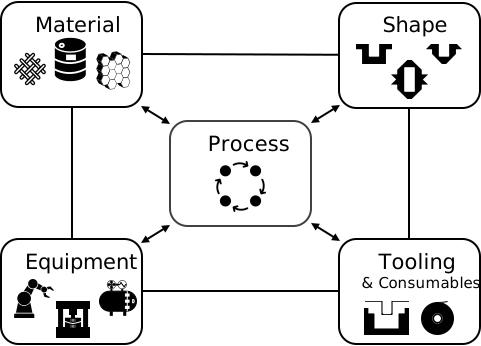
The way that the material, shape, tooling & consumables and equipment (abbreviated as MSTE) interact with each other during a process step is critical to the outcome of the manufacturing step, and ultimately critical to the quality of the finished part. The interactions between MSTE during a process step can be numerous and complex, but the Knowledge in Practice Centre aims to make you aware of these interactions, understand how one parameter affects another, and understand how to analyze the problem using a systems based approach. Using this approach, the factory can then be developed with a complete understanding and control of all interactions.
Interrelationship of Function, Shape, Material & Process
Design for manufacturing is critical to ensuring the producibility of a part. Trouble arises when it is considered too late or not at all in the design process. Conversely, process design (controlling the interactions between shape, material, tooling & consumables and equipment to achieve a desired outcome) must always consider the shape and material of the part. Ashby has developed and popularized the approach linking design (function) to the choice of material and shape, which influence the process selected and vice versa, as shown below:
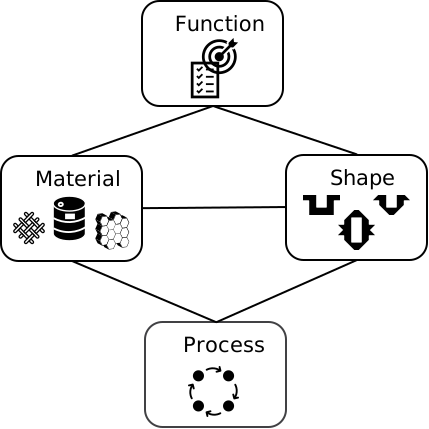
Within the Knowledge in Practice Centre the same methodology is applied but the process is more fully defined by also explicitly calling out the equipment and tooling & consumables. Note that in common usage, a process which consists of many steps can be arbitrarily defined by just one step, e.g. "spray-up". Though convenient, this can be misleading.

Workflows
The KPC's Practice and Case Study volumes consist of three types of workflows:
- Development - Analyzing the interactions between MSTE in the process steps to make decisions on processing parameters and understanding how the process steps and factory cells fit within the factory.
- Troubleshooting - Guiding you to possible causes of processing issues affecting either cost, rate or quality and directing you to the most appropriate development workflow to improve the process
- Optimization - An expansion on the development workflows where a larger number of options are considered to achieve the best mixture of cost, rate & quality for your application.
To use this website, you must agree to our Terms and Conditions and Privacy Policy.
By clicking "I Accept" below, you confirm that you have read, understood, and accepted our Terms and Conditions and Privacy Policy.

