
SAMPE Canada - CKN - CANCOM Student Competition: Case Study - C121
SAMPE Case study
| SAMPE Canada - CKN - CANCOM Student Competition: Case Study | |||||||
|---|---|---|---|---|---|---|---|
| Case study | |||||||

| |||||||
| Document Type | Case study | ||||||
| Document Identifier | 121 | ||||||
| Themes | |||||||
| Tags | |||||||
| Objective functions |
| ||||||
| MSTE workflow | Development | ||||||
| Prerequisites | |||||||
Summary[edit | edit source]
This case study investigates the development of a composite dome structure as a reference for the SAMPE CANADA-CKN-CANCOM 2026 Student Competition. The study aimed to validate proposed competition rules and establish realistic proof-load targets through the design, fabrication, and testing of a carbon-fibre/epoxy dome. Various tooling and design approaches, including 3D-printed polymer moulds and laminate variants, were evaluated to demonstrate practical fabrication methods and performance trade-offs. The results provide guidance and baseline data to help devise contest rules and provide student teams insight to prepare their designs, select suitable materials and processes, and understand key factors influencing structural behavior and manufacturability.
Introduction[edit | edit source]
Lightweight composite structures are essential for future deployable habitats, particularly in aerospace and planetary exploration contexts. The SAMPE CANADA-CKN-CANCOM 2026 Student Competition was conceived to challenge teams to design and fabricate a miniature dome structure capable of sustaining a prescribed proof load under compression while minimizing mass and maximizing sustainability. To ensure the competition rules and performance targets are both realistic and technically meaningful, a reference study was undertaken to establish baseline design data, manufacturing methods, and load-displacement behavior for a representative composite dome. This case study documents the design, fabrication, and testing of an 18-ply carbon-fibre composite dome developed to evaluate proposed geometric and mechanical criteria for the competition. The dome was built to assess the practicality of candidate rules, such as maximum envelope dimensions, minimum enclosed volume, and access-port requirements and to generate data for setting the final proof-load targets. Although sustainability is a key element of the planned competition, the reference dome employed a carbon-fibre/epoxy system to provide a consistent mechanical benchmark against which future teams using natural or recyclable materials can be compared. Sustainability scoring in the event will be based on the mass fraction of natural or recyclable constituents. The contest rules are posted here.
Approach[edit | edit source]
Design overview[edit | edit source]
The design approach focused on achieving high stiffness-to-weight efficiency using fibre-reinforced polymer composites. A dome geometry was selected for its inherent ability to distribute loads under axial compression. For the reference build, a carbon-fibre/epoxy laminate was selected to provide a high-performance baseline for validation and comparison with other designs. Core concepts involving lightweight balsa or foam were also evaluated to improve buckling resistance, although the tested dome was a monolithic laminate.
Finite element analysis was employed to evaluate compressive strength and identify critical failure zones. Manufacturing methods under consideration included vacuum-assisted resin transfer molding (VARTM) and wet layup, both permitted under the competition guidelines. Process repeatability, fibre alignment, and surface finish were assessed to ensure consistency.
Geometry and constraints[edit | edit source]
A spherical dome was selected for efficient load sharing under axial plate compression. The target inner radius was approximately 100 mm, with wall thickness controlled to remain within the 200 mm envelope after cure and trimming. Two ports were introduced to satisfy the pass-through requirement specified in the competition rules.
Tooling[edit | edit source]
Tooling selection (A340 & An Overview of Composite Tooling Construction - A396) was based on the required geometric accuracy, surface finish, and reusability for multiple dome fabrications. Two approaches were evaluated: additively manufactured polymer tools and conventional machined metal tools. 3D-printed polymer tooling (e.g. PLA or PETG) offered low cost, rapid turnaround, and design flexibility for small-batch production. However, print-layer texture can transfer to the composite surface, requiring sanding or coating to achieve a smooth finish. Dimensional stability during vacuum cure is acceptable for moderate temperatures (< 80 °C). Metal tooling (aluminum or steel) provides superior dimensional accuracy, thermal stability, and surface quality but at higher cost and lead time. Such tooling is more suitable for repeated builds or higher-temperature cure cycles. For this reference build, a 3D-printed rigid polymer mold was selected (Figure 1) to allow fast iteration of the dome geometry and to validate the feasibility of additive tooling for student teams. A mould release agent was applied to minimize fibre imprint and ease demolding.

Materials and lay-up[edit | edit source]
The baseline article employed a monolithic 18-ply fibre-reinforced polymer shell (Figure 2a) produced by wet lay-up with vacuum bagging on a rigid 3D printed mould (Figure 2b). Care was taken to avoid ply waviness, maintain consistent debulk pressure, and ensure a continuous vacuum seal throughout gelation and cure.

Manufacturing notes:
- A mold release was applied to a smooth tool surface to reduce print-through and facilitate demolding.
- Ply orientation followed a quasi-balanced sequence optimized for in-plane stiffness and hoop stability.
- After cure, the dome was trimmed, and the ports were cut and sealed.
Testing and modelling[edit | edit source]
The dome was tested under quasi-static compression between flat plates. The 18-ply shell reached approximately 3 mm displacement and carried a peak load near 14 kN, with continued load capacity during geometric flattening. A finite element (FE) shell model was calibrated to the measured response using effective orthotropic properties representative of hand lay-up quality (Et ≈ 12GPa, Gt ≈ 3GPa). Sensitivity studies indicated:
- Adding a thin H80 foam core (3 mm) over the full area increased displacement under compression, producing a softer global response.
- Replacing the continuous core with discrete foam ribs offered little improvement over the monolithic shell.
- Introducing periodic 0° “rib” plies in the laminate stack had a minor effect on global stiffness for this load case.
Force-Displacement Results[edit | edit source]
A comparison between the experimental and numerical force-displacement responses is presented in Figure 3. The experimental curve corresponds to the 18-ply monolithic shell tested under quasi-static plate compression. The finite element (FEA) predictions show the baseline “no-core” configuration and three design variants: inclusion of a foam core, addition of 0° rib plies, and reduction of dome radius to 70 mm.

The baseline FEA result (“FEA - no core”) closely matched the experimental response up to approximately 3 mm displacement and captured the overall load progression up to ~14 kN. The “FEA - core” case exhibited noticeably lower stiffness, confirming that sandwich cores soften the global response for thin shells under compression. The “FEA - 0 ribs” configuration produced only minor stiffness improvement, while the “FEA - 7 cm radius” case showed the highest load capacity, consistent with the expected increase in curvature stiffness for smaller radii. These results validate the monolithic dome as an effective proof-of-concept design and highlight key stiffness trends that student teams can investigate further through material and geometric optimization.
Outcome[edit | edit source]
Performances[edit | edit source]
The 18-ply monolithic shell met the intent of the competition proof concept, exhibiting a stable force-displacement response and yielding near 3 mm at approximately 14 kN. The post-yield behaviour was gradual due to progressive shell flattening, which is preferable to abrupt instability for a student test article.
Implications for student teams[edit | edit source]
- Under plate compression, sandwich cores tend to reduce stiffness for thin shells; a compact, well-consolidated monolithic laminate is advantageous.
- Vacuum quality and ply handling drive effective stiffness; expect large property swings between poor and good consolidation.
- If volume margin exists, reducing radius within the volume limit increases stiffness for the same laminate but must be balanced against the 200 mm envelope and port geometry.
Related pages[edit | edit source]
Related pages
 |
 |
| About | Help |

Welcome
Welcome to the CKN Knowledge in Practice Centre (KPC). The KPC is a resource for learning and applying scientific knowledge to the practice of composites manufacturing. As you navigate around the KPC, refer back to the information on this right-hand pane as a resource for understanding the intricacies of composites processing and why the KPC is laid out in the way that it is. The following video explains the KPC approach:
Understanding Composites Processing
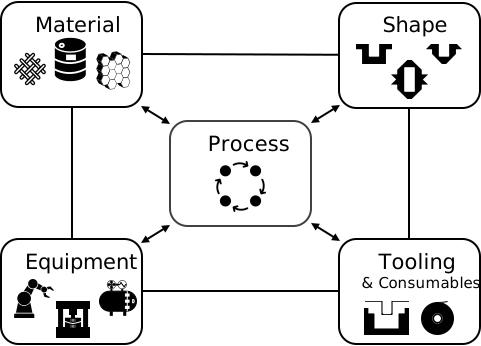
The Knowledge in Practice Centre (KPC) is centered around a structured method of thinking about composite material manufacturing. From the top down, the heirarchy consists of:
- The factory
- Factory cells and/or the factory layout
- Process steps (embodied in the factory process flow) consisting of:
The way that the material, shape, tooling & consumables and equipment (abbreviated as MSTE) interact with each other during a process step is critical to the outcome of the manufacturing step, and ultimately critical to the quality of the finished part. The interactions between MSTE during a process step can be numerous and complex, but the Knowledge in Practice Centre aims to make you aware of these interactions, understand how one parameter affects another, and understand how to analyze the problem using a systems based approach. Using this approach, the factory can then be developed with a complete understanding and control of all interactions.
Interrelationship of Function, Shape, Material & Process
Design for manufacturing is critical to ensuring the producibility of a part. Trouble arises when it is considered too late or not at all in the design process. Conversely, process design (controlling the interactions between shape, material, tooling & consumables and equipment to achieve a desired outcome) must always consider the shape and material of the part. Ashby has developed and popularized the approach linking design (function) to the choice of material and shape, which influence the process selected and vice versa, as shown below:
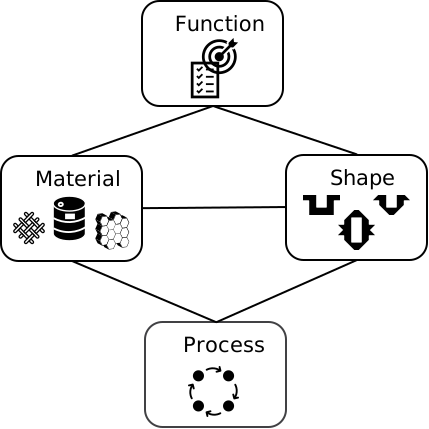
Within the Knowledge in Practice Centre the same methodology is applied but the process is more fully defined by also explicitly calling out the equipment and tooling & consumables. Note that in common usage, a process which consists of many steps can be arbitrarily defined by just one step, e.g. "spray-up". Though convenient, this can be misleading.

Workflows
The KPC's Practice and Case Study volumes consist of three types of workflows:
- Development - Analyzing the interactions between MSTE in the process steps to make decisions on processing parameters and understanding how the process steps and factory cells fit within the factory.
- Troubleshooting - Guiding you to possible causes of processing issues affecting either cost, rate or quality and directing you to the most appropriate development workflow to improve the process
- Optimization - An expansion on the development workflows where a larger number of options are considered to achieve the best mixture of cost, rate & quality for your application.

