
SAMPE Canada–CKN–CANCOM 2026 Student Competition - A400
| SAMPE Canada–CKN–CANCOM 2026 Student Competition | |
|---|---|

| |
| Document Type | Article |
| Document Identifier | 400 |
| Themes | |
| Tags | |
SAMPE Contest Rules
Overview[edit | edit source]
The SAMPE Canada–CKN–CANCOM Student Competition challenges students to design and build a miniature, lightweight 'habitat' using composite materials. The structure must withstand a minimum compressive load of 20 kN with no more than 5 mm of deflection while fitting within a 200 mm by 200 mm by 200 mm envelope. Students will build their 'habitats' and bring them to CANCOM 2026 for to compete in the live competition. This hands-on competition promotes awareness of composite materials and their applications in advanced structures, while encouraging creativity, teamwork, and sustainable design.
How It Works[edit | edit source]
Student teams will:
- Form a team (up to five members, including a faculty advisor). At least one member must be a SAMPE member and one a CACSMA member.
- Register and submit a proposal outlining their design and materials.
- Fabricate a composite habitat that fits within a 200 mm × 200 mm × 200 mm envelope.
- Create a short video poster (≤ 5 minutes) showcasing the design and manufacturing process.
- Compete at CANCOM 2026, held August 10, 2026, at the University of British Columbia in Vancouver, BC.
Check out the full contest rules here:

Key Dates[edit | edit source]
| Event | Date |
|---|---|
| Team Registration | |
| Proposal Submission | |
| Proposal Approval Notification | |
| Competition and Video Submission | August 10, 2026 |
Awards[edit | edit source]
Prizes are awarded in two categories:
- Performance:
- 1st Place – $500
- 2nd Place – $300
- 3rd Place – $100
- Sustainability:
- 1st Place – $200
Competition Details[edit | edit source]
- The competition will take place on the first day of CANCOM 2026 (August 10, 2026).
- Testing will be performed live, with results posted in real time.
- Sustainability is assessed based on the mass percentage of natural or recyclable materials used.
- Official rules and proposal templates are available above and at https://cancom2026.ca/
For questions, contact info@sampecanada.ca.
Related pages[edit | edit source]
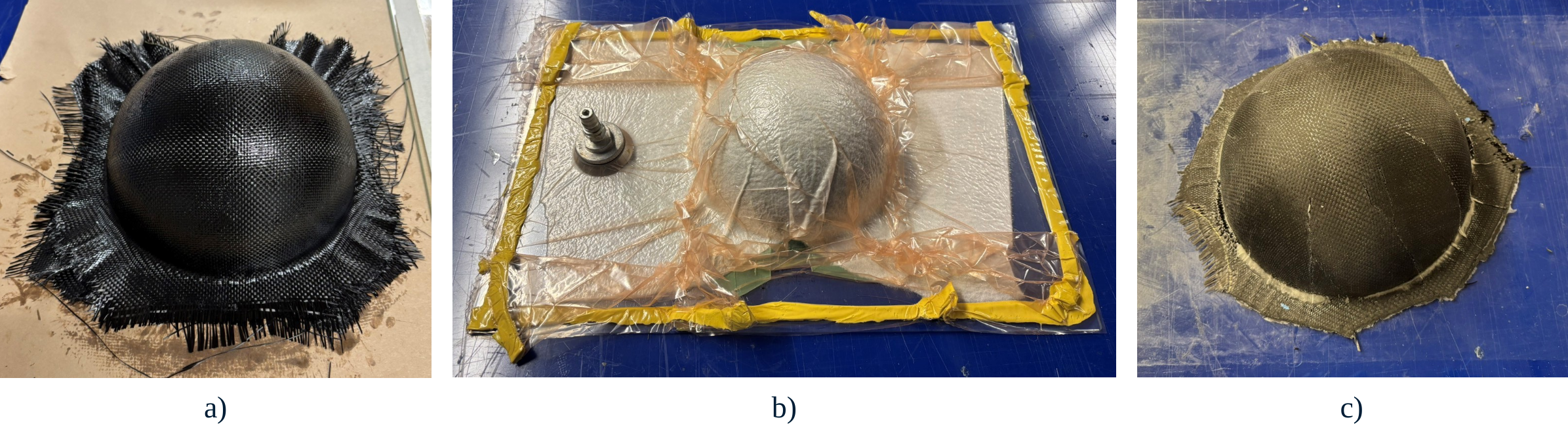
Learn more about how one group approached this project by reading this case study.
Related pages
 |
 |
| About | Help |

Welcome
Welcome to the CKN Knowledge in Practice Centre (KPC). The KPC is a resource for learning and applying scientific knowledge to the practice of composites manufacturing. As you navigate around the KPC, refer back to the information on this right-hand pane as a resource for understanding the intricacies of composites processing and why the KPC is laid out in the way that it is. The following video explains the KPC approach:
Understanding Composites Processing
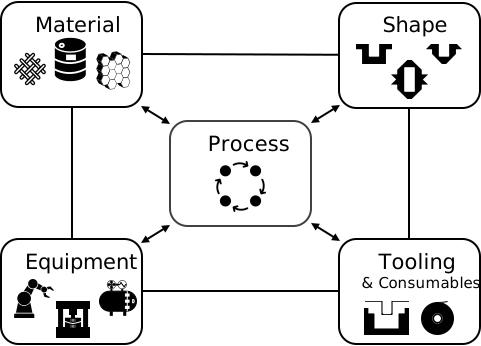
The Knowledge in Practice Centre (KPC) is centered around a structured method of thinking about composite material manufacturing. From the top down, the heirarchy consists of:
- The factory
- Factory cells and/or the factory layout
- Process steps (embodied in the factory process flow) consisting of:
The way that the material, shape, tooling & consumables and equipment (abbreviated as MSTE) interact with each other during a process step is critical to the outcome of the manufacturing step, and ultimately critical to the quality of the finished part. The interactions between MSTE during a process step can be numerous and complex, but the Knowledge in Practice Centre aims to make you aware of these interactions, understand how one parameter affects another, and understand how to analyze the problem using a systems based approach. Using this approach, the factory can then be developed with a complete understanding and control of all interactions.
Interrelationship of Function, Shape, Material & Process
Design for manufacturing is critical to ensuring the producibility of a part. Trouble arises when it is considered too late or not at all in the design process. Conversely, process design (controlling the interactions between shape, material, tooling & consumables and equipment to achieve a desired outcome) must always consider the shape and material of the part. Ashby has developed and popularized the approach linking design (function) to the choice of material and shape, which influence the process selected and vice versa, as shown below:
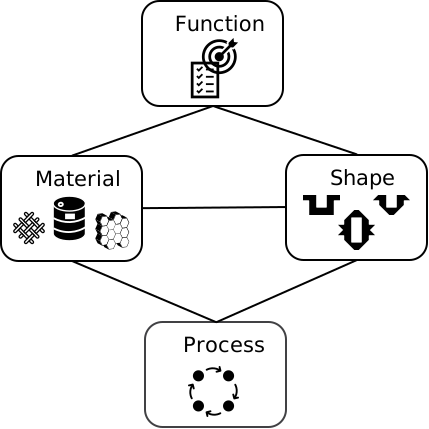
Within the Knowledge in Practice Centre the same methodology is applied but the process is more fully defined by also explicitly calling out the equipment and tooling & consumables. Note that in common usage, a process which consists of many steps can be arbitrarily defined by just one step, e.g. "spray-up". Though convenient, this can be misleading.

Workflows
The KPC's Practice and Case Study volumes consist of three types of workflows:
- Development - Analyzing the interactions between MSTE in the process steps to make decisions on processing parameters and understanding how the process steps and factory cells fit within the factory.
- Troubleshooting - Guiding you to possible causes of processing issues affecting either cost, rate or quality and directing you to the most appropriate development workflow to improve the process
- Optimization - An expansion on the development workflows where a larger number of options are considered to achieve the best mixture of cost, rate & quality for your application.
To use this website, you must agree to our Terms and Conditions and Privacy Policy.
By clicking "I Accept" below, you confirm that you have read, understood, and accepted our Terms and Conditions and Privacy Policy.


