
The CKN Knowledge in Practice Centre is in the early stages of content creation and currently focuses on the theme of thermal management.
We appreciate any feedback or content suggestions/requests using the links below

Content requests General feedback Feedback on this page

Resources - A141

From CKN Knowledge in Practice Centre
Systems Catalogue - A5Resources - A141

This section of the systems catalogue contains information on various resources that are not directly involved in "The factory", for example, they are not equipment, tooling and consumables, part or material that are involved in process steps. You can find resources including software packages that are used for analysis, courses on composite design and manufacturing, expert consultants, etc. in this section.

Refer to the Level I view to navigate to the resources content quickly, or refer to the Level II view to navigate to the resources content with additional context.


Courses Icon-N8hRZerjiuLg.svg
Software Icon-Bofj2uGIQY4q.svg
Vendor Icon-Ckmi8jGIWX8r.png
A500 Image Events HW2N7wHjXvZq.png
Courses
Software Packages
Vendors
Events
Read more

This section of the KPC contains a collection of courses on a variety of topics related to composites. The courses are compiled from the references/data of "Composites Education In Canada: A Survey Of Composite Materials Course Offerings At CEAB Accredited Institutes" presented by Dr. Casey Keulen at CANCOM2024 - 13th Canadian-International Conference on Composites, Waterloo, On. Click here to explore the courses.

This webpage offers a collection of software packages for the design and processing of composite parts. It features tools for modeling, simulation, and analysis, enabling engineers and designers to optimize the part properties and processing method. In-house software will be provided in the future for simple composite calculations. Click here to explore the software packages.

This webpage offers a collection of vendors for materials, equipment, and consumables used for manufacturing composite parts. Click here to explore the vendors.

This webpage offers a collection of conferences, webinars, workshops, and other events related to composite materials and manufacturing technologies. It supports professional development, knowledge exchange, and community engagement within the composites community.Click here to check our events.

Overview[edit | edit source]

This section of the systems catalogue provides valuable information on various resources that fall outside the scope of "The factory" operations but are necessary steps in the composite design and manufacturing workflow and support the broader aspects of composite design and production. Here, you will find a range of offerings including software packages designed for analysis and simulation of composite materials and manufacturing of composite parts. Additionally, this section contains links and information about educational courses on composite design and manufacturing and vendors. Expert consultants who provide specialized guidance and insights will be listed in the future. Please send your contact information to ckn@composites.ubc.ca if you would like to feature your course, software, or expert knowledge in this volume. Together, these resources contribute to our goal, offering a resource for both learning and applying scientific knowledge to composite manufacturing practices while connecting the community.

How to use this volume[edit | edit source]

Volume Framework[edit | edit source]

Applying your foundational knowledge to the complexities of composite manufacturing can be challenging, particularly when making practical decisions that integrate various systems. This volume is designed to support you by providing resources, including information about software capabilities, vendor links, and relevant courses. By exploring the capabilities of different software tools, accessing direct links to vendors, and engaging with educational resources, you will gain practical insights into how to effectively obtain scientific knowledge and apply them in real-world scenarios. We hope that these resources and examples will help you navigate the intricacies of composite manufacturing with greater confidence and expertise.

Volume Features[edit | edit source]

Most pages in the perspectives volume consist of tables of information and links to outside resources.

Content[edit | edit source]

Courses[edit | edit source]

Courses Icon-N8hRZerjiuLg.svg
This page provides data on courses that include content on composite materials offered by CEAB accredited institutes in Canada. This data set accompanies the paper Composites Education In Canada: A Survey Of Composite Materials Course Offerings At CEAB Accredited Institutes presented by Dr. Casey Keulen at CANCOM2024 - 13th Canadian-International Conference on Composites, Waterloo, On. Encompassing 46 institutes from all 10 provinces in Canada, data is collected from official course lists provided publicly by each institute. The analysis categorizes course content levels based on the extent of focus on composites (e.g., minor, medium, main focus). Additionally, the paper reports on specific areas of focus, such as mechanics, processing, applications, and material science, the level (undergraduate or graduate) courses are offered, and if there is a laboratory component. Click here to explore composites courses offered by Canadian Higher Education Institution.

Software Packages[edit | edit source]

Software Icon-Bofj2uGIQY4q.svg
The Composites Knowledge Network is working towards collecting a list of software packages for the design and processing of composite parts. This page features free and enterprise software for modeling, simulation, and analysis of composite parts. In-house software will be provided in the future for simple composite calculations. Click here to explore the software packages.

If you have suggestions for adding courses related to composites or software packages for design and manufacturing composite parts, please contact us to discuss the details.

Vendors[edit | edit source]

Vendor Icon-Ckmi8jGIWX8r.png
The Composites Knowledge Network is working towards collecting a list of vendors who provide materials, equipment, and consumables for composite manufacturing. This page features a list of vendors with a focus on Canadian vendors. Click here to explore the vendors.

If you have suggestions for adding courses related to composites or software packages for design and manufacturing composite parts, please contact us to discuss the details.

Events[edit | edit source]

A500 Image Events HW2N7wHjXvZq.png
The Composites Knowledge Network is collecting information on conferences, webinars, workshops, and other events relevant to composite materials and manufacturing technologies. This page provides an overview of upcoming and recent events to support professional development, knowledge exchange, and community engagement in the composites community. Click here to explore our events.

If you have suggestions for adding courses related to composites or software packages for design and manufacturing composite parts, please contact us to discuss the details.

Explore this area further


About-hpWrZW97CxCB.svg
Help-hlkrZW15CxCB.svg
About Help
CKN KPC logo

Welcome

Welcome to the CKN Knowledge in Practice Centre (KPC). The KPC is a resource for learning and applying scientific knowledge to the practice of composites manufacturing. As you navigate around the KPC, refer back to the information on this right-hand pane as a resource for understanding the intricacies of composites processing and why the KPC is laid out in the way that it is. The following video explains the KPC approach:

Understanding Composites Processing

The Knowledge in Practice Centre (KPC) is centered around a structured method of thinking about composite material manufacturing. From the top down, the heirarchy consists of:

The way that the material, shape, tooling & consumables and equipment (abbreviated as MSTE) interact with each other during a process step is critical to the outcome of the manufacturing step, and ultimately critical to the quality of the finished part. The interactions between MSTE during a process step can be numerous and complex, but the Knowledge in Practice Centre aims to make you aware of these interactions, understand how one parameter affects another, and understand how to analyze the problem using a systems based approach. Using this approach, the factory can then be developed with a complete understanding and control of all interactions.
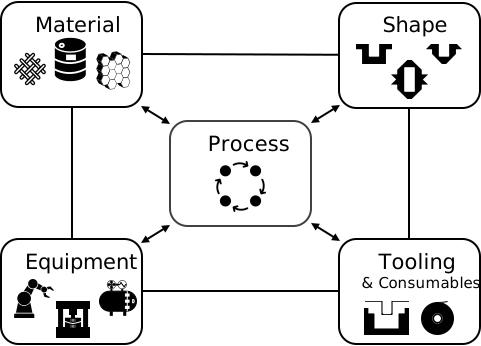
The relationship between material, shape, tooling & consumables and equipment during a process step


Interrelationship of Function, Shape, Material & Process

Design for manufacturing is critical to ensuring the producibility of a part. Trouble arises when it is considered too late or not at all in the design process. Conversely, process design (controlling the interactions between shape, material, tooling & consumables and equipment to achieve a desired outcome) must always consider the shape and material of the part. Ashby has developed and popularized the approach linking design (function) to the choice of material and shape, which influence the process selected and vice versa, as shown below:
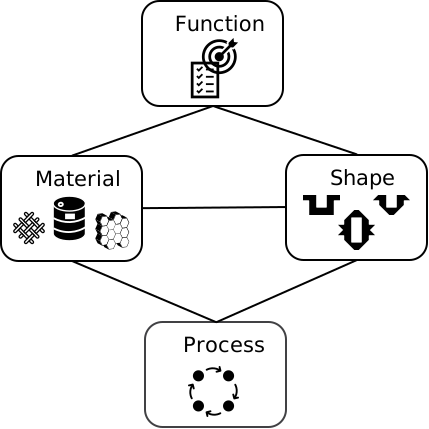
The relationship between function, material, shape and process


Within the Knowledge in Practice Centre the same methodology is applied but the process is more fully defined by also explicitly calling out the equipment and tooling & consumables. Note that in common usage, a process which consists of many steps can be arbitrarily defined by just one step, e.g. "spray-up". Though convenient, this can be misleading.

The relationship between function, material, shape and process consisting of Equipment and Tooling and consumables


Workflows

The KPC's Practice and Case Study volumes consist of three types of workflows:

  • Development - Analyzing the interactions between MSTE in the process steps to make decisions on processing parameters and understanding how the process steps and factory cells fit within the factory.
  • Troubleshooting - Guiding you to possible causes of processing issues affecting either cost, rate or quality and directing you to the most appropriate development workflow to improve the process
  • Optimization - An expansion on the development workflows where a larger number of options are considered to achieve the best mixture of cost, rate & quality for your application.

To use this website, you must agree to our Terms and Conditions and Privacy Policy.

By clicking "I Accept" below, you confirm that you have read, understood, and accepted our Terms and Conditions and Privacy Policy.