
Improving Quality of a Truck Fender Using Ply Draping Modelling - C122
| Improving Quality of a Truck Fender Using Ply Draping Modelling | |||||||
|---|---|---|---|---|---|---|---|
| Case study | |||||||

| |||||||
| Document Type | Case study | ||||||
| Document Identifier | 122 | ||||||
| Themes | |||||||
| Tags | |||||||
| Objective functions |
| ||||||
| MSTE workflow | Development | ||||||
Summary[edit | edit source]
A lightweight truck fender was required for a semi-trailer that displayed the carbon fibre weave to achieve an aesthetically pleasing design. Initial prototypes suffered from wrinkles and visual inconsistencies from overlapping plies. A draping analysis was performed to determine a suitable manufacturing approach. A flat pattern was produced based on the analysis results that improved the consistency and aesthetics of the production parts.
Challenge[edit | edit source]
The geometry of the truck fender consisted of a doubly curved surface. A 0/90 bi-directional stitched carbon fibre fabric had been selected for manufacturing. The stitched architecture limited the ability of the 0/90 fibre bundles from shearing relative to each other. This made it challenging to conform the fabric around the geometry of the fender. Wrinkles that were visually unacceptable appeared in the parts when the initial prototypes were manufactured. The manufacturing technicians started adding ply darts (cuts) during the layup process, but the darts ruined the continuous fibre aesthetic that was desired. It also resulted in inconsistency between parts because each manufacturing technician applied the darts at different locations.
Approach[edit | edit source]
When a fabric is draped over a doubly curved surface the fibres undergo in-plane shearing to conform to the geometry. The fibres eventually reach a maximum shear angle that locks the fibres from further shear deformation. When deformation continues past this angle the fabric begins to deform out-of-plane resulting in wrinkles in the part. Ply draping modelling can be used to predict changes in fibre orientation due to draping, as well as the location of wrinkles. Adjustments of the ply draping start location and initial ply orientation can change the draping results. Additionally, the inclusion of ply darts can help to eliminate wrinkles (see Ply Draping Modelling for Structural Analysis and Manufacturing).
Fabric lock angle was the key material parameter required for the draping analysis. Standardized tests such as picture frame and bias extension exist to quantify fabric lock angle, but these were not readily available for this project. Instead, a manual approach was adopted that was less accurate, but provided sufficient data to successfully complete the project.
A square section of fabric was cut from the material roll. A smaller square was sketched onto the fabric while ensuring the material remained flat and undistorted. Two fingers were placed diagonally opposite of each other outside of the sketched square and then slid away from each other. When the fabric began to distort out-of-plane, the angle between the lines of the sketched square was measured using a protractor. This angle was subtracted from 90° to calculate the lock angle of the fabric as shown in Figure 1. The measured lock angle for the stitched biaxial carbon fibre fabric was 35°.

The next step in the analysis was to set up the finite element model. Care was given in deciding the appropriate mesh size for the analysis . It was important to choose a mesh size that was small enough to accurately capture geometry changes that could affect the draping process. However, it was also important not to use too small a mesh as this dramatically increased the processing time. The final mesh selection is shown in Figure 2.

To perform the draping analysis the solver required definition of the layup starting point, initial fibre orientation, lock angle, and location of ply darts. Each solver has different methods of displaying the output of the analysis. As shown in Figure 3, the solver used in this analysis displayed two arrows on each element that indicated the longitudinal and transverse fibre orientation for that specific element. Red arrows indicated the shear angle exceeded the lock angle. The solver also provided an option to look up the numerical value of the shear angle for each element via a spreadsheet.

Initial trials focused on selecting the starting point of the draping process as well as the initial direction of the fabric. Changes to these two parameters were shown to change the distortion in the fabric. The first iteration selected a starting point at the bottom and centre of the fender. This led to good conformity near the starting point of the layup, but the lock angle was exceeded once the fabric reached the curvature leading to the top of the fender as shown in Figure 3.
After some initial trials the most effective starting point was found to be at the apex of the fender with the initial direction of the fabric running along the length of the fender. The preliminary results displayed in Figure 4 showed that the fabric could successfully drape over the top of the fender without exceeding the lock angle, but as the fabric moved away from the top of the fender it began to exceed the lock angle as it draped over the sides. However, this approach showed promise as the pattern was symmetric resulting in a symmetric cutting template that made manufacturing easier.

Based on the preliminary draping results it was determined that darts would be required to prevent wrinkling in the part. The finished fender needed to have a continuous carbon fibre surface that was not marred by cuts and overlaps in the fabric. The plan was to paint the edges of the fender, so this gave an opportunity to hide the required darts and leave the centre section continuous. The advantage of performing the draping analysis was that several options for dart locations could be investigated in a relatively short amount of time. The initial trial involved adding nine short darts along each side of the fender. The darts were stopped short of the curvature leading to the top of the fender as shown in Figure 5. The subsequent draping analysis showed that inclusion of these darts resulted in very little change in the draping results. Many areas still exceeded the lock angle as shown in Figure 6.
 |
 |
Another attempt increased the length of the darts so they extended over the curvature and stopped at the top of the fender. Initially only four darts on each side were included as shown in Figure 7. The results shown in Figure 8 demonstrated a clear reduction in the number of elements that exceeded the lock angle. However, the number of darts wasn’t sufficient to completely eliminate potential wrinkles.
 |
 |
Additional darts were added along the edge of the part, each of which extended over the curvature to the top of the fender. Nine darts were included on each side as shown in Figure 9. This change eliminated the elements that exceeded the lock angle as shown in Figure 10. It took approximately ten iterations to reach the final design. The goal of the process was to eliminate the wrinkling while minimizing the size and number of required darts.
 |
 |
Once the dart locations were finalized the software created a flat pattern of the fabric based on the part geometry and the length and location of each dart. The flat pattern was used to manufacture a physical template that was implemented during production of the fenders. The manufacturing technicians used the template to consistently cut the fabric to the correct shape. The technicians then laid up the part using the pre-cut fabric and the same starting location that was defined in the analysis (top centre of the fender).

Outcome[edit | edit source]
Performing a draping analysis of the fender allowed for a quick investigation of options to reduce wrinkling in the part. The analysis helped to identify the ideal layup starting location and direction, as well as determine the appropriate length and locations for ply darts. The creation of a flat pattern that was used as a cutting template enabled the production of fenders without wrinkles and with a consistent, high quality aesthetic look.

Related pages[edit | edit source]
- See Webinar on Fiber Architecture
- See Webinar on Fabric Forming
- See page on Ply Draping Modelling for Structural Analysis and Manufacturing
Related pages
 |
 |
| About | Help |

Welcome
Welcome to the CKN Knowledge in Practice Centre (KPC). The KPC is a resource for learning and applying scientific knowledge to the practice of composites manufacturing. As you navigate around the KPC, refer back to the information on this right-hand pane as a resource for understanding the intricacies of composites processing and why the KPC is laid out in the way that it is. The following video explains the KPC approach:
Understanding Composites Processing
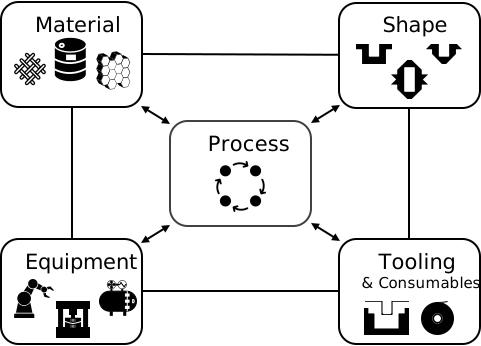
The Knowledge in Practice Centre (KPC) is centered around a structured method of thinking about composite material manufacturing. From the top down, the heirarchy consists of:
- The factory
- Factory cells and/or the factory layout
- Process steps (embodied in the factory process flow) consisting of:
The way that the material, shape, tooling & consumables and equipment (abbreviated as MSTE) interact with each other during a process step is critical to the outcome of the manufacturing step, and ultimately critical to the quality of the finished part. The interactions between MSTE during a process step can be numerous and complex, but the Knowledge in Practice Centre aims to make you aware of these interactions, understand how one parameter affects another, and understand how to analyze the problem using a systems based approach. Using this approach, the factory can then be developed with a complete understanding and control of all interactions.
Interrelationship of Function, Shape, Material & Process
Design for manufacturing is critical to ensuring the producibility of a part. Trouble arises when it is considered too late or not at all in the design process. Conversely, process design (controlling the interactions between shape, material, tooling & consumables and equipment to achieve a desired outcome) must always consider the shape and material of the part. Ashby has developed and popularized the approach linking design (function) to the choice of material and shape, which influence the process selected and vice versa, as shown below:
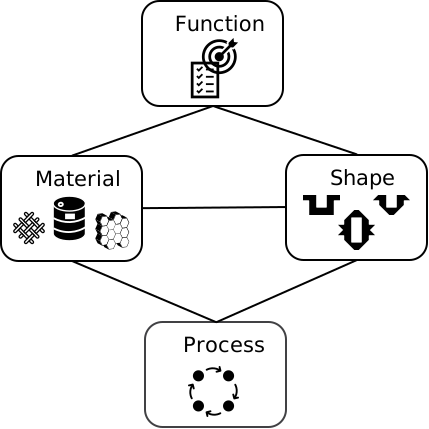
Within the Knowledge in Practice Centre the same methodology is applied but the process is more fully defined by also explicitly calling out the equipment and tooling & consumables. Note that in common usage, a process which consists of many steps can be arbitrarily defined by just one step, e.g. "spray-up". Though convenient, this can be misleading.

Workflows
The KPC's Practice and Case Study volumes consist of three types of workflows:
- Development - Analyzing the interactions between MSTE in the process steps to make decisions on processing parameters and understanding how the process steps and factory cells fit within the factory.
- Troubleshooting - Guiding you to possible causes of processing issues affecting either cost, rate or quality and directing you to the most appropriate development workflow to improve the process
- Optimization - An expansion on the development workflows where a larger number of options are considered to achieve the best mixture of cost, rate & quality for your application.
To use this website, you must agree to our Terms and Conditions and Privacy Policy.
By clicking "I Accept" below, you confirm that you have read, understood, and accepted our Terms and Conditions and Privacy Policy.

