
Coefficient of thermal expansion - A272
| Coefficient of thermal expansion | |
|---|---|
| Foundational knowledge article | |

| |
| Document Type | Article |
| Document Identifier | 272 |
| Themes | |
| Relevant Class |
Material |
| Tags | |
| Prerequisites | |
Introduction[edit | edit source]
The coefficient of thermal expansion (CTE) is a material property representing the extent to which a material will contract or expand under a given temperature change [1]. It can be used to predict changes in length, area, and volume due to changes in temperature. Although generally reported as a single value, the CTE for most materials varies with both temperature and direction. The direction-dependent effect is most noticeable with anisotropic materials like carbon fiber.
Scope[edit | edit source]
This page defines the coefficient of thermal expansion, explains its significance in composites processing, and provides some typical values. Measurement and processing effects are briefly discussed. Links to ASTM measurement techniques are provided, but are not discussed in great detail on this page, as this is covered in CMH-17 and the provided ASTM links.
Significance[edit | edit source]
In composite processing, the coefficient of thermal expansion (CTE) is an important material property that is heavily considered in both part and tooling design. Expansion of the composite part and the tooling during the cure cycle can have large effects on the final geometry of the part. The mismatch between the CTEs of the composite material and the tooling can introduce residual thermal stresses upon cooling. These residual stresses can show up as localized stress concentrations, warping, and distortion, which may compromise dimensional tolerances and structural integrity, and eventually lead to premature failure of the composite part. Accurate consideration and compensation for CTE mismatches are therefore essential in process development.
Significance for Tooling[edit | edit source]
Effect of tooling in a thermal management system
The mismatch between the CTEs of the composite part and the tooling is one of the biggest factors in tooling design and tool material selection, as it can significantly affect the formation of defects during processing. Metal tooling with a high CTE (such as aluminum) will experience greater dimensional changes throughout the cure cycle and is more likely to warp, inducing stresses in the lower CTE part [2]. This results in a common defect known as “spring-in,” where the final angle of the part is more acute than the angle formed by the tooling. This is due to residual stresses caused by differences in CTEs during cooling. With enough data analysis, some of this effect can be mitigated through tooling design; however, the introduction of stresses in general is not desirable. Most often, this results in poor dimensional accuracy of the part. To reduce this effect, when high-dimensional accuracy or complex geometry is required, material with a low CTE (such as Invar or CFRP) is more often used [2]. Other considerations for tooling material selection include tool lifetime, cost, and heat capacity. Metal tooling is often more robust and can withstand many more cycles than a composite tool, although they generally have a much higher initial cost. Materials such as Invar have a high heat capacity, meaning they take more time and energy to heat up. This can lead to a lower part temperature and must be considered during the cure cycle. CFRP has a much lower heat capacity, meaning that it heats up faster, but results in much more uneven temperature distribution. A case study on different tooling materials can be seen here:Conducting a thermal tooling survey on three complex tools of different materials.
Significance for Assembly[edit | edit source]
It is important to consider CTEs at a higher level than the laminate and component level. Composite parts are frequently combined with other materials and joined together through bonding and bolted connections. CTE mismatch can play a huge role in the quality of a bonded connection, especially when the connection is through a metal and a composite, such as the bonding of aluminum to carbon fiber. Since the CTE difference is so high for these materials, it is important that testing is performed on the bonded part to ensure that stresses induced at the extreme ends of the operating conditions do not result in part failure or too small of a safety factor [2]. To model this effect, Laminated Plate Theory and Finite Element Analysis (FEA) can be used.
Related pages
References
- ↑ 1.0 1.1 1.2 1.3 1.4 1.5 1.6 [Ref] Callister, William D. (2003). Materials Science and Engineering: An Introduction. John Wiley & Sons, Inc. ISBN 0-471-13576-3.CS1 maint: uses authors parameter (link) CS1 maint: date and year (link)
- ↑ 2.0 2.1 2.2 [Ref] Composite Materials Handbook 17 - Polymer Matrix Composites; Materials Usage, Design and Analysis. 3. SAE International on behalf of CMH-17, a division of Wichita State University. 2012. ISBN 978-1-68015-454-2.CS1 maint: date and year (link)
- ↑ 3.0 3.1 [Ref] Composite Materials Handbook 17 - Polymer Matrix Composites; Guidelines for Characterization of Structural Materials. 1. SAE International on behalf of CMH-17, a division of Wichita State University. 2012. ISBN 978-0-7680-7811-4.CS1 maint: date and year (link)
- ↑ 4.0 4.1 4.2 4.3 4.4 [Ref] Johnson, Robert R. et al. (1981), Thermal Expansion Properties of Composite Materials. (published 1 July 1981)
|access-date=requires|url=(help)CS1 maint: extra punctuation (link) CS1 maint: uses authors parameter (link) CS1 maint: date and year (link) - ↑ [Ref] MatWeb LLC. "MatWeb: Online Materials Information Resource". Retrieved 9 September 2020.CS1 maint: uses authors parameter (link)
- ↑ [Ref] "Study of Thermal Expansion in Carbon Fiber-Reinforced Polymer Composites - SAMPE". Retrieved 13 March 2026.
- ↑ 7.0 7.1 [Ref] Lebrun, Gilbert; Denault, Johanne (2010). "Effect of annealing on the thermal expansion and residual stresses of bidirectional thermoplastic composite laminates". 41 (1). Elsevier. doi:10.1016/j.compositesa.2009.09.009. ISSN 1359-835X. Retrieved 13 March 2026. Cite journal requires
|journal=(help)CS1 maint: uses authors parameter (link)
 |
 |
| About | Help |

Welcome
Welcome to the CKN Knowledge in Practice Centre (KPC). The KPC is a resource for learning and applying scientific knowledge to the practice of composites manufacturing. As you navigate around the KPC, refer back to the information on this right-hand pane as a resource for understanding the intricacies of composites processing and why the KPC is laid out in the way that it is. The following video explains the KPC approach:
Understanding Composites Processing
The Knowledge in Practice Centre (KPC) is centered around a structured method of thinking about composite material manufacturing. From the top down, the heirarchy consists of:
- The factory
- Factory cells and/or the factory layout
- Process steps (embodied in the factory process flow) consisting of:
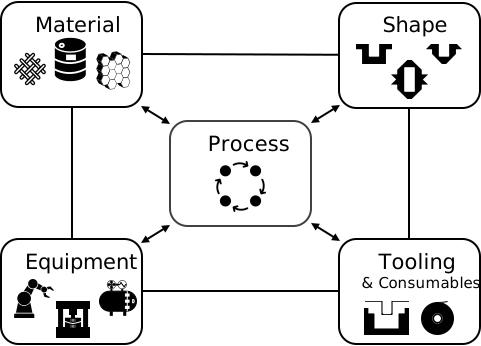
The way that the material, shape, tooling & consumables and equipment (abbreviated as MSTE) interact with each other during a process step is critical to the outcome of the manufacturing step, and ultimately critical to the quality of the finished part. The interactions between MSTE during a process step can be numerous and complex, but the Knowledge in Practice Centre aims to make you aware of these interactions, understand how one parameter affects another, and understand how to analyze the problem using a systems based approach. Using this approach, the factory can then be developed with a complete understanding and control of all interactions.
Interrelationship of Function, Shape, Material & Process
Design for manufacturing is critical to ensuring the producibility of a part. Trouble arises when it is considered too late or not at all in the design process. Conversely, process design (controlling the interactions between shape, material, tooling & consumables and equipment to achieve a desired outcome) must always consider the shape and material of the part. Ashby has developed and popularized the approach linking design (function) to the choice of material and shape, which influence the process selected and vice versa, as shown below:
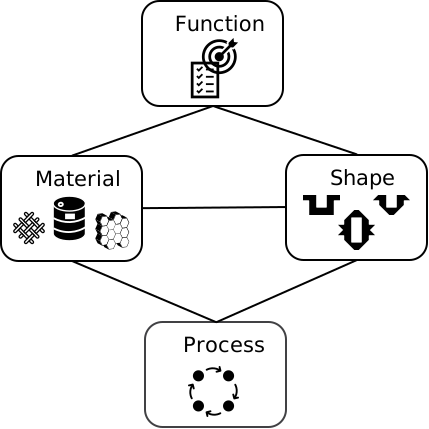
Within the Knowledge in Practice Centre the same methodology is applied but the process is more fully defined by also explicitly calling out the equipment and tooling & consumables. Note that in common usage, a process which consists of many steps can be arbitrarily defined by just one step, e.g. "spray-up". Though convenient, this can be misleading.

Workflows
The KPC's Practice and Case Study volumes consist of three types of workflows:
- Development - Analyzing the interactions between MSTE in the process steps to make decisions on processing parameters and understanding how the process steps and factory cells fit within the factory.
- Troubleshooting - Guiding you to possible causes of processing issues affecting either cost, rate or quality and directing you to the most appropriate development workflow to improve the process
- Optimization - An expansion on the development workflows where a larger number of options are considered to achieve the best mixture of cost, rate & quality for your application.
To use this website, you must agree to our Terms and Conditions and Privacy Policy.
By clicking "I Accept" below, you confirm that you have read, understood, and accepted our Terms and Conditions and Privacy Policy.

