
Coefficient of cure shrinkage - A273
| Coefficient of cure shrinkage | |
|---|---|
| Foundational knowledge article | |

| |
| Document Type | Article |
| Document Identifier | 273 |
| Themes | |
| Relevant Class |
Material |
| Tags | |
| Prerequisites | |
Introduction[edit | edit source]
The coefficient of cure shrinkage describes the volumetric change of the resin system during the curing process. For many thermosetting resins, this relationship is approximately linear within specific cure intervals, and the proportionality constant is called the coefficient of cure shrinkage.
Scope[edit | edit source]
This page defines the coefficient of cure shrinkage and outlines its significance in composite manufacturing. It will summarize how temperature and cure affect the development of strain within a part during the cure process. Also, typical ranges of this parameter for various resin systems are provided.
Significance[edit | edit source]
During the manufacturing of composite parts, resin shrinkage can introduce residual stresses within the system. The part may undergo deformation to relieve these stresses, commonly referred to as “spring-in”. This deformation is also influenced by the difference in the thermal expansion of matrix and reinforcement [1][2]. These uneven thermal expansion coefficients and the cure shrinkage phenomenon lead to the development of internal residual stresses. The presence of these unintended internal stresses leads to a loss in dimensional accuracy and compromised longer-term performance and durability. As a result, an understanding of these principals are required when designing parts and their processing steps.
Prerequisites[edit | edit source]
Recommended documents to review before, or in parallel with this document:
- Polymer properties
- Degree of cure
- Gelation
- Coefficient of thermal expansion
Definition[edit | edit source]
During the curing process of a typical thermoset resin, the total volume decreases exclusively as a function of the degree of cure [3], this phenomenon is commonly referred to as cure shrinkage. As covalent bonds are formed between the chains, they are pulled closer and the proximity increases likelihood of more bonds being formed. Similarly in thermoplastic resins the process of crystallization causes volume shrinkage.
Process Dependencies[edit | edit source]
For the cure reaction to occur the resin must be heated, this increase or decrease in temperature also causes expansion or contraction of the matrix and reinforcement through thermal expansion. This creates a competing response at times in the cure cycle.

The figure above illustrates the volumetric change of thermosets during the curing process. In the Pre-Gelation portion, from (a) to (b) the resin is a viscous liquid and hence expands by thermal expansion. Between (b) and (c), the volumetric change starts to be dominated by cure shrinkage, as the gelation point (c) is approached. In most cure cycles, the longest part of the cycle is the soak, which is when the part is held at a constant temperature. During the Cure development portion, the part undergoes the majority of the shrinkage. The Post-gelation portion of the cycle demonstrates the shrinking of the part as a result of the thermal expansion of the gelled resin. It is worth noting that the end point (e) is lower volume than the starting point (a).
It should be noted that the cure shrinkage is dominated by the matrix, and not the reinforcement in the composite. The fibers are much stiffer than the matrix, therefore in the fiber dominant direction cure shrinkage is often not appreciable. However, in the matrix dominant direction the part can shrink. For instance, unidirectional prepreg will not shrink in the direction of the fibers. However, in the transverse and thickness directions, the effects of cure shrinkage will affect the final dimensions of the part noticeably.
Gelation and cure Shrinkage[edit | edit source]
Gelation is the point at which the resin transitions from a viscous liquid to a rubbery state [1]; this occurs by increasing the crosslinking between polymer chains. This transition occurs at a constant degree of cure, that is independent of curing temperature [2]. It is this transition from a viscous liquid to the solid that defines the modulus of the resin, and locks in internal stresses in the material [4].
During curing cycles of prepreg parts, temperature ramp and holds have different effects on the cure shrinkage. When the part is being held in a soak/hold, the temperature is held constant, the part undergoes cure shrinkage as the degree of cure increases. The relation between the strain over the degree of cure, which can be appreciated at this stage of the curing process, is referred to as the coefficient of cure shrinkage (CCS).

Although the relationship between cure shrinkage and degree of cure is often thought of as linear [5], experimentally a non-linear behavior is observed. The non-linear characteristic of this relationship stems from the phase transition, carried forth by the gelation of the material. Specifically, the transition from liquid to rubbery solid through the crosslinking of the curing process directly affects the cure shrinkage as a degree of cure. As a result, to best represent the data, a piecewise linear best fit is proposed, in which a linear best fit is applied before and after the gelation of the thermoset.

Typical Values[edit | edit source]
Total volume shrinkage of different resins from after fully cured.
- Polyester: 7-10%
- Epoxy: 2-8%
Measurement Method[edit | edit source]
To measure the CCS it is recommended to use a TMA. The TMA works by heating a sample and recording its displacements to a high accuracy. Another less common method is to place the sample on a heating stage and record it as it goes through a cure cycle and use Digital Image Correlation (DIC) which records a sample as it deforms, which a computer can analyze to get accurate displacements.

Related pages
References
- ↑ 1.0 1.1 [Ref] McCrum, N. G. et al. (1997). Principles of Polymer Engineering. Oxford University Press. ISBN 978-0-198565-26-0.CS1 maint: extra punctuation (link) CS1 maint: uses authors parameter (link) CS1 maint: date and year (link)
- ↑ 2.0 2.1 [Ref] Ramis, X. et al. (2003). "Curing of a thermosetting powder coating by means of DMTA, TMA and DSC". 44 (7). Elsevier. doi:10.1016/S0032-3861(03)00059-4. ISSN 0032-3861. Retrieved 23 February 2026. Cite journal requires
|journal=(help)CS1 maint: extra punctuation (link) CS1 maint: uses authors parameter (link) - ↑ [Ref] Li, Chun et al. (2004). "In-situ measurement of chemical shrinkage of MY750 epoxy resin by a novel gravimetric method". 64 (1). Elsevier. doi:10.1016/S0266-3538(03)00199-4. ISSN 0266-3538. Retrieved 23 February 2026. Cite journal requires
|journal=(help)CS1 maint: extra punctuation (link) CS1 maint: uses authors parameter (link) - ↑ [Ref] Khoun, Loleï; Hubert, Pascal (2010). "Cure shrinkage characterization of an epoxy resin system by two in situ measurement methods". 31 (9). John Wiley & Sons, Ltd. doi:Https://doi.org/10.1002/pc.20949 Check
|doi=value (help). ISSN 0272-8397. Cite journal requires|journal=(help)CS1 maint: uses authors parameter (link) - ↑ [Ref] Shah, Darshil U.; Schubel, Peter J. (2010). "Evaluation of cure shrinkage measurement techniques for thermosetting resins". 29 (6). Elsevier. doi:10.1016/j.polymertesting.2010.05.001. ISSN 0142-9418. Retrieved 23 February 2026. Cite journal requires
|journal=(help)CS1 maint: uses authors parameter (link)
 |
 |
| About | Help |

Welcome
Welcome to the CKN Knowledge in Practice Centre (KPC). The KPC is a resource for learning and applying scientific knowledge to the practice of composites manufacturing. As you navigate around the KPC, refer back to the information on this right-hand pane as a resource for understanding the intricacies of composites processing and why the KPC is laid out in the way that it is. The following video explains the KPC approach:
Understanding Composites Processing
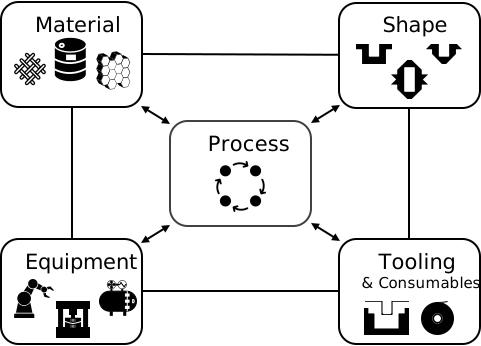
The Knowledge in Practice Centre (KPC) is centered around a structured method of thinking about composite material manufacturing. From the top down, the heirarchy consists of:
- The factory
- Factory cells and/or the factory layout
- Process steps (embodied in the factory process flow) consisting of:
The way that the material, shape, tooling & consumables and equipment (abbreviated as MSTE) interact with each other during a process step is critical to the outcome of the manufacturing step, and ultimately critical to the quality of the finished part. The interactions between MSTE during a process step can be numerous and complex, but the Knowledge in Practice Centre aims to make you aware of these interactions, understand how one parameter affects another, and understand how to analyze the problem using a systems based approach. Using this approach, the factory can then be developed with a complete understanding and control of all interactions.
Interrelationship of Function, Shape, Material & Process
Design for manufacturing is critical to ensuring the producibility of a part. Trouble arises when it is considered too late or not at all in the design process. Conversely, process design (controlling the interactions between shape, material, tooling & consumables and equipment to achieve a desired outcome) must always consider the shape and material of the part. Ashby has developed and popularized the approach linking design (function) to the choice of material and shape, which influence the process selected and vice versa, as shown below:
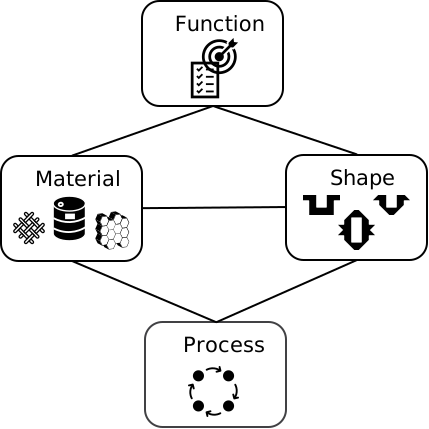
Within the Knowledge in Practice Centre the same methodology is applied but the process is more fully defined by also explicitly calling out the equipment and tooling & consumables. Note that in common usage, a process which consists of many steps can be arbitrarily defined by just one step, e.g. "spray-up". Though convenient, this can be misleading.

Workflows
The KPC's Practice and Case Study volumes consist of three types of workflows:
- Development - Analyzing the interactions between MSTE in the process steps to make decisions on processing parameters and understanding how the process steps and factory cells fit within the factory.
- Troubleshooting - Guiding you to possible causes of processing issues affecting either cost, rate or quality and directing you to the most appropriate development workflow to improve the process
- Optimization - An expansion on the development workflows where a larger number of options are considered to achieve the best mixture of cost, rate & quality for your application.
To use this website, you must agree to our Terms and Conditions and Privacy Policy.
By clicking "I Accept" below, you confirm that you have read, understood, and accepted our Terms and Conditions and Privacy Policy.

