
Light RTM Vehicle Door Design and Quality Issues - C128
| Light RTM Vehicle Door Design and Quality Issues | |||||||
|---|---|---|---|---|---|---|---|
| Case study | |||||||

| |||||||
| Document Type | Case study | ||||||
| Document Identifier | 128 | ||||||
| Themes | |||||||
| Tags | |||||||
| Objective functions |
| ||||||
| MSTE workflow | Development | ||||||
Summary[edit | edit source]
Light RTM processing was selected to manufacture the mass transit vehicle external door shown in Figure 1. After prototyping it was discovered that the stiffness of the door did not meet the design requirements. Additional reinforcement was added to the design, but the new design thickness exceeded the part cavity thickness leading to issues closing the mould and degrading the exterior surface finish. A new B-side mould needed to be manufactured because the part cavity thickness wasn’t properly considered during the design process.

Challenge[edit | edit source]
The performance of the exterior door needed to meet specific requirements during service. These requirements included:
- Aesthetics – Class A surface finish free from material print-through.
- Structural – Meet minimum safety factor and maximum deflection limits when undergoing door opening, slamming, and collision load cases.
The layup of the door was designed based on a preliminary stiffness analysis. The materials used in the layup were comprised of a stitched infusion sandwich mat consisting of a non-woven synthetic core sandwiched between two layers of chopped strand mat, stitched unidirectional mat, and low-density polyurethane foam core. The A-side and B-side light RTM moulds were manufactured with the part cavity thickness specified to match the predicted layup design thickness.
Physical testing was performed once a prototype part was manufactured. The prototype door was installed on the vehicle and opened and slammed closed. The deflections across the door were measured and it was discovered that the door did not meet the stiffness requirements. The addition of another unidirectional mat to the layup was trialed in an attempt to stiffen the design. It was observed that adding a single ply of unidirectional mat was not sufficient, so multiple plies were added to meet the stiffness requirement. This increased the thickness of the laminate by 17%. However, when the new design was being manufactured it was found that the B-side mould would not close and properly seal.
Approach[edit | edit source]
It was discovered that physical clamps were required to close the B-side mould when manufacturing the updated design. The infusion was completed successfully but the resin flow rate was slowed considerably compared to the original layup design. Both of these factors, the time needed to clamp the mould and the additional infusion time, increased the cycle time of the process by approximately 20%. This drove up the cost to manufacture the part. As well, the extra clamping force resulted in additional wear to the moulds, decreasing their lifespan and increasing the tooling cost amortization rate across each production part.
Another problem that arose was print through on the exterior surface. The additional reinforcement mats that were forced into the part cavity thickness lowered the resin content of the part and decreased the ability of the chopped strand mat plies to block the print through from the directional reinforcement mats and along the edges of the core.
When assessing potential mitigation strategies another contributing factor was discovered. During the initial design process a thickness of 1.5 mm was assumed for the stitched infusion sandwich mat. Upon review, it was determined that the assumed thickness was too small and was outside of the manufacturer’s recommendations. A value of 3 mm was determined to be more suitable. Since the part cavity was designed based on the 1.5 mm thickness, it meant that during production the stitched infusion mat was overly compressed reducing resin flow. It also meant that when additional reinforcement was added to the design the stitched infusion mat was unable to compress any further since it was already beyond it’s designed thickness range. This further increased the challenge to close the B-side mould.
During the redesign process it was also determined that adding more unidirectional reinforcement was not the most efficient method of improving the stiffness of the door. Increasing the thickness of the core was a much more efficient method to improve stiffness . By increasing the core thickness by 12.5% the stiffness of the design increased by 36%. Adding the extra reinforcement increased the stiffness by only 10%. This comparison is shown in Figure 2. This helped explain why adding a single ply of unidirectional reinforcement was not sufficient to meet the design requirements and instead, multiple plies of reinforcement were required. Subsequently, the need to add multiple reinforcement plies led to the challenges of closing the tool and a reduction in the resin flow rate.

Outcome[edit | edit source]
The challenges that arose during the manufacturing of the door after adding extra unidirectional reinforcements to the layup demonstrate the importance of analysing and testing a light RTM design sufficiently to properly define the part cavity thickness before the B-side mould is built. The need to include extra plies of reinforcement within a pre-set part cavity thickness led to the difficulties in closing the mould, increased the cycle time, and increased the prevalence of print through on the exterior surface.
Although the part could be manufactured with the revised layup and using the existing mould, a decision was made to manufacture a new B-side mould with an increased part cavity thickness. This allowed for a more efficient revised design that included a thicker core and less directional reinforcement, eliminated the need to use physical clamps to close the mould, reduced print through, and decreased the part fill time resulting in a reduction of the cycle time for each part.
Related pages[edit | edit source]
- Practice for troubleshooting a Light RTM step - P107
- Light Resin Transfer Moulding (LRTM) - A424
- Part Design for Light RTM - P177
Related pages
 |
 |
| About | Help |

Welcome
Welcome to the CKN Knowledge in Practice Centre (KPC). The KPC is a resource for learning and applying scientific knowledge to the practice of composites manufacturing. As you navigate around the KPC, refer back to the information on this right-hand pane as a resource for understanding the intricacies of composites processing and why the KPC is laid out in the way that it is. The following video explains the KPC approach:
Understanding Composites Processing
The Knowledge in Practice Centre (KPC) is centered around a structured method of thinking about composite material manufacturing. From the top down, the heirarchy consists of:
- The factory
- Factory cells and/or the factory layout
- Process steps (embodied in the factory process flow) consisting of:
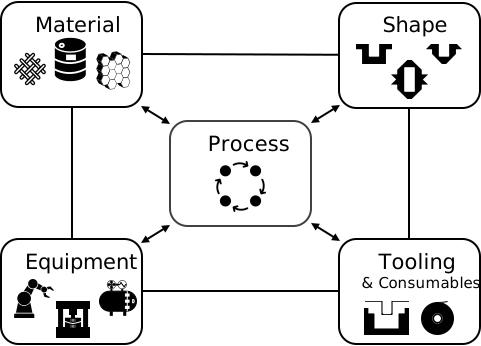
The way that the material, shape, tooling & consumables and equipment (abbreviated as MSTE) interact with each other during a process step is critical to the outcome of the manufacturing step, and ultimately critical to the quality of the finished part. The interactions between MSTE during a process step can be numerous and complex, but the Knowledge in Practice Centre aims to make you aware of these interactions, understand how one parameter affects another, and understand how to analyze the problem using a systems based approach. Using this approach, the factory can then be developed with a complete understanding and control of all interactions.
Interrelationship of Function, Shape, Material & Process
Design for manufacturing is critical to ensuring the producibility of a part. Trouble arises when it is considered too late or not at all in the design process. Conversely, process design (controlling the interactions between shape, material, tooling & consumables and equipment to achieve a desired outcome) must always consider the shape and material of the part. Ashby has developed and popularized the approach linking design (function) to the choice of material and shape, which influence the process selected and vice versa, as shown below:
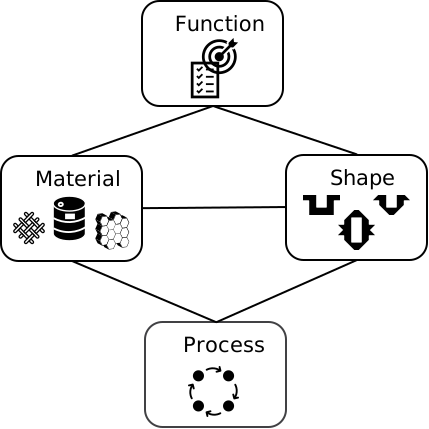
Within the Knowledge in Practice Centre the same methodology is applied but the process is more fully defined by also explicitly calling out the equipment and tooling & consumables. Note that in common usage, a process which consists of many steps can be arbitrarily defined by just one step, e.g. "spray-up". Though convenient, this can be misleading.

Workflows
The KPC's Practice and Case Study volumes consist of three types of workflows:
- Development - Analyzing the interactions between MSTE in the process steps to make decisions on processing parameters and understanding how the process steps and factory cells fit within the factory.
- Troubleshooting - Guiding you to possible causes of processing issues affecting either cost, rate or quality and directing you to the most appropriate development workflow to improve the process
- Optimization - An expansion on the development workflows where a larger number of options are considered to achieve the best mixture of cost, rate & quality for your application.
To use this website, you must agree to our Terms and Conditions and Privacy Policy.
By clicking "I Accept" below, you confirm that you have read, understood, and accepted our Terms and Conditions and Privacy Policy.

