
Light Resin Transfer Moulding (LRTM) - A424
| Light Resin Transfer Moulding (LRTM) | |
|---|---|
| Document Type | Article |
| Document Identifier | 424 |
| Tags | |
| Prerequisites | |
Introduction[edit | edit source]
Light resin transfer moulding (LRTM) is a closed mould, liquid composite moulding, infusion process that shares commonalities with resin transfer moulding (RTM) and vacuum assisted resin transfer moulding (VARTM) with some key differences. Dry fibre mats are placed in a rigid mould and covered with a semi-rigid counter mould. Resin is injected into the mould to infuse the dry fabric and then allowed to cure.
Significance[edit | edit source]
LRTM is a suitable process to increase productivity, reduce emissions, and improve quality compared to traditional wet layup. Understanding the scientific theory behind this process and the practical implications is critical to successfully produce parts.
Scope[edit | edit source]
This article will provide a detailed description of the LRTM process and explain the relevant scientific theory to successfully produce parts. The article will then describe the materials, shape, tooling, and equipment required for this manufacturing method. Finally, the advantages and disadvantages of adopting LRTM manufacturing will be presented.
Process Description[edit | edit source]
LRTM tooling consists of a rigid base mould (A-side) and a semi-rigid counter mould (B-side) as shown in Figure 1. After the moulds have been cleaned, released and gel coat applied, dry fibre mats are placed into the lower mould.
After the material is loaded into the base mould, the counter mould must be aligned evenly on all sides and lowered onto the part. During this process it is important to ensure the material in the base mould does not move. As it is lowered, the counter mould should be pushed down until the outer vacuum seal contacts the lower mould.
A vacuum line is then attached to the counter mould between the outer vacuum seal and the inner resin seal. Full vacuum is applied to the vacuum channel to clamp the counter mould to the lower mould.
The resin inlet port is located on the counter mould and inside of the inner resin seal. Usually there is space left open for a resin channel to surround the part cavity. This helps to ensure even distribution of the resin throughout the part.
A vacuum line is then attached to a port located within the part cavity. This vacuum line is connected to a resin catchpot to ensure that no resin reaches and damages the vacuum pump. All connections must be sealed using tape to prevent leaks. Typically, half vacuum level is applied to the part cavity. Vacuum integrity is then tested on the catch pot, part cavity, and the outer vacuum seal.
After vacuum integrity is confirmed the injection gun is attached and the injection process is started. The resin may be injected using the pressure differential caused by the vacuum, or it may be injected using positive pressure to increase the pressure differential. Applicatino specific LRTM pumps are available. Once the appropriate amount of resin has been injected to ensure the part is fully infused and meets the required fibre content requirement, the injection hose is pinched off and the gun disconnected. The vacuum lines must stay connected during the curing process. Typically, the demoulding process can begin once the counter mould has returned to room temperature.

Theory[edit | edit source]
Darcy’s law is used to model fluid flow through porous media, and like RTM and VARTM processing, the law can be used to model flow with LRTM processing.
\(Q = -\frac{KA}{\mu}\frac{\Delta P}{x}\)
Where,
\(Q = \) Volumetric flow rate
\(K = \) Preform permeability
\(A = \) Preform cross-sectional area
\(\mu = \) Resin viscosity
\(\Delta P = \) Pressure differential across preform
\(x = \) In-plane flow distance of pressure differential
Darcy’s law defines the critical parameters that need to be controlled to successfully produce a part using LRTM. The resin viscosity term shows that a lower viscosity will increase the flow rate. This helps to reduce fill time and prevent dry spots within the part.
A higher pressure differential also increases the flow rate and reduces fill time of the part. This explains why some LRTM parts are injected using positive pressure. However, care must be taken when setting the pressure differential because if the value is too high the flow rate may be too fast to allow the escape of volatile gases. This can result in porosity within the part.
Darcy’s law also shows that the flow rate is reduced as the in-plane flow distance is increased. This is why the distance from the resin injection port to the vacuum port in the part cavity should be minimized when designing the tool. It is also the reason why a resin channel that surrounds the part cavity is included. The resin channel allows for the resin to easily flow around the perimeter of the part and therefore shortens the flow distance through the fibre mat.
A higher preform permeability also increases the flow rate and is the reason why the fibre architecture of the mats needs to be carefully chosen. Ensuring high permeability helps to reduce the probability of dry spots in the part. It also demonstrates why the part cavity thickness and number of plies must be selected carefully. The number of reinforcement plies may be increased to improve the strength and stiffness of a part, but adding more plies to a pre-defined cavity thickness reduces the permeability of the preform. If the permeability of the mat stack is reduced too much then the result is dry spots in the part.
The use of Darcy’s Law and numerical methods can be used to model flow during LRTM processing. A challenge for modelling flow through LRTM tooling is the fact that the counter mould is semi-rigid. This means that the counter mould can flex depending on the number of plies stacked in the part cavity and the injection pressure. As the counter mould flexes this changes the permeability of the reinforcements and the cross-sectional area, therefore changing the volume flow rate. The amount of flex in the counter mould is dependent on the thickness and construction of the tool [1][2]. These factors have to be taken into consideration to accurately model the injection process of the part.
Materials[edit | edit source]
Reinforcements[edit | edit source]
A variety of fibre mats are commonly used for LRTM manufacturing. Continuous filament mat and chopped strand mat are the two most common due to their low cost and high permeability. Unidirectional and bidirectional stitched mats are often used when increased stiffness and strength are required.
In many applications assistance is needed to help the resin flow through the part and avoid dry spots. In these cases, mats that consist of a synthetic non-woven core sandwiched between two layers of chopped strand mat are a good option. The non-woven core allows for easy resin flow while the chopped strand mat provides stiffness. These types of mats have the additional bonus that the non-woven core adds thickness to the part without adding the full weight of a glass ply.
Another option to improve resin flow is the inclusion of polyester-based mats that include resin channels. Similar to the non-woven cores discussed above, these mats improve resin flow while adding thickness to the part. They can also be used to aid in print blocking.
Resin[edit | edit source]
Polyester and vinyl ester resins are most commonly used during LRTM processing, although epoxy resin is also an option. Low viscosity resins are best suited to help ensure complete wet out of the part. Typical viscosity levels are in the range of 50 to 200 mPa-a (centipoise). Resin gel times need to be long enough to allow for degassing and for the mould to fill completely.
Core[edit | edit source]
Core materials suitable for LRTM processing include plywood, balsa, and a variety of foams including PVC, PET, and polyurethane. Foam-filled honeycomb is another possibility, but open cell honeycomb is not suitable as the cells would fill up with resin resulting in a dramatic weight increase. Depending on the part and tooling design, the core may hamper the flow of resin through the part. To improve resin flow shallow grooves may be added to the core. Another option is to perforate the core which allows the resin to transfer from one side of the core to the other.
Shape[edit | edit source]
LRTM processing is suitable for most geometries, but undercuts should be avoided. This is because the semi-rigid counter mould can’t be removed when undercuts are present. In some other processing methods split tools can be used when undercuts are present, but this is not recommended for LRTM as it comprises the vacuum integrity of the tool. Additionally, very tight geometry should be avoided because it is challenging to construct a B-side mould to accommodate these features. Tight geometry is also more likely to lead to fibre bridging and resin rich areas. The draw depth should also be considered. Although deep draws are possible, they increase the difficulty level to deposit the reinforcing layers, and to close and open the B-side tool.
Tooling[edit | edit source]
LRTM tooling consists of a rigid base mould (A-side) and a semi-rigid counter mould (B-side). The A-side tool is typically made from thick fibreglass and reinforced with framing as needed. The B-side is also made from fibreglass but is thinner than the A-side. It contains a number of key features. The first is the outer mould seal that contains the vacuum within the tool. The second is the vacuum/resin seal. The area between the outer and inner seal is the vacuum channel. When vacuum is applied to the channel atmospheric pressure clamps the B-side mould to the A-side mould. Most B-side moulds contain one or two vacuum ports in the vacuum channel depending on the size of the part.
The inner seal surrounds the resin channel and the part cavity. It prevents resin from travelling from the resin channel and part cavity into the vacuum channel. The placement of the vacuum and resin ports within the part cavity are critical to manufacture a quality part. Once resin enters the part cavity it will flow along the path of least resistance. The ports should be placed so that all material will be infused before the resin reaches the exit vacuum port. As an example, the placement of the ports in Figure 2 will likely result in dry spots as the resin will quickly travel to the vacuum port and cut off areas for gases to escape. In comparison, the placement of ports in Figure 3 allows for the resin to easily travel around the resin channel and then fill the part cavity evenly before reaching the vacuum port.


Equipment[edit | edit source]
The two primary pieces of equipment for this type of processing are a resin injection system and a vacuum source. There are two options for supplying resin under pressure. The first is a pressure pot where the resin is placed inside the pot within a disposable container. The injection tube is fed through the lid of the pot and into the resin container. Compressed air is then used to create pressure within the pot and force the resin to flow. The second option is a standard resin injection system. Most of these systems use pumps driven by an air motor. The equipment automatically mixes the resin and the catalyst at a specified level and then injects the resin at the required pressure level. Controls on the equipment can also be set to count the appropriate number of strokes so that a consistent amount of resin is injected for each part.
There are also two options to supply vacuum. The first is a venturi that uses compressed air to produce a vacuum. This is the cheapest option, but the flow rates are small. The second option is an industrial vacuum pump. This is a more expensive alternative but provides much greater flow rates. It is helpful if the vacuum source has the ability to adjust the vacuum level as for many LRTM applications full vacuum is applied to the vacuum channel to clamp the tool, while half vacuum is applied to the part cavity to draw the resin. It is also critical that the compressor and tank are sized appropriately depending on the size of the parts being manufactured.
Advantages[edit | edit source]
- Can produce near-net shapes (limited trimming required)
- Produces consistent parts (thickness and fibre content)
- Produces smoother B-side surface than open mould methods
- Higher production rates than wet layup
- Reduced labour compared to wet layup
- Closed moulding leads to reduced emissions of volatile organic compounds (VOCs)
- Less expensive capital equipment than RTM
- Lower tooling cost than RTM
Disadvantages[edit | edit source]
- Lower fibre content than RTM and VARTM processing
- B-side surface finish not as good as processes that use metallic tooling
- More expensive tooling than open mould since it requires a top mould
- More equipment required than wet layup (vacuum pump and resin injection systems)
- Lower cycle times than RTM or compression moulding
Related pages[edit | edit source]
- See Webinar on Composite materials engineering - Manufacturing processes - Liquid composite moulding
- See Page on Practice for troubleshooting a Light RTM step
- See Page on Process Selection for a Composite Transit Vehicle Door
- See Page on Resin flow
 |
 |
| About | Help |

Welcome
Welcome to the CKN Knowledge in Practice Centre (KPC). The KPC is a resource for learning and applying scientific knowledge to the practice of composites manufacturing. As you navigate around the KPC, refer back to the information on this right-hand pane as a resource for understanding the intricacies of composites processing and why the KPC is laid out in the way that it is. The following video explains the KPC approach:
Understanding Composites Processing
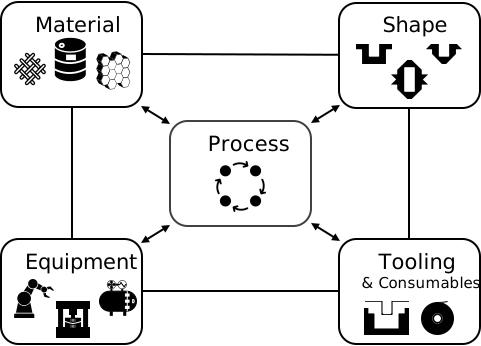
The Knowledge in Practice Centre (KPC) is centered around a structured method of thinking about composite material manufacturing. From the top down, the heirarchy consists of:
- The factory
- Factory cells and/or the factory layout
- Process steps (embodied in the factory process flow) consisting of:
The way that the material, shape, tooling & consumables and equipment (abbreviated as MSTE) interact with each other during a process step is critical to the outcome of the manufacturing step, and ultimately critical to the quality of the finished part. The interactions between MSTE during a process step can be numerous and complex, but the Knowledge in Practice Centre aims to make you aware of these interactions, understand how one parameter affects another, and understand how to analyze the problem using a systems based approach. Using this approach, the factory can then be developed with a complete understanding and control of all interactions.
Interrelationship of Function, Shape, Material & Process
Design for manufacturing is critical to ensuring the producibility of a part. Trouble arises when it is considered too late or not at all in the design process. Conversely, process design (controlling the interactions between shape, material, tooling & consumables and equipment to achieve a desired outcome) must always consider the shape and material of the part. Ashby has developed and popularized the approach linking design (function) to the choice of material and shape, which influence the process selected and vice versa, as shown below:
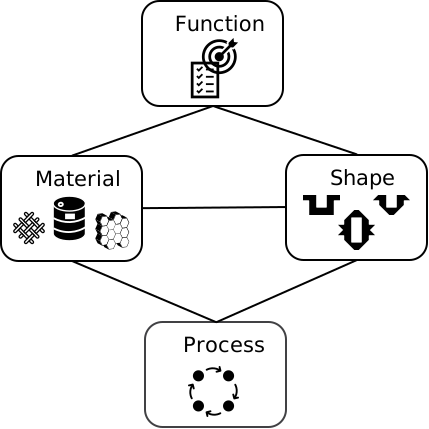
Within the Knowledge in Practice Centre the same methodology is applied but the process is more fully defined by also explicitly calling out the equipment and tooling & consumables. Note that in common usage, a process which consists of many steps can be arbitrarily defined by just one step, e.g. "spray-up". Though convenient, this can be misleading.

Workflows
The KPC's Practice and Case Study volumes consist of three types of workflows:
- Development - Analyzing the interactions between MSTE in the process steps to make decisions on processing parameters and understanding how the process steps and factory cells fit within the factory.
- Troubleshooting - Guiding you to possible causes of processing issues affecting either cost, rate or quality and directing you to the most appropriate development workflow to improve the process
- Optimization - An expansion on the development workflows where a larger number of options are considered to achieve the best mixture of cost, rate & quality for your application.
To use this website, you must agree to our Terms and Conditions and Privacy Policy.
By clicking "I Accept" below, you confirm that you have read, understood, and accepted our Terms and Conditions and Privacy Policy.

