
Part Design for Light RTM - P177
| Part Design for Light RTM | |||||||
|---|---|---|---|---|---|---|---|
| Practice document | |||||||

| |||||||
| Document Type | Practice | ||||||
| Document Identifier | 177 | ||||||
| Themes | |||||||
| Tags | |||||||
| Objective functions |
| ||||||
| MSTE workflow | Development | ||||||
| Prerequisites | |||||||
"Expression error: Unrecognized punctuation character ","." is not a number.
Introduction[edit | edit source]
This article will discuss how design choices affect the processing and final quality of parts made with the light resin transfer moulding (LRTM) process. It will include information on design and selection of materials, part thickness, geometry, aesthetics, and connections.
Significance[edit | edit source]
With the increasing adoption of light RTM processing, it is important to understand how to convert existing open mould designs, or design new parts, that are suitable for this type of processing. Without understanding key design criteria, the likelihood of quality or part performance issues significantly increases.
Scope[edit | edit source]
This article will discuss material options for LRTM processing and how they affect key manufacturing parameters such as fill time, curing properties, and aesthetics. It will also discuss the design of the layup and part thickness, and how they can affect part quality. Important geometry design considerations for LRTM will be presented along with a discussion on methods to achieve a high quality exterior surface finish. Finally, options for designing connection locations for LRTM parts will be examined.
Practice[edit | edit source]
Design decisions regarding material options, part cavity thickness, part geometry, and connection methods affect the manufacturing process. Potential quality issues can be prevented by making informed design decisions outlined below.
Materials[edit | edit source]
Reinforcements[edit | edit source]
One of the key considerations when selecting the reinforcements for a LRTM part is resin flow. For small and relatively thin parts the use of continuous filament mat or chopped strand mat may be sufficient. As the part size and thickness increases the fill time will dramatically increase without the introduction of other materials that aid in resin flow. Unlike vacuum infusion (VARTM), external flow media can’t be used during LRTM processing, so the flow media needs to be incorporated within the layup. One option is to introduce a sandwich mat that consists of two exterior layers of chopped strand mat and a middle layer of a synthetic non-woven core. The resin flows easily through the synthetic core and then travels through the thickness to impregnate the outer reinforcement plies. This type of mat provides good bending stiffness due to the outer chopped strand mat plies.
Another material option to increase resin flow is the use of a non-woven mat made from fine polyester fibres that contain resin channels. The resin easily flows along these channels while the rest of the mat sees little uptake of resin which minimizes part weight.
The aesthetics of the part are also influenced by reinforcement selection (see Aesthetics section for more details). One option to improve the exterior surface finish of the part is to include a non-woven surface veil made from glass or polymer fibres. This creates a resin-rich layer at the surface that helps to block print through. Another option is the use of non-woven mats made from fine polyester fibres. Unlike the mats discussed above, these mats don’t include resin channels and help to block any print through from reinforcements or cores deeper in the layup.
Resin[edit | edit source]
Resin selection for LRTM processing is critical to achieve a high quality part. Polyester and vinyl ester are the most common options. Epoxy resins may also be used but are much less popular. Since the resin needs to flow through the fibre mats it is critical to use a low viscosity resin usually in the range of 50 to 200 mPa-s (centipoise). Infusion during LRTM processing does not use high pressure compared to RTM so using a low viscosity resin is even more important. The criticality of a low viscosity resin is reflected in Darcy’s Law where the flow rate is inversely proportional to viscosity as described here in the context of LRTM. The use of a higher viscosity resin can lead to dry spots in the part. This is especially true for larger parts that have a longer distance between the resin port and the vacuum exit port. Resin gel time is also a critical design parameter. Using a resin with a shorter gel time can reduce the cycle time of the process. However, if the gel time is too short the resin will cutoff paths that allow for air and volatile gases to escape leading to porosity in the part. In most cases the selection of a lower gel time resin increases the peak exotherm during cure. Care must be taken to ensure the peak exotherm temperature does not exceed the maximum temperature allowed for the tooling material. If so, it may permanently damage the tool. Another resin property to consider is the degree of cure that is achievable at room temperature. A low degree of cure may result in the part warping after demoulding if it is exposed to higher temperatures. This could occur during a post-curing procedure or an elevated temperature paint process if the part is not fixtured securely. The selection of the resin can also affect the aesthetics of the parts. Using a low-shrink resin can help reduce the likelihood of print through on the exterior surface (see the Aesthetics section for more details).
Core[edit | edit source]
Cores are usually included in LRTM parts to increase the thickness, and therefore improve the bending stiffness, while minimizing weight. They may also be included to act as hard points for fastening, increase damping of the part, or for thermal insulation reasons. A variety of core materials may be selected, but it is critical that they are closed cell materials. Since LRTM is an infusion process the resin will flow into open cell cores, increasing the weight of the part, and eliminating the advantages of using a core material.
The inclusion of core within a LRTM part affects the resin flow pattern and can increase the fill time. Resin flow can be increased by adding shallow grooves to the core to provide channels for the resin to travel. Grooves can be added in both the longitudinal and transverse directions, or in a single direction depending on the part and tooling design. Depending on the location of the resin and vacuum ports, problems filling the area underneath the core may arise. In these cases, perforations can be added to the core that allow for the resin to flow from one side of the core to the other. When grooves and perforations are added to the core it affects the surface finish. Reducing the size of the grooves and perforations helps to minimize the impact. Including grooves on only one side of the core and placing the groove side away from the exterior surface is another way to minimize impact on aesthetics. Inclusion of grooves and perforations will also increase the weight of the final part.
Part Thickness[edit | edit source]
When a B-side counter mould is built it sets the thickness of the part cavity. This value can’t be changed without building a new counter mould which is time consuming and costly. Therefore, it is important to design the layup and specify the part thickness before the B-side tool is built. Plies added to the layup after the part cavity has been defined result in compaction of the plies and a corresponding reduction in permeability. This increases the fill time of the part and can potentially lead to dry spots.
The inclusion of additional plies also increases the difficulty of closing the top cover. In some cases clamps are required to apply additional pressure to close the cover. This increases the stress in the cover and can damage it. It also results in more wear to the tool and reduces its life expectancy. The additional fibre mats also increase the likelihood of print through appearing on the exterior surface.
Another consideration when specifying the part thickness for LRTM parts is the location and type of ply splices. In most cases overlap splices should be avoided for LRTM parts because the additional thickness build-up can’t be accommodated in the B-side mould. If overlap splices are required it is best if the plies are thin and the splices are staggered to minimize the increase in thickness. Butt splices are usually a better option for LRTM parts, however the joints will be weaker than the surrounding areas. This can be minimized by staggering the joint locations. If chopped strand mats are included in the layup the edges of the mats can be frayed to help fill in the splice location and increase the strength of the joint.
Geometry[edit | edit source]
Radii[edit | edit source]
Generous radii should be incorporated into part design where possible because sharp corners result in stress concentrations. It is also likely that fibre mats will bridge tight corners. Bridging is when the fibre mat does not fully conform to the geometry of the tool and instead leaves a gap between the mat and the tool as shown in Figure 1. This gap then fills with resin and becomes brittle after curing. This leads to the part chipping easily in the corners. It is recommended that a minimum radius of 1/8 inches is used for LRTM parts.

When tight radii can’t be avoided one option is to push roving into the corners. The fibre mats are then laid on top of the roving as shown in Figure 2. The roving fibres in the corner provide additional reinforcement and help to reduce cracking.

Draft[edit | edit source]
When resin cures it shrinks and causes contraction of the part. This can result in the part becoming locked in the mould. Adding a draft angle to the mould as shown in Figure 3 can prevent this from happening. Best practice is to have a minimum of 1 to 2 degrees of draft. Typically, the higher the draft angle the better, as it makes it easier to demould the part and increases the life of the mould.

Undercuts[edit | edit source]
Undercuts occur when the geometry of the mould has a negative or reverse draft as shown in Figure 4. This prevents the B-side mould from closing. The use of split tools is often employed when undercuts are present, but this option is rarely used for LRTM because it can lead to vacuum leaks in the tool.

Aesthetics[edit | edit source]
Class A surface finish is achievable during LRTM processing due to the use of a rigid A-side mould. Additionally, the use of a semi-rigid B-side mould results in a superior back-side surface finish when compared to wet layup or VARTM methods. However, careful consideration must be given to the choice of materials, the layup sequence, and processing parameters to avoid surface imperfections.
Print through is a common aesthetic defect observed for LRTM parts as shown in Figure 5. Two types of print through can occur. The first is when the fibre pattern becomes visible on the gel coat surface. The second type is when the edges of the core are visible on the gel coat surface. Both types occur when resin shrinks during curing and is constrained either by the fibre tows or by the edges of the core.

There are a few options to minimize print through during production. The first option is to select a low-shrink resin. This will help to reduce the amount of print through but usually isn’t sufficient on its own. The second option is to include a veil mat on the exterior surface. The veil mat results in a resin rich layer that is not constrained by fibre tows during curing and helps to block print through from fibre mats deeper in the layup. A third related option is to include stitched or woven directional mats away from the exterior surface of the part. When these types of mats are included at the surface the shrinkage of the resin around the fibre tows is much more likely to appear as print through. Some stitched directional mats also include a layer of chopped strand mat. In these cases, the chopped strand mat should be positioned closer to the exterior surface to help block the print through from the directional mats.
The edges of cores should be chamfered to help reduce print through. When the core is not chamfered it creates a 90 degree corner that fills with excess resin and leads to greater shrinkage and more print through. Another option to reduce print through from cores is to include a non-woven synthetic mat in the layup between the core and the exterior surface. This type of mat acts as a print blocker and helps to reduce the visible signs of resin shrinkage around the core edges.
Connections and Joints[edit | edit source]
Many parts produced using LRTM need to be mechanically fastened to other components. For most applications drilling into the composite and core (if included in the design) does not provide sufficient screw retention and bearing strength. For these cases, high density foam, balsa, plywood, or metal tapping plates can be included during the layup process. When metal tapping plates are included, the low-density core is machined to match the shape of the tapping plates, so they are easy to locate and fast to drop into place. The part is then manufactured as usual, and the holes are drilled into the tapping plate after the part has cured.
In some cases there is a desire to include studs during the infusion process. This complicates the design of the B-side mould and the production process. When studs are desired, the B-side tool must include a protrusion at each stud location. During production the protrusions will fill up with resin unless wax, clay, or a similar material that will not stick to the resin is placed into the protrusion. After demoulding, the wax or clay can then be removed from around the stud.
Closing Remarks[edit | edit source]
The likelihood of quality issues such as dry spots, porosity, cracking, and print through can be reduced by carefully making design decisions. This helps to decrease manufacturing costs by increasing the production rate and reducing the need for rework.
Related pages[edit | edit source]
- See Page on Practice for troubleshooting a Light RTM step
- Light RTM Vehicle Door Design and Quality Issues
- See Page on Resin flow
- See Page on Darcy's law
Related pages
 |
 |
| About | Help |

Welcome
Welcome to the CKN Knowledge in Practice Centre (KPC). The KPC is a resource for learning and applying scientific knowledge to the practice of composites manufacturing. As you navigate around the KPC, refer back to the information on this right-hand pane as a resource for understanding the intricacies of composites processing and why the KPC is laid out in the way that it is. The following video explains the KPC approach:
Understanding Composites Processing
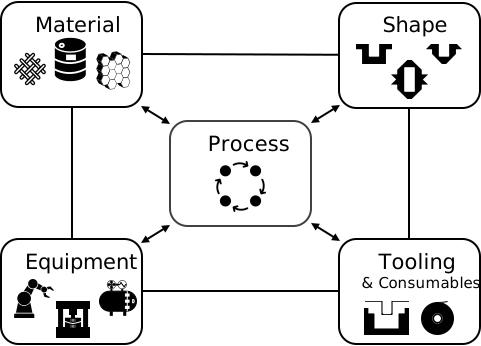
The Knowledge in Practice Centre (KPC) is centered around a structured method of thinking about composite material manufacturing. From the top down, the heirarchy consists of:
- The factory
- Factory cells and/or the factory layout
- Process steps (embodied in the factory process flow) consisting of:
The way that the material, shape, tooling & consumables and equipment (abbreviated as MSTE) interact with each other during a process step is critical to the outcome of the manufacturing step, and ultimately critical to the quality of the finished part. The interactions between MSTE during a process step can be numerous and complex, but the Knowledge in Practice Centre aims to make you aware of these interactions, understand how one parameter affects another, and understand how to analyze the problem using a systems based approach. Using this approach, the factory can then be developed with a complete understanding and control of all interactions.
Interrelationship of Function, Shape, Material & Process
Design for manufacturing is critical to ensuring the producibility of a part. Trouble arises when it is considered too late or not at all in the design process. Conversely, process design (controlling the interactions between shape, material, tooling & consumables and equipment to achieve a desired outcome) must always consider the shape and material of the part. Ashby has developed and popularized the approach linking design (function) to the choice of material and shape, which influence the process selected and vice versa, as shown below:
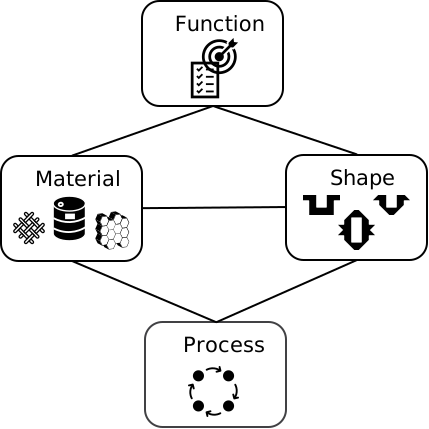
Within the Knowledge in Practice Centre the same methodology is applied but the process is more fully defined by also explicitly calling out the equipment and tooling & consumables. Note that in common usage, a process which consists of many steps can be arbitrarily defined by just one step, e.g. "spray-up". Though convenient, this can be misleading.

Workflows
The KPC's Practice and Case Study volumes consist of three types of workflows:
- Development - Analyzing the interactions between MSTE in the process steps to make decisions on processing parameters and understanding how the process steps and factory cells fit within the factory.
- Troubleshooting - Guiding you to possible causes of processing issues affecting either cost, rate or quality and directing you to the most appropriate development workflow to improve the process
- Optimization - An expansion on the development workflows where a larger number of options are considered to achieve the best mixture of cost, rate & quality for your application.
To use this website, you must agree to our Terms and Conditions and Privacy Policy.
By clicking "I Accept" below, you confirm that you have read, understood, and accepted our Terms and Conditions and Privacy Policy.

