
Fundamentals of Designing and Fabricating Filament-Wound Flywheel Rotors - C129
| Fundamentals of Designing and Fabricating Filament-Wound Flywheel Rotors | |||||||
|---|---|---|---|---|---|---|---|
| Case study | |||||||

| |||||||
| Document Type | Case study | ||||||
| Document Identifier | 129 | ||||||
| Themes | |||||||
| Tags | |||||||
| Objective functions |
| ||||||
| MSTE workflow | Development | ||||||
Introduction[edit | edit source]
This case study focuses on the design and fabrication of filament-wound flywheel energy-storage rotors. While deceptively simple, flywheel rotors are a demanding application of filament winding (FW) technology. Flywheels operate at high rotational speeds, often exceeding tens of thousands of revolutions per minute, which makes mass distribution, structural stiffness, and fatigue performance critical design factors. The case study begins with an overview of rotor architecture, typically consisting of a composite rim wound over a metallic or composite hub, and explains how winding angles, laminate sequence, and fiber volume fraction govern the rotor’s ability to store kinetic energy safely[1][2][3][4][5][6].
Significance[edit | edit source]
In addition to material properties, a key aspect is rotor balancing, since even small mass asymmetries can cause severe vibration at operating speeds. The study summarizes how precision winding, controlled resin content, and post-cure trimming or machining are used to achieve both static and dynamic balance. These steps ensure uniform mass distribution and stable operation.
Scope[edit | edit source]
The case study also addresses the management of mechanical stresses, focusing on the high hoop and radial stresses generated during rotation. It explains how analytical and numerical models are used to select material systems during design, predict burst speed, and evaluate safety margins, and why avoiding defects such as fiber waviness or resin-rich regions is crucial for maintaining interlaminar integrity. Finally, burst-testing results are used as the ultimate validation tool. These tests progressively increase rotor speed until failure, confirming whether the winding design, material system, and processing conditions meet performance expectations. The findings illustrate how design, process control, and quality assurance converge to produce safe and reliable FW flywheel rotors.
Introduction[edit | edit source]
Filament-wound composite flywheel rotors represent a technically demanding application of composite manufacturing, driven by the high mechanical and dynamic requirements associated with high-speed flywheel energy storage. Flywheel energy storage systems (FESS) operate by converting electrical energy, via an electrical machine (motor-generator unit), into kinetic energy stored in a rotating mass and reconverting it back into electrical energy during discharge when needed.
As an illustration, Figure 1 depicts a cut-away schematic of a scaled-down FESS designed for short-term energy storage from regenerative braking in light-rail transit applications. To maximize energy density, modern flywheel rotors are designed to operate at high angular velocities, frequently exceeding tens of thousands of revolutions per minute. At such speeds, even minor imperfections in geometry, material composition, or laminate architecture can lead to severe dynamic instabilities or catastrophic failure[1][2][3][4][5][6].
The fundamental architecture of most composite flywheel rotors consists of one or multiple filament-wound composite rims coupled to a central hub, which may be metallic or composite depending on system requirements. The rotor rims are responsible for storing the majority of the kinetic energy, while the hub transmits torque between the rotor and the motor-generator assembly. This rim-hub configuration allows designers to exploit the elastic properties and high specific strength of fiber-reinforced polymers to manage stress concentrations and interface loads[1][2][3].
The ability of a flywheel rotor to store energy safely is governed by the interaction between material properties, laminate design, and rotational stress states. Fiber reinforcement and polymer matrix selection, winding angle, stacking sequence, and fiber volume fraction directly influence rim hoop stiffness and strength, radial compliance, and interlaminar strength. Optimal laminate architectures are therefore required to maximize stored energy while maintaining acceptable safety margins against burst failure[2][5][6]. Consequently, FW offers unique advantages for flywheel manufacturing, as it enables precise control of fiber orientation, tension, and placement along rotationally symmetric geometries.

Rotor Architechture and Material Configuration[edit | edit source]
Composite Rim and Hub Integration[edit | edit source]
The composite rotor rim, or rims, are the primary energy-storing components of the flywheel and are typically manufactured using high-strength continuous fibers embedded in a thermosetting polymer matrix. FW enables the production of thick, axisymmetric rims with fiber orientations that are tailored to align with the dominant stress directions induced by rotation, while also providing compliance where needed to achieve more favorable overall stress states. An example of the fabrication of a composite rim by FW is shown in Figure 2.

One or multiple rims are commonly press-fitted, adhesively bonded, or mechanically coupled to a hub that transfers torque while accommodating differential deformation between components[1][2][6]. The hub design plays a critical role in stress transfer and long-term reliability. Improper stiffness matching and thermal expansion behavior between the rim and hub can introduce residual stresses during manufacturing and unfavorable stress states during operation, potentially leading to failure. Careful selection of hub material and interface geometry is therefore necessary to avoid excessive radial stresses or delamination at rim-hub and rim-rim interfaces[2][5].
It should be noted that the stress due to centripetal forces increases quadratically with both radius and angular speed. As a result, radial tensile stresses may develop that exceed the transverse strength of circumferentially oriented fiber composites, leading to hoop fractures. While stresses in the hoop direction are dominant, comparatively low material strength in the radial direction poses a significant risk to rotor integrity if not properly accounted for in the design. Material selection, the use of multiple rims, and the intentional introduction of residual compressive stresses, through press-fitting the hub and rotor rim(s) or pre-stressing fibers wound onto the rotor hub, are viable strategies for controlling radial stresses.
The manufacturing process of multi-rim composite rotors can be categorized into four main steps: filament winding of the rotor rims, curing, machining (turning) of the rims to provide toleranced surfaces for assembly, and, finally, adhesive bonding or press fitting of the components. A schematic of the complete manufacturing process for a multi-rim composite rotor assembled by press fitting is shown in Figure 3.

Winding Angles and Laminate Sequence[edit | edit source]
The dominant stress in a rotating flywheel rim is the circumferential (hoop) stress, which increases quadratically with angular velocity. As a result, most flywheel laminates are heavily biased toward near-hoop winding angles to maximize tensile load-bearing capacity in the circumferential direction. However, purely hoop-wound structures are limited in their ability to provide the compliance needed to control radial and interlaminar stresses, which, as explained above, can lead to matrix cracking or delamination [1-3]. To address this limitation, rims with optimized material selection and laminates incorporating hoop and slightly off-axis plies can be employed. Low-angle plies improve radial compliance and help reduce interlaminar stresses. The balance between hoop stiffness, radial compliance, and interlaminar strength therefore represents a key design trade-off in flywheel rotors[5][6].
Fiber Volume Fraction and Resin Content[edit | edit source]
High fiber volume fraction is essential for maximizing specific energy storage, as fibers carry the majority of the hoop tensile load. However, excessively low resin content can reduce interlaminar shear strength and increase susceptibility to microcracking. Filament winding (FW) allows tight control of resin content through impregnation methods, tow tension, and compaction during winding[1][2]. Analytical and experimental results indicate that uniform resin distribution is critical for maintaining consistent stiffness and damping characteristics throughout the rotor. Resin-rich regions introduce local compliance variations, which can promote stress concentrations and dynamic imbalance during high-speed operation[3][4][5].
Stress State and Structural Mechanics of Flywheel Rotors[edit | edit source]
Hoop and Radial Stress Development[edit | edit source]
During rotation, the rotor rim experiences a complex multiaxial stress state dominated by hoop stress, with secondary radial and axial stresses governed by Poisson’s effects, material anisotropy, and geometric constraints. Analytical formulations based on thick-walled rotating cylinder theory are commonly used to estimate stress distributions as functions of radius, angular velocity, and material properties[2][3]. Radial stress gradients can be significant near the inner radius of the rim, particularly at the interface with the hub. These stresses influence the onset of matrix cracking and interlaminar failure, especially under long-term operation or cyclic loading[3][5].
Viscoelastic Effects and Stress Evolution[edit | edit source]
Polymer matrices exhibit time-dependent viscoelastic behavior, which may lead to stress relaxation and redistribution over the operational lifetime of the flywheel, particularly because flywheels are typically maintained in a state of constant rotation. Viscoelastic modeling shows that initially high hoop stresses may partially relax over time, while radial stresses can increase in certain regions due to constrained deformation[3]. Lifetime analyses incorporating viscoelastic constitutive models demonstrate that stress evolution must be considered when assessing long-term safety margins. Neglecting time-dependent effects can result in non-conservative predictions of burst speed and fatigue life[3].
Analytical and Numerical Modeling Approaches[edit | edit source]
Flywheel rotor design relies heavily on combined analytical and numerical (finite element) modeling approaches. Analytical solutions provide rapid estimates of stress distributions and energy density, enabling early-stage design optimization. Finite element models can capture geometric nonlinearities, anisotropic material behavior, and interface effects, allowing more accurate prediction of failure initiation and progression[2][5][6]. These models can be integrated into multi-objective optimization frameworks to simultaneously maximize stored energy, minimize mass, and ensure adequate safety factors. Such approaches demonstrate that even small changes in laminate architecture or material selection can significantly affect performance and reliability[5].
Dynamic Performance and Balancing Requirements[edit | edit source]
Importance of Mass Distribution[edit | edit source]
At rotational speeds exceeding tens of thousands of revolutions per minute, even minute mass asymmetries can generate significant forces, leading to excessive vibration and increased loads on supporting components such as bearings, thereby causing potential system failure. Static and dynamic balance are therefore critical requirements for flywheel rotors[1][2][4]. Imbalance forces scale with the square of rotational speed, making high-speed flywheels particularly sensitive to manufacturing tolerances. As a result, mass uniformity must be controlled at every stage of fabrication[1][4].
Precision Winding and Process Control[edit | edit source]
FW provides high repeatability in fiber placement and tension, which is essential for achieving uniform mass distribution. Controlled winding paths, constant tow tension, and precise resin impregnation reduce variability in local density and stiffness[1][6]. Post-winding curing processes need to be carefully managed to control residual stresses and geometric distortion. Thermal gradients during curing can lead to warping or non-uniform shrinkage, which directly affects balance quality[2]. In addition, gravity-induced resin flow may cause non-uniform consolidation, which can be mitigated by maintaining part rotation during curing.
Post-Cure Trimming and Machining[edit | edit source]
Despite precision winding, minor geometric deviations are unavoidable, especially at the rim surface in the outermost radial regions, which cannot be constrained by the mandrel. Post-cure trimming or machining is therefore employed to correct mass asymmetries and achieve final balance specifications. Material removal is performed in a controlled manner to preserve laminate integrity while adjusting mass distribution[1][4]. Properly trimmed rotors may exhibit significantly reduced vibration amplitudes and improved operational stability across the full speed range[4].
Defect Sensitivity and Quality Considerations[edit | edit source]
Waviness and Fiber Misalignment[edit | edit source]
Fiber waviness and misalignment reduce the effective tensile stiffness and strength in the hoop direction, directly lowering burst speed and energy density. Even small deviations in fiber orientation can lead to localized stress amplification under rotation[2][5]. FW minimizes these defects through controlled fiber tension and guided placement. However, improper setup or process instability can still introduce waviness, emphasizing the need for rigorous quality control[1][6].
Resin-Rich Regions and Interlaminar Integrity[edit | edit source]
Non-uniform resin distribution can create resin-rich or resin-starved regions that act as weak points under multiaxial stress. Resin-rich regions exhibit lower stiffness and strength compared with fiber-dominated areas, increasing the likelihood of interlaminar failure[3][5]. Resin-starved regions may act as crack initiation sites. Avoiding such defects is essential for maintaining interlaminar integrity, particularly near the inner radius of the rim where radial stresses are highest. Process monitoring and material characterization are therefore integral to high-quality flywheel manufacturing[2].
Burst Speed Prediction and Safety Margins[edit | edit source]
Analytical Prediction of Burst Speed[edit | edit source]
Burst speed is defined as the rotational speed at which the flywheel rotor fails due to material rupture or structural instability. Analytical burst criteria are typically based on maximum allowable hoop strain or stress in the composite laminate[2][5]. These models provide initial estimates of failure speed and are widely used for preliminary design and safety assessment. However, they often neglect complex failure modes such as delamination or progressive damage accumulation[3].
Numerical Evaluation of Failure[edit | edit source]
Finite element modeling enables more detailed evaluation of burst behavior by incorporating anisotropic material properties, interaction effects between rims and the hub, nonlinear deformation, and advanced damage criteria. Such models predict not only burst speed but also the location and mode of failure[5][6]. When accurate material data and boundary conditions are used, close agreement between numerical predictions and experimental burst test results can be achieved[2][5].
Experimental Validation and Burst Testing[edit | edit source]
Burst testing is the ultimate validation method for flywheel rotor design. In these tests, the rotor is progressively accelerated beyond its nominal operating speed until catastrophic failure occurs. This approach directly verifies whether the design meets safety and performance requirements[1][2][6]. Instrumentation during testing captures rotational speed, vibration, and energy loss, providing insight into failure mechanisms and dynamic behavior leading up to burst[4].
Due to the potentially violent nature of these tests, protective facilities such as so-called spin pits must be employed, and strict safety requirements must be adhered to. Furthermore, due to the high rotational speeds involved, direct instrumentation of the rotor, for example, for strain measurement, is usually not feasible. Optical measurement techniques, such as laser displacement methods, can provide limited but valuable information on rotor behavior during rotation and can be used to support validation of numerical models.
Integration of Design, Manufacturing, and Quality Assurance[edit | edit source]
The successful development of filament-wound flywheel rotors relies on the convergence of design optimization, precise manufacturing, and rigorous quality assurance. Design methodologies establish optimal material selection and laminate architectures and ensure adequate safety margins, while FW enables the controlled realization of these designs. Quality assurance practices ensure that defects and variability are minimized, thereby preserving the assumptions underlying analytical and numerical models[1][2][3][4][5][6]. Safe and reliable flywheel rotors are achieved not through isolated design choices, but through an integrated approach that spans material selection, structural mechanics, process control, high-quality fabrication, and experimental validation.
Conclusions[edit | edit source]
Filament-wound composite flywheel rotors are seemingly simple devices that represent a mature yet highly demanding application of composite manufacturing technology. High rotational speeds impose stringent requirements on mass distribution, structural integrity, and long-term reliability. Aspects such as rotor architecture, material selection, winding angles, fiber volume fraction, and consistent material consolidation govern the ability of the rotor to store kinetic energy safely and efficiently[1][2][3][4][5][6]. Balancing emerges as a critical factor, with precision winding, controlled curing, and post-processing required to achieve stable operation. Stress management through analytical and numerical modeling enables accurate prediction of burst speed and safety margins, while defect avoidance ensures that interlaminar integrity is maintained under extreme loading. Burst testing serves as the definitive validation tool, confirming whether design and manufacturing objectives have been successfully achieved. The present case study demonstrates how integrated design strategies, process control, and experimental verification collectively enable the production of high-performance, reliable filament-wound flywheel energy-storage rotors suitable for advanced energy storage applications.
Related pages[edit | edit source]
- Fundamentals of filament winding: systems, processes and design principles - A422
- Testing and quality control in filament-wound composites - A425
- Emerging technologies in filament winding: Materials, multifunctionality and embedded systems - A426
Related pages
References
- ↑ 1.00 1.01 1.02 1.03 1.04 1.05 1.06 1.07 1.08 1.09 1.10 1.11 1.12 [Ref] Basaure, Francisco; Mertiny, Pierre (2023). "Design Strategies for Flywheel Energy Storage Systems in EV Fast Charging". 6. American Society of Mechanical Engineers Digital Collection. doi:10.1115/IMECE2022-94653. ISBN 9780791886687. Retrieved 16 March 2026. Cite journal requires
|journal=(help)CS1 maint: uses authors parameter (link) - ↑ 2.00 2.01 2.02 2.03 2.04 2.05 2.06 2.07 2.08 2.09 2.10 2.11 2.12 2.13 2.14 2.15 2.16 2.17 [Ref] Skinner, Miles; Mertiny, Pierre (2022). "Energy Storage Flywheel Rotors—Mechanical Design". 2 (1). Multidisciplinary Digital Publishing Institute. doi:10.3390/encyclopedia2010019. ISSN 2673-8392. Retrieved 16 March 2026. Cite journal requires
|journal=(help)CS1 maint: uses authors parameter (link) - ↑ 3.00 3.01 3.02 3.03 3.04 3.05 3.06 3.07 3.08 3.09 3.10 3.11 [Ref] Skinner, Miles; Mertiny, Pierre (2021). "Effects of Viscoelasticity on the Stress Evolution over the Lifetime of Filament-Wound Composite Flywheel Rotors for Energy Storage". 11 (20). Multidisciplinary Digital Publishing Institute. doi:10.3390/app11209544. ISSN 2076-3417. Retrieved 16 March 2026. Cite journal requires
|journal=(help)CS1 maint: uses authors parameter (link) - ↑ 4.0 4.1 4.2 4.3 4.4 4.5 4.6 4.7 4.8 4.9 [Ref] Skinner, Miles; Mertiny, Pierre (2021). "Experimental Characterization of Low-Speed Passive Discharge Losses of a Flywheel Energy Storage System". 2 (1). Multidisciplinary Digital Publishing Institute. doi:10.3390/applmech2010001. ISSN 2673-3161. Retrieved 16 March 2026. Cite journal requires
|journal=(help)CS1 maint: uses authors parameter (link) - ↑ 5.00 5.01 5.02 5.03 5.04 5.05 5.06 5.07 5.08 5.09 5.10 5.11 5.12 5.13 5.14 5.15 [Ref] Mittelstedt, Marvin et al. (2018). "Design and Multi-Objective Optimization of Fiber-Reinforced Polymer Composite Flywheel Rotors". 8 (8). Multidisciplinary Digital Publishing Institute. doi:10.3390/app8081256. ISSN 2076-3417. Retrieved 16 March 2026. Cite journal requires
|journal=(help)CS1 maint: extra punctuation (link) CS1 maint: uses authors parameter (link) - ↑ 6.00 6.01 6.02 6.03 6.04 6.05 6.06 6.07 6.08 6.09 6.10 6.11 [Ref] Ertz, G. et al. (2017). "Design of Low-Cost FlyWheel Energy Storage Systems". 53 (6). ISSN 0091-1062. Retrieved 16 March 2026. Cite journal requires
|journal=(help)CS1 maint: extra punctuation (link) CS1 maint: uses authors parameter (link)
 |
 |
| About | Help |

Welcome
Welcome to the CKN Knowledge in Practice Centre (KPC). The KPC is a resource for learning and applying scientific knowledge to the practice of composites manufacturing. As you navigate around the KPC, refer back to the information on this right-hand pane as a resource for understanding the intricacies of composites processing and why the KPC is laid out in the way that it is. The following video explains the KPC approach:
Understanding Composites Processing
The Knowledge in Practice Centre (KPC) is centered around a structured method of thinking about composite material manufacturing. From the top down, the heirarchy consists of:
- The factory
- Factory cells and/or the factory layout
- Process steps (embodied in the factory process flow) consisting of:
The way that the material, shape, tooling & consumables and equipment (abbreviated as MSTE) interact with each other during a process step is critical to the outcome of the manufacturing step, and ultimately critical to the quality of the finished part. The interactions between MSTE during a process step can be numerous and complex, but the Knowledge in Practice Centre aims to make you aware of these interactions, understand how one parameter affects another, and understand how to analyze the problem using a systems based approach. Using this approach, the factory can then be developed with a complete understanding and control of all interactions.
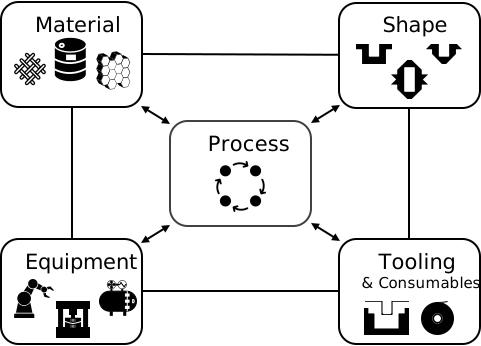
Interrelationship of Function, Shape, Material & Process
Design for manufacturing is critical to ensuring the producibility of a part. Trouble arises when it is considered too late or not at all in the design process. Conversely, process design (controlling the interactions between shape, material, tooling & consumables and equipment to achieve a desired outcome) must always consider the shape and material of the part. Ashby has developed and popularized the approach linking design (function) to the choice of material and shape, which influence the process selected and vice versa, as shown below:
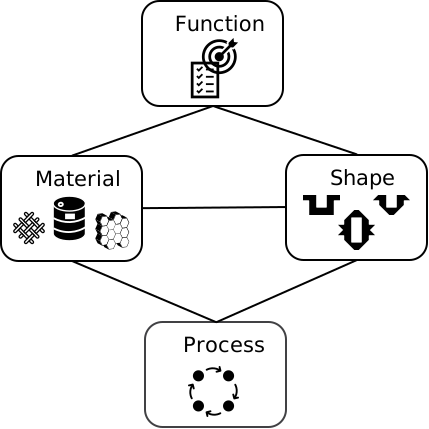
Within the Knowledge in Practice Centre the same methodology is applied but the process is more fully defined by also explicitly calling out the equipment and tooling & consumables. Note that in common usage, a process which consists of many steps can be arbitrarily defined by just one step, e.g. "spray-up". Though convenient, this can be misleading.

Workflows
The KPC's Practice and Case Study volumes consist of three types of workflows:
- Development - Analyzing the interactions between MSTE in the process steps to make decisions on processing parameters and understanding how the process steps and factory cells fit within the factory.
- Troubleshooting - Guiding you to possible causes of processing issues affecting either cost, rate or quality and directing you to the most appropriate development workflow to improve the process
- Optimization - An expansion on the development workflows where a larger number of options are considered to achieve the best mixture of cost, rate & quality for your application.
To use this website, you must agree to our Terms and Conditions and Privacy Policy.
By clicking "I Accept" below, you confirm that you have read, understood, and accepted our Terms and Conditions and Privacy Policy.

