
Fundamentals of filament winding: systems, processes and design principles - A422
| Fundamentals of filament winding: systems, processes and design principles | |
|---|---|
| Document Type | Article |
| Document Identifier | 422 |
| Themes | |
| Tags | |
Introduction[edit | edit source]
Filament winding (FW) is a cost-effective and repeatable process for manufacturing high-performance composite tubes, pipes, and pressure vessels. This article provides an accessible overview of FW fundamentals to support engineers, technicians, and learners in understanding how materials, machine systems, and process parameters combine to produce reliable wound structures. It introduces the basic terminology, identifies the main equipment components, and explains how design considerations interact with process control.
Significance[edit | edit source]
The article first defines FW system elements: machines (2-axis, 4-axis, and multi-axis), fiber creels, delivery and tensioning devices, resin impregnation systems, and mandrels. It then outlines the winding sequence, emphasizing how rotation speed, fiber angle, and band placement determine laminate architecture and mechanical performance. Next, it explains resin and fiber compatibility, addressing the influence of viscosity, cure kinetics, and fiber sizing on product quality. The design section discusses liner selection, thickness control, and strategies for minimizing defects such as slippage or gaps. Schematics and step-by-step illustrations align with the MSTEP manufacturing framework, showing how FW fits within material preparation, structure design, tooling, and process execution.
Scope[edit | edit source]
Readers gain a clear understanding of the FW process workflow (from setup to curing) and how machine control and material selection affect end-use performance. The article provides the foundational vocabulary and system knowledge necessary for interpreting subsequent KPC entries on testing and advanced applications.
Definition and Role of Filament Winding System Elements[edit | edit source]
Filament winding (FW) is a highly integrated composite manufacturing process in which machine configuration, material delivery, and tooling collectively determine product quality and performance[1][2]. FW systems are fundamentally composed of winding machines, fiber creels, delivery and tensioning devices, resin impregnation systems, and mandrels. Machines are commonly classified based on the number of controllable axes, including 2-axis systems (mandrel rotation and carriage translation), 4-axis systems (adding eye rotation and cross-feed), and multi-axis systems capable of complex, non-geodesic winding paths[1]. Increasing the number of controlled axes expands the design freedom of fiber placement, enabling variable angle laminates and localized reinforcement.


In filament winding, the design and selection of fiber guides, such as the pay-out eye, are influenced by the processing method. In wet filament winding, the presence of resin provides inherent lubrication, allowing the use of static guides without excessive fiber friction. Alternatively, rollers or pulleys can be employed to further reduce friction. Due to resin buildup, cleaning and maintenance requirements are an important consideration, and careful selection of guides and their surface material is recommended, with common choices including stainless steel and polytetrafluoroethylene (PTFE), which offer smooth surfaces and good resistance to wear and chemical exposure.

Fiber creels serve as the supply system for continuous rovings, ensuring uninterrupted fiber delivery during winding operations. Dispensing fibers from creels is coupled with suitable tensioning devices, which maintain consistent fiber tension as fibers are guided from the creel to the resin impregnation unit and finally to the mandrel surface[1][2].

Fiber material for FW is available as direct (single-end) roving and assembled roving, which differ in how the fibers are produced and combined. In the former case, individual filaments are spun and gathered directly into a single roving. In contrast, assembled roving is formed by combining multiple strands to create a heavier roving. While assembled rovings can increase production rates, care must be taken to avoid catenary effects, as small differences in strand length can lead to fiber misalignment and unequal fiber tensioning.
Fiber creels are available in two configurations: center-pull or outside-pull. In the former case, creels typically rest on shelves and tension is applied to the fiber strands via mechanical systems such as s-wrap tension bars. For outside-pull creels, cardboard cores facilitate mounting each creel to a computer-controlled drive that applies torque and thus tension to each strand using a feedback control system with an appropriate device for measuring fiber tension.
Tension control is emphasized as a critical variable because it promotes fiber straightness, material compaction and part consolidation, including the reduction of voids, and bonding between subsequent layers during placement. However, excessive fiber tension may lead to fiber damage and/or slippage of fibers along the mandrel for low winding angles.
Resin impregnation systems are responsible for wetting the fibers prior to deposition. In thermoset-based FW, this is achieved using resin baths or metered impregnation units, where fibers pass through the resin before winding[1]. In a dip-type resin bath, the fibers are fully immersed in a resin-filled tank, with resin content controlled downstream using a squeegee or similar device. In contrast, a drum-type resin bath minimizes friction on the fibers by wetting them with a thin resin film formed on the surface of a rotating drum. In thermoplastic FW systems, impregnation may occur upstream during tape or tow fabrication, with consolidation occurring during winding through applied heat and pressure [2][3].

The mandrel functions as both a forming tool and a load-bearing element during winding, defining the internal geometry of the structure and providing support during curing or consolidation. Mandrel material, surface finish, and release characteristics are therefore integral to successful part fabrication[2]. Mandrels can either be removed after curing or remain as an integral part of the fabricated component, as is the case for certain pressure vessel designs. In more complex geometries, multi-part mandrels can be employed to accommodate undercuts and enable removal after curing. Mandrels can also be actively heated to maintain a controlled temperature during winding, and in advanced configurations may incorporate heat-pipe technology enabling effective thermal management and, in some cases, supporting in-situ curing of the composite structure.
The final fabrication step for thermoset composite materials is typically curing at elevated temperatures. Temperature-controlled ovens are commonly employed to match the thermal conditions to the cure kinetics of the material. Wet winding requires mandrel rotation during curing to avoid resin drip-off and promote part roundness. Prior to curing, parts may be wrapped with peel ply, resin-absorbing cloth, and shrink tape to promote consolidation, remove excess resin, and create a uniform textured surface.
Winding Sequence and Kinematic Control[edit | edit source]
The winding sequence governs how fibers are deposited on the mandrel and directly controls the laminate architecture of the final composite structure[1][4][2]. The interaction between mandrel rotational speed, carriage translation speed, and fiber angle determines the fiber trajectory and band placement. These parameters define whether fibers follow hoop, helical, or polar winding paths, which are combined to achieve desired structural performance. The fiber angle relative to the mandrel axis is a function of the ratio between these two motions and is identified as one of the most influential design variables in FW structures[1][4]. Small changes in winding angle can lead to significant differences in stiffness, strength, and load distribution, particularly in vessels and pipes subjected to internal pressure. Band placement strategies, including the width of the fiber band and the degree of overlap between adjacent passes, are also highlighted as important considerations[1][2]. Uniform band placement promotes consistent thickness and minimizes stress concentrations, whereas misalignment or irregular overlap can introduce local defects.

Relationship Between Laminate Architecture and Mechanical Performance[edit | edit source]
The mechanical performance of filament-wound structures is linked to laminate architecture, which is itself controlled by winding parameters[4][2]. Fiber orientation determines how loads are transferred through the composite, with hoop-dominated laminates providing high resistance to circumferential stresses and helical layers contributing to axial load-bearing capacity. Design studies on filament-wound pressure vessels demonstrate that fiber angles must be selected to match the anticipated stress state[4]. Improper angle selection can result in inefficient material usage or premature failure. Maintaining consistent laminate thickness is therefore essential for predictable mechanical response.
Mechanical performance is not just dictated by fiber orientation but also by placement accuracy and repeatability[1][2]. Deviations from intended winding paths can introduce fiber waviness or resin-rich zones, which degrade load transfer efficiency. As a result, precise control of machine kinematics and real-time monitoring of winding parameters are necessary to translate design intent into manufactured performance.
In practice, laminate architecture is further influenced by process parameters and their control during winding. Commercial filament winding suppliers offer sophisticated design and simulation software that enables detailed path planning, parameter optimization, and prediction of laminate buildup. Despite these capabilities, designing winding patterns for complex geometries, such as pressure vessels with domed end caps or components with variable diameters, remains challenging, often requiring an iterative approach combining simulation, experimental validation, and incremental refinement of winding parameters.
Resin and Fiber Compatibility[edit | edit source]
Resin-fiber compatibility is identified as a foundational requirement for achieving high-quality filament-wound composites[1][2][3]. The rheological properties of the resin, particularly viscosity, directly influence fiber wetting and impregnation quality. Low-viscosity resins promote effective fiber wet-out but may increase the risk of resin drainage or uneven distribution, whereas high-viscosity resins may hinder impregnation and lead to void formation. Cure kinetics in thermoset systems are also critical, as premature gelation can restrict fiber movement and compromise consolidation[1]. Fiber surface treatments and sizing are noted as additional factors that influence interfacial adhesion between fibers and the matrix[2]. In thermoplastic FW systems, resin compatibility is framed in terms of melt behavior and consolidation efficiency[3]. Processing temperature, applied pressure, and residence time govern the degree of intimate contact between fibers and matrix.
Structural Design Considerations and Liner Selection[edit | edit source]
Structural design in filament winding extends beyond fiber orientation to include liner selection, thickness control, and geometric constraints[4][2]. Liners can serve multiple roles, including providing a gas or fluid barrier, defining internal geometry, and supporting the composite during winding and curing. Liner stiffness and thickness influence how loads are shared between the liner and the composite layers[4]. A liner that is too compliant may lead to excessive deformation, whereas an overly stiff liner may carry excessive loads, reducing the efficiency of the composite overwrap. Liner properties must therefore be considered concurrently with composite design rather than treated as an independent component. Thickness control is another key design consideration, as variations in thickness can introduce stress concentrations and reduce structural reliability[2]. Design strategies therefore emphasize uniform coverage, controlled overlap, and smooth transitions between winding patterns to minimize abrupt changes in thickness.
Defect Formation and Mitigation Strategies[edit | edit source]
Manufacturing defects are an inherent risk in filament winding and are closely linked to process control[1][2][3]. Common defects include fiber slippage, gaps between adjacent bands, overlaps, resin-rich areas, and voids. These defects originate from improper tension control, inaccurate machine kinematics, or mismatches between material properties and processing conditions. Fiber slippage occurs when friction is insufficient to maintain contact with the mandrel surface or preceding layers[2]. Gaps and overlaps result from errors in band placement or changes in winding speed. Resin-rich regions may form due to excessive resin pickup or insufficient drainage during winding, while voids are often associated with poor wetting or incomplete consolidation.
Process optimization approaches are highlighted as effective means of defect mitigation[3]. By systematically varying key parameters such as winding speed, tension, and temperature, optimal processing windows can be identified that reduce defect prevalence. In addition, tooling such as pin rings can be introduced to mitigate fiber slippage in layups that include low winding angles.
Integration Within the MSTEP Manufacturing Framework[edit | edit source]
FW is positioned as a manufacturing process that naturally aligns with the MSTEP framework, encompassing material selection, structure design, tooling, execution, and process control[1][2]. Material preparation involves selecting compatible fibers and resins and conditioning them for consistent delivery. Structural design defines fiber angles, stacking sequences, and thickness distributions based on performance requirements. Tooling, primarily in the form of mandrels and liners, provides geometric definition and mechanical support throughout the process. Execution encompasses the coordinated control of machine kinematics, fiber tensioning, resin impregnation, and curing. These stages are interconnected rather than sequential, as decisions made during material selection influence feasible winding speeds and impregnation strategies, while tooling design constrains achievable fiber paths[1][2]. Filament winding is therefore characterized as a system-level process in which materials, design, and manufacturing must be considered simultaneously.
Relevance to Modern Composite Manufacturing[edit | edit source]
FW remains a technically mature yet evolving manufacturing method with continued relevance to modern composite applications[1][4][2][3]. Its ability to produce high fiber volume fraction and repeatable axisymmetric structures makes it suitable for pressure vessels, pipes, and other load-bearing components. Advances in machine control, material systems, and process optimization further expand its applicability to both thermoset and thermoplastic composites.
References[edit | edit source]
References
- ↑ 1.00 1.01 1.02 1.03 1.04 1.05 1.06 1.07 1.08 1.09 1.10 1.11 1.12 1.13 Munro, M. (1988). "Review of manufacturing of fiber composite components by filament winding". Polymer Composites. 9 (5): 353–359. doi:10.1002/pc.750090508.
- ↑ 2.00 2.01 2.02 2.03 2.04 2.05 2.06 2.07 2.08 2.09 2.10 2.11 2.12 2.13 2.14 2.15 2.16 Gonzalez Henriquez, R.; Mertiny, P. (2018). "3.21 Filament Winding Applications". In Beaumont, P.W.R.; Zweben, C.H. (eds.). Comprehensive Composite Materials II. 3. Oxford: Academic Press. pp. 556–577. doi:10.1016/B978-0-12-803581-8.10313-3.
- ↑ 3.0 3.1 3.2 3.3 3.4 3.5 Orman, S.; Dogu, M.; Ozbek, B. (2024). "Optimization of the Filament Winding Process for Glass Fiber-Reinforced PPS and PP Composites Using Box–Behnken Design". Polymers. 16 (24): 3488. doi:10.3390/polym16243488.
- ↑ 4.0 4.1 4.2 4.3 4.4 4.5 4.6 Teng, T.-L.; Yu, C.-M.; Wu, Y. Y. (2005). "Optimal Design of Filament-Wound Composite Pressure Vessels". Mechanics of Composite Materials. 41 (4): 489–498. doi:10.1007/s11029-005-0058-0.

Welcome
Welcome to the CKN Knowledge in Practice Centre (KPC). The KPC is a resource for learning and applying scientific knowledge to the practice of composites manufacturing. As you navigate around the KPC, refer back to the information on this right-hand pane as a resource for understanding the intricacies of composites processing and why the KPC is laid out in the way that it is. The following video explains the KPC approach:
Understanding Composites Processing
The Knowledge in Practice Centre (KPC) is centered around a structured method of thinking about composite material manufacturing. From the top down, the heirarchy consists of:
- The factory
- Factory cells and/or the factory layout
- Process steps (embodied in the factory process flow) consisting of:
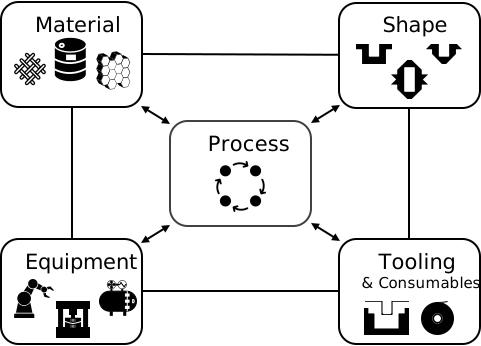
The way that the material, shape, tooling & consumables and equipment (abbreviated as MSTE) interact with each other during a process step is critical to the outcome of the manufacturing step, and ultimately critical to the quality of the finished part. The interactions between MSTE during a process step can be numerous and complex, but the Knowledge in Practice Centre aims to make you aware of these interactions, understand how one parameter affects another, and understand how to analyze the problem using a systems based approach. Using this approach, the factory can then be developed with a complete understanding and control of all interactions.
Interrelationship of Function, Shape, Material & Process
Design for manufacturing is critical to ensuring the producibility of a part. Trouble arises when it is considered too late or not at all in the design process. Conversely, process design (controlling the interactions between shape, material, tooling & consumables and equipment to achieve a desired outcome) must always consider the shape and material of the part. Ashby has developed and popularized the approach linking design (function) to the choice of material and shape, which influence the process selected and vice versa, as shown below:
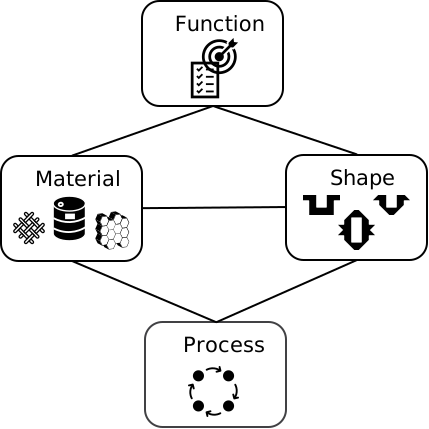
Within the Knowledge in Practice Centre the same methodology is applied but the process is more fully defined by also explicitly calling out the equipment and tooling & consumables. Note that in common usage, a process which consists of many steps can be arbitrarily defined by just one step, e.g. "spray-up". Though convenient, this can be misleading.

Workflows
The KPC's Practice and Case Study volumes consist of three types of workflows:
- Development - Analyzing the interactions between MSTE in the process steps to make decisions on processing parameters and understanding how the process steps and factory cells fit within the factory.
- Troubleshooting - Guiding you to possible causes of processing issues affecting either cost, rate or quality and directing you to the most appropriate development workflow to improve the process
- Optimization - An expansion on the development workflows where a larger number of options are considered to achieve the best mixture of cost, rate & quality for your application.
To use this website, you must agree to our Terms and Conditions and Privacy Policy.
By clicking "I Accept" below, you confirm that you have read, understood, and accepted our Terms and Conditions and Privacy Policy.

