
Emerging technologies in filament winding: Materials, multifunctionality and embedded systems - A426
| Emerging technologies in filament winding: Materials, multifunctionality and embedded systems | |
|---|---|
| Document Type | Article |
| Document Identifier | 426 |
| Tags | |
| Prerequisites | |
Introduction[edit | edit source]
Filament winding (FW) is evolving rapidly due to new material systems and digital manufacturing concepts. This article introduces emerging technologies reshaping FW, from thermoplastic towpregs and multifunctional matrices to embedded sensors and adaptive control, highlighting opportunities for innovation across Canadian industry.
Significance[edit | edit source]
The first section reviews advanced material systems, including thermoplastic tapes having PEEK (polyether ether ketone), PPS (polyphenylene sulfide), and PP (polypropylene) matrices [1] and high-temperature thermoset towpregs (bismaleimide (BMI), cyanate ester, etc.) [2].
It describes processing challenges such as in-situ consolidation and local heating requirements [3]. Next, multifunctional composites are discussed, featuring resin systems with electrical conductivity, self-sensing capability, or barrier layers for fluid containment [4]. The integration of embedded structures (fiber-optic sensors, strain gauges, or RFID tags) is presented as a route toward smart filament-wound components capable of structural health monitoring [5]. Finally, the article highlights digital and model-based manufacturing, emphasizing feedback-controlled winding paths and virtual simulation [6] [7] [8].
Scope[edit | edit source]
Readers understand how to evaluate and potentially adopt new FW technologies for high-value applications. The content encourages collaboration between research institutions and industry to pilot multifunctional and data-enabled composite systems.
Advanced Material Systems for Filament Winding[edit | edit source]
Advanced material systems for FW emphasize thermoplastic composites and high-temperature thermoset systems due to their performance, durability, and manufacturing advantages [1] [2]. Thermoplastic tapes based on matrices such as PEEK, PPS, and PP are highlighted for their high toughness, damage tolerance, and recyclability [1]. These materials enable rapid processing cycles because they do not rely on chemical curing reactions, instead consolidating through heating and cooling. Thermoplastic tapes are well suited for pressure vessels, pipes, and structural components requiring high impact resistance and fatigue durability. PEEK- and PPS-based systems are particularly suitable for applications demanding elevated temperature resistance and chemical stability. These materials retain mechanical integrity under aggressive service environments and are compatible with automated manufacturing routes such as FW and automated fiber placement [1]. PP-based thermoplastic composites may be considered cost-effective alternatives for moderate-performance applications, offering low density and corrosion resistance while still benefiting from thermoplastic processing advantages.
In contrast, high-temperature thermoset towpregs, particularly those based on BMI, cyanate ester, and related resin systems, are reviewed as established solutions for demanding aerospace and pressure-containment applications [2]. These towpregs combine continuous fiber reinforcement with solid or semi-solid resin, allowing controlled impregnation and tack during winding. Notably, some materials such as BMI towpreg feature a matrix phase that can be liquified by heating, which provides opportunities to combine the advantages of towpreg winding and conventional wet winding when using heated mandrel systems or external heating sources such infrared heaters. Parts made from these composite systems offer high thermal stability, low moisture uptake, and superior dimensional stability compared with conventional epoxy systems, making them suitable for thick-walled or load-critical filament-wound structures.
Processing Challenges and In-Situ Consolidation[edit | edit source]
Despite the advantages of advanced material systems, significant processing challenges exist, particularly for thermoplastic FW. In-situ consolidation is identified as a central technical hurdle, requiring sufficient heat and pressure during winding to achieve intimate contact between adjacent layers and eliminate voids [3]. Unlike thermoset systems, thermoplastics demand localized heating above the matrix melting temperature at the point of deposition, followed by controlled cooling to ensure proper crystallization and interlaminar bonding. The literature describes various localized heating strategies, including laser, infrared, hot-gas, and resistive heating systems, each with distinct advantages and limitations [3]. Laser-assisted FW offers precise energy delivery and rapid heating rates but requires careful control to avoid thermal degradation or uneven consolidation. Infrared and hot-gas heating systems are noted for their broader heating zones, which can be beneficial for thicker sections but may reduce process precision.
In contrast, high-temperature thermoset towpregs, particularly those based on BMI, cyanate ester, and related resin systems, are reviewed as established solutions for demanding aerospace and pressure-containment applications [2]. These towpregs combine continuous fiber reinforcement with solid or semi-solid resin, allowing controlled impregnation and tack during winding. Notably, some materials, such as BMI towpregs, feature a matrix phase that can be liquefied by heating (i.e., the resin is ‘frozen’ at room temperature), which provides opportunities to combine the advantages of towpreg winding and conventional wet winding when using heated mandrel systems or external heating sources such as infrared heaters. Parts made from these composite systems offer high thermal stability, low moisture uptake, and superior dimensional stability compared with conventional epoxy systems, making them suitable for thick-walled or load-critical filament-wound structures.
Multifunctional Composite Concepts[edit | edit source]
Beyond structural performance, filament-wound composites are increasingly engineered to deliver multifunctional capabilities. Multifunctional glass fiber/epoxy composite tubes demonstrate how FW production lines can be modified to incorporate additional functionalities without disrupting the primary load-bearing role of the structure [4]. These multifunctional systems integrate electrical conductivity, sensing capability, and barrier performance directly into the composite architecture. Electrically conductive pathways are achieved through the integration of conductive phases (e.g., particulate carbon fillers) within the resin system or through strategically placed functional layers during winding [4]. These features enable damage detection, strain monitoring, or electromagnetic shielding while maintaining structural integrity. However, these multifunctional designs require careful coordination of winding sequence, material placement, and curing conditions to ensure compatibility between structural and functional layers.
On the other hand, barrier layers can be considered as critical elements for fluid containment applications, particularly in pipes and pressure vessels exposed to aggressive media [4]. These layers are integrated during FW to limit permeation, protect reinforcement fibers, and extend service life. The referenced work demonstrates that FW allows precise placement of barrier materials, enabling tailored performance across the wall thickness. These cross-scale manufacturing approaches can increase scalability and industrial relevance, showing that multifunctional features can be embedded using modified yet practical FW processes [4].
Embedded Structures and Smart Filament-Wound Components[edit | edit source]
The integration of embedded sensing elements (i.e., fiber optic sensors) can be considered as a key pathway toward smart filament-wound structures capable of real-time structural health monitoring [5]. These sensors enable continuous monitoring of strain, temperature, and damage evolution throughout the service life of the structure. Fiber optic sensors are particularly emphasized due to their small size, immunity to electromagnetic interference, and compatibility with composite processing environments [5]. Their integration within filament-wound laminates allows internal state measurements that are not accessible through surface-mounted sensors. Sensor placement must be carefully coordinated with winding patterns to avoid fiber and sensor damage and signal degradation.
In addition to fiber optic sensors, embedded strain gauges and identification elements such as RFID tags might be considered as complementary technologies for smart composite systems [5]. These embedded structures support condition-based maintenance strategies and enhance the reliability of critical components such as propellant tanks and pressure vessels. Embedding sensors during FW does not inherently compromise structural performance when properly designed, reinforcing the feasibility of smart composite manufacturing at the component scale.
Digital and Model-Based Manufacturing in Filament Winding[edit | edit source]
In-situ monitoring techniques using embedded or surface-mounted sensors are used as tools for capturing real-time process and structural response data [6]. These systems enable monitoring of temperature, pressure, strain, and fatigue damage during fabrication and service, providing feedback for both manufacturing optimization and operational safety. In contrast, machine performance characterization and experimental assessment of multi-axis FW systems highlight the importance of precise kinematic control and repeatability [7]. Machine accuracy influences fiber placement, winding angle fidelity, and overall component quality. Such assessments support the development of digital twins and predictive models for FW processes.
Robotic FW can be considered as a transformative approach for manufacturing complex-shaped structural parts [8]. By decoupling fiber placement from traditional mandrel-based constraints, robotic systems enable variable-angle winding, highly non-axisymmetric geometries, and enhanced design freedom. Virtual simulation and offline programming are essential for collision avoidance, path optimization, and defect minimization in robotic FW.
Digital and model-based manufacturing approaches underscore the transition toward feedback-controlled, digitally enabled FW systems. Virtual simulation, sensor-driven monitoring, and adaptive control strategies are then considered as enablers for improving quality, reducing waste, and expanding the design space of filament-wound composite structures [6][7][8].
References
- ↑ 1.0 1.1 1.2 1.3 [Ref] Phiri, Resego et al. (2024). "Advances in lightweight composite structures and manufacturing technologies: A comprehensive review". 10 (21). Elsevier. doi:10.1016/j.heliyon.2024.e39661. ISSN 2405-8440. Retrieved 16 March 2026. Cite journal requires
|journal=(help)CS1 maint: extra punctuation (link) CS1 maint: uses authors parameter (link) - ↑ 2.0 2.1 2.2 2.3 [Ref] Jois, Kumar C. et al. (2024). "Towpreg manufacturing and characterization for filament winding application". 45 (9). John Wiley and Sons Inc. doi:10.1002/pc.28311. ISSN 1548-0569. Retrieved 16 March 2026. Cite journal requires
|journal=(help)CS1 maint: extra punctuation (link) CS1 maint: uses authors parameter (link) - ↑ 3.0 3.1 3.2 [Ref] Boon, Yi Di et al. (2021). "Review: Filament Winding and Automated Fiber Placement with In Situ Consolidation for Fiber Reinforced Thermoplastic Polymer Composites". 13 (12). Multidisciplinary Digital Publishing Institute. doi:10.3390/polym13121951. ISSN 2073-4360. Retrieved 16 March 2026. Cite journal requires
|journal=(help)CS1 maint: extra punctuation (link) CS1 maint: uses authors parameter (link) - ↑ 4.0 4.1 4.2 4.3 4.4 [Ref] Karalis, George et al. (2024). "Cross-Scale Industrial Manufacturing of Multifunctional Glass Fiber/Epoxy Composite Tubes via a Purposely Modified Filament Winding Production Line". 16 (12). Multidisciplinary Digital Publishing Institute. doi:10.3390/polym16121754. ISSN 2073-4360. Retrieved 16 March 2026. Cite journal requires
|journal=(help)CS1 maint: extra punctuation (link) CS1 maint: uses authors parameter (link) - ↑ 5.0 5.1 5.2 5.3 [Ref] Nosseir, Ahmed E.S. et al. (2024). "Composite structures with embedded fiber optic sensors: A smart propellant tank for future spacecraft applications". 223 (6). Pergamon. doi:10.1016/j.actaastro.2024.06.040. ISSN 0094-5765. Retrieved 16 March 2026. Cite journal requires
|journal=(help)CS1 maint: extra punctuation (link) CS1 maint: uses authors parameter (link) - ↑ 6.0 6.1 6.2 [Ref] Xiao, Biao et al. (2019). "In-Situ Monitoring of a Filament Wound Pressure Vessel by the MWCNT Sensor under Hydraulic Fatigue Cycling and Pressurization". 19 (6). Multidisciplinary Digital Publishing Institute. doi:10.3390/s19061396. ISSN 1424-8220. PMID 30901895. Retrieved 16 March 2026. Cite journal requires
|journal=(help)CS1 maint: extra punctuation (link) CS1 maint: uses authors parameter (link) - ↑ 7.0 7.1 7.2 [Ref] Quanjin, Ma et al. (2019). "Experimental assessment of the 3-axis filament winding machine performance". 2 (3). Elsevier. doi:10.1016/j.rineng.2019.100017. ISSN 2590-1230. Retrieved 16 March 2026. Cite journal requires
|journal=(help)CS1 maint: extra punctuation (link) CS1 maint: uses authors parameter (link) - ↑ 8.0 8.1 8.2 [Ref] Sorrentino, Luca et al. (2019). "Robotic filament winding: An innovative technology to manufacture complex shape structural parts". 220. Elsevier. doi:10.1016/j.compstruct.2019.04.055. ISSN 0263-8223. Retrieved 16 March 2026. Cite journal requires
|journal=(help)CS1 maint: extra punctuation (link) CS1 maint: uses authors parameter (link)

Welcome
Welcome to the CKN Knowledge in Practice Centre (KPC). The KPC is a resource for learning and applying scientific knowledge to the practice of composites manufacturing. As you navigate around the KPC, refer back to the information on this right-hand pane as a resource for understanding the intricacies of composites processing and why the KPC is laid out in the way that it is. The following video explains the KPC approach:
Understanding Composites Processing
The Knowledge in Practice Centre (KPC) is centered around a structured method of thinking about composite material manufacturing. From the top down, the heirarchy consists of:
- The factory
- Factory cells and/or the factory layout
- Process steps (embodied in the factory process flow) consisting of:
The way that the material, shape, tooling & consumables and equipment (abbreviated as MSTE) interact with each other during a process step is critical to the outcome of the manufacturing step, and ultimately critical to the quality of the finished part. The interactions between MSTE during a process step can be numerous and complex, but the Knowledge in Practice Centre aims to make you aware of these interactions, understand how one parameter affects another, and understand how to analyze the problem using a systems based approach. Using this approach, the factory can then be developed with a complete understanding and control of all interactions.
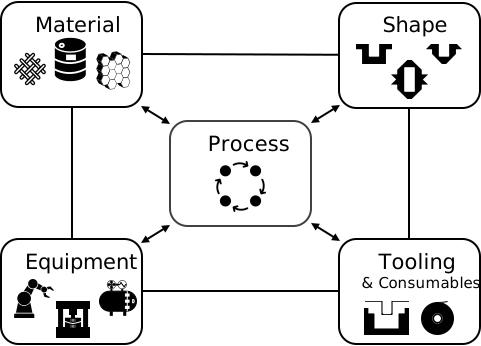
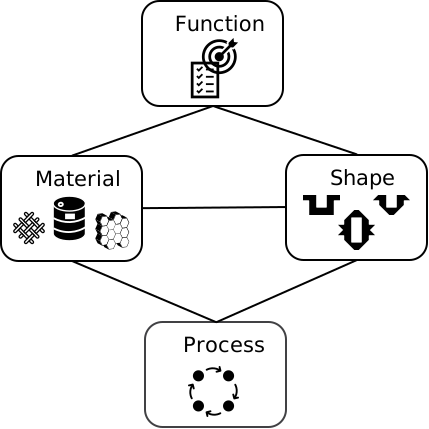
Interrelationship of Function, Shape, Material & Process
Design for manufacturing is critical to ensuring the producibility of a part. Trouble arises when it is considered too late or not at all in the design process. Conversely, process design (controlling the interactions between shape, material, tooling & consumables and equipment to achieve a desired outcome) must always consider the shape and material of the part. Ashby has developed and popularized the approach linking design (function) to the choice of material and shape, which influence the process selected and vice versa, as shown below:
Within the Knowledge in Practice Centre the same methodology is applied but the process is more fully defined by also explicitly calling out the equipment and tooling & consumables. Note that in common usage, a process which consists of many steps can be arbitrarily defined by just one step, e.g. "spray-up". Though convenient, this can be misleading.

Workflows
The KPC's Practice and Case Study volumes consist of three types of workflows:
- Development - Analyzing the interactions between MSTE in the process steps to make decisions on processing parameters and understanding how the process steps and factory cells fit within the factory.
- Troubleshooting - Guiding you to possible causes of processing issues affecting either cost, rate or quality and directing you to the most appropriate development workflow to improve the process
- Optimization - An expansion on the development workflows where a larger number of options are considered to achieve the best mixture of cost, rate & quality for your application.
To use this website, you must agree to our Terms and Conditions and Privacy Policy.
By clicking "I Accept" below, you confirm that you have read, understood, and accepted our Terms and Conditions and Privacy Policy.

