
Reference - Composite structures with embedded fiber optic sensors: A smart propellant tank for future spacecraft applications
| Type | Journal |
|---|---|
| Title | Composite structures with embedded fiber optic sensors: A smart propellant tank for future spacecraft applications |
| Abstract | Modern spacecraft and launch vehicle design is more oriented towards reducing system-level design and assembly complexities. In order to maintain high overall system performance while reducing these complexities, the use of smart materials and smart structural components is a well-known practice and is currently of rising interest to space systems' designers. The paper discusses a concept of smart space structures, in particular, a carbon fiber composites structure embedded with Optical Fiber Sensors (OFS) for spacecraft and launch vehicle applications. This study highlights the operational requirements for such tank and the smart features enabled by the optical fiber sensors. For the latter aspect, a quantitative comparison between Fiber Bragg Grating sensors (FBGs) and Distributed Optical Fiber Sensors (DOFS) based on Optical Frequency Domain Reflectometry (OFDR) is presented to state their core performance parameters, such as the sensitivity, sensing range, dynamic measurement capability, and spatial resolution. The increased performance and reliability in harsh environments associated with fiber optic sensors come with a reduction in size, mass, and power consumption compared to the conventional electronic sensors. Optical fiber sensors embedded in carbon fiber structures have proven their capability in providing accurate real-time measurements of temperature and monitoring structural integrity while detecting precisely possible points of rupture and failure as discussed and demonstrated in the literature review. The applications of fiber optic sensing in smart propellant tanks may extend to detecting fluid leakage, also providing increased precision in propellant gauging through temperature mapping, and can be used in on-ground qualification, pre-flight testing, as well as in-orbit operation, condition, and structural health monitoring. The article presents a statement for an optimal FOS embedding approach in composite pressure vessels and discusses the related placement and orientation method for the fiber optic sensors, coupled with a one component simplified analytical stress-strain transfer model deriving the stress component along the maximum principal direction (i.e., σMaxPrincipal). The novel approach is believed to serve the optimal employment of embedded FOS in composite structures, e.g., pressure vessels and light-weight structures in spacecraft, among other applications. The simplified model is believed to pave the way for effective data interpretation and processing, utilizing the available limited computational resources on-board the spacecraft. |
| Accessed | 2026-03-16 |
| Authors |
|
| Date | 2024-10-1 |
| Issue | 6 |
| Pages | 144-158 |
| Publisher | Pergamon |
| Journal | Acta Astronautica |
| Volume | 223 |
| Websites | |
| DOI | 10.1016/j.actaastro.2024.06.040 |
| ISSN | 00945765 |
| Keywords | Advanced space systems, Optical fiber sensors, Rocket propulsion systems, Smart structures, Structural health monitoring |

Welcome
Welcome to the CKN Knowledge in Practice Centre (KPC). The KPC is a resource for learning and applying scientific knowledge to the practice of composites manufacturing. As you navigate around the KPC, refer back to the information on this right-hand pane as a resource for understanding the intricacies of composites processing and why the KPC is laid out in the way that it is. The following video explains the KPC approach:
Understanding Composites Processing
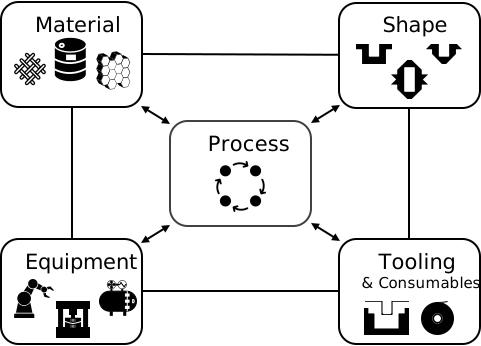
The Knowledge in Practice Centre (KPC) is centered around a structured method of thinking about composite material manufacturing. From the top down, the heirarchy consists of:
- The factory
- Factory cells and/or the factory layout
- Process steps (embodied in the factory process flow) consisting of:
The way that the material, shape, tooling & consumables and equipment (abbreviated as MSTE) interact with each other during a process step is critical to the outcome of the manufacturing step, and ultimately critical to the quality of the finished part. The interactions between MSTE during a process step can be numerous and complex, but the Knowledge in Practice Centre aims to make you aware of these interactions, understand how one parameter affects another, and understand how to analyze the problem using a systems based approach. Using this approach, the factory can then be developed with a complete understanding and control of all interactions.
Interrelationship of Function, Shape, Material & Process
Design for manufacturing is critical to ensuring the producibility of a part. Trouble arises when it is considered too late or not at all in the design process. Conversely, process design (controlling the interactions between shape, material, tooling & consumables and equipment to achieve a desired outcome) must always consider the shape and material of the part. Ashby has developed and popularized the approach linking design (function) to the choice of material and shape, which influence the process selected and vice versa, as shown below:
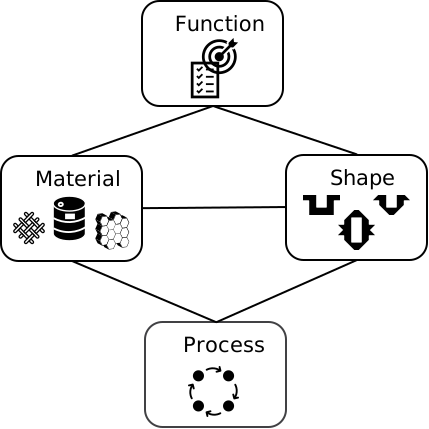
Within the Knowledge in Practice Centre the same methodology is applied but the process is more fully defined by also explicitly calling out the equipment and tooling & consumables. Note that in common usage, a process which consists of many steps can be arbitrarily defined by just one step, e.g. "spray-up". Though convenient, this can be misleading.

Workflows
The KPC's Practice and Case Study volumes consist of three types of workflows:
- Development - Analyzing the interactions between MSTE in the process steps to make decisions on processing parameters and understanding how the process steps and factory cells fit within the factory.
- Troubleshooting - Guiding you to possible causes of processing issues affecting either cost, rate or quality and directing you to the most appropriate development workflow to improve the process
- Optimization - An expansion on the development workflows where a larger number of options are considered to achieve the best mixture of cost, rate & quality for your application.
To use this website, you must agree to our Terms and Conditions and Privacy Policy.
By clicking "I Accept" below, you confirm that you have read, understood, and accepted our Terms and Conditions and Privacy Policy.

