
Testing and quality control in filament-wound composites - A425
| Testing and quality control in filament-wound composites | |
|---|---|
| Document Type | Article |
| Document Identifier | 425 |
| Tags | |
| Prerequisites | |
Introduction[edit | edit source]
Because Filament Winding (FW) components are often pressure-bearing and safety-critical (e.g., pressure vessels, piping, drive shafts), robust testing and inspection are essential. This article summarizes recognized test standards and quality-control approaches for filament-wound parts, highlighting practical methods for verifying structural integrity and compliance with design specifications.
Significance[edit | edit source]
The article categorizes testing into destructive and non-destructive methods. Mechanical evaluations include hoop and axial tensile tests, burst and proof-pressure tests, interlaminar shear strength, and fatigue assessment. Non-destructive evaluation (NDE) methods, such as ultrasonic inspection, acoustic emission monitoring, X-ray computed tomography, and thermography, are discussed with emphasis on defect detection (voids, delamination, fiber misalignment). Dimensional checks such as roundness, thickness variation, and surface finish are addressed alongside statistical process control and documentation practices. The article references relevant ASTM and ISO standards, linking each to its typical application. An additional section introduces digital quality monitoring, including sensor integration, in-situ tension tracking, and AI-assisted data analysis for real-time feedback.
Scope[edit | edit source]
Readers learn how to establish quality protocols that ensure filament-wound components meet performance and safety targets. The article provides decision guidance on selecting test methods based on product geometry and criticality, reinforcing the link between testing, certification, and continuous improvement.
Classification of Testing Approaches for Filament-Wound Structures[edit | edit source]
Testing and inspection of filament-wound composite structures are consistently divided into destructive and non-destructive approaches, reflecting their distinct roles in qualification and quality assurance. Destructive testing establishes, e.g., ultimate strength, failure modes, and damage tolerance limits, which are critical for certification and design validation. Non-destructive evaluation (NDE), by contrast, is aimed at identifying manufacturing-induced defects, monitoring damage evolution, and verifying structural integrity without compromising the component's usability.[1][2] For pressure vessels and piping, these two approaches are complementary and are typically applied sequentially or in parallel throughout the manufacturing and qualification lifecycle.
Destructive Mechanical Testing Methods[edit | edit source]
Pressure, Tensile, and Structural Performance Tests[edit | edit source]
Destructive mechanical testing of filament-wound composites includes hoop tensile tests, axial tensile tests, burst pressure tests, and proof-pressure tests, each targeting specific aspects of structural response. Hoop and axial tensile tests isolate directional stiffness and strength contributions associated with winding angle and fiber orientation. The typically cylindrical geometry of filament-wound components may pose challenges, as part curvature can limit the fabrication of common specimen types, such as dogbone tensile specimens. Consequently, burst pressure testing is a widely used approach to evaluate the combined response of the laminate under internal pressure, revealing catastrophic failure mechanisms such as fiber rupture, matrix cracking, and delamination propagation.[1] These tests are also effective in assessing the influence of localized damage, such as low-velocity impact, on residual strength in composite overwrapped pressure vessels. Proof-pressure testing, conducted at pressures below burst levels, serves as a structural integrity verification step and is widely prescribed in ASTM standards for filament-wound pipes and vessels.[3][4]
Interlaminar Shear and Fatigue Testing[edit | edit source]
Interlaminar shear strength (ILSS) testing using short beam specimens provides a direct measure of the quality of bonding between adjacent layers formed during FW. Because ILSS is sensitive to void content, resin-rich or resin-starved regions, and incomplete consolidation, it is frequently used to evaluate the effects of winding tension, resin impregnation, and cure quality. Notably, it is permissible to use curved laminates as short beam specimens. Fatigue testing, often performed under cyclic pressure rather than mechanical loading, assesses stiffness degradation and progressive damage accumulation, which are critical considerations for pressure vessels subjected to repeated service cycles.[1]
Non-Destructive Evaluation (NDE) Techniques[edit | edit source]
Ultrasonic Inspection and Associated Defect Types[edit | edit source]
Ultrasonic inspection is among the most widely applied NDE methods for filament-wound composites, capable of detecting voids, delaminations, and fiber misalignment through pulse-echo or through-transmission configurations.[2]
Acoustic Emission Monitoring and Damage Mechanisms[edit | edit source]
Acoustic emission (AE) monitoring is used to detect active damage mechanisms rather than pre-existing defects. AE signals are generated by events such as matrix microcracking, fiber-matrix debonding, delamination growth, and fiber fracture during mechanical or pressure loading. AE is valuable during proof-pressure and burst testing, as it enables correlation between load levels and the onset of specific damage mechanisms.[2] In filament-wound structures, AE monitoring can therefore be used to identify critical damage thresholds and to distinguish between benign manufacturing defects and damage that actively propagates under load.
X-ray Computed Tomography and Internal Architecture Defects[edit | edit source]
X-ray computed tomography (CT) provides three-dimensional visualization of internal laminate architecture and is capable of resolving porosity distribution, fiber waviness, fiber misalignment, and local resin-rich regions. CT is a validation tool for characterizing complex internal features that are difficult to detect using conventional ultrasonic methods.[2] Although its application is generally limited to laboratory-scale components, CT is used to benchmark manufacturing quality and to validate damage observations from destructive testing.
Infrared Thermography and Near-Surface Defects[edit | edit source]
Infrared thermography is primarily sensitive to near-surface defects and subsurface delaminations, which alter local heat flow and thermal diffusivity. Thermographic methods are particularly effective for rapid inspection over large surface areas, making them suitable for cylindrical filament-wound shells.[2] Active thermography, in which an external heat source is applied, enhances defect detectability and is commonly used to screen for delamination and debonding in composite structures.
Dimensional Inspection and Process Control[edit | edit source]
Dimensional inspection complements mechanical testing and NDE methods by verifying geometric conformity. Measurements of roundness, wall thickness variation, and surface finish are essential for ensuring that filament-wound components meet design tolerances and performance expectations. Variations in thickness or roundness can indicate inconsistencies in winding tension, fiber placement accuracy, or mandrel alignment, all of which can influence mechanical performance.[3][4] Packaging and handling of filament-wound products also follow standardized requirements to preserve structural integrity during transport.[5] ASTM standards emphasize the use of statistical process control (SPC) and detailed documentation to track manufacturing variability and ensure traceability. These practices support correlation between process parameters and observed defects or performance deviations, reinforcing quality assurance frameworks for filament-wound products.
Standards Governing Testing and Manufacturing Practices[edit | edit source]
ASTM and ISO standards provide structured guidance linking test methods to specific applications. ASTM D2996[3] and ASTM D3299[4] define requirements for filament-wound pipes and corrosion-resistant tanks, including pressure testing, dimensional inspection, and documentation. ASTM D4018[6] supports raw material qualification by standardizing testing of continuous filament carbon and graphite fiber tows. ISO 1268-5[7] specifies procedures for producing filament-wound test plates, enabling consistent mechanical characterization. Together, these standards ensure that destructive testing, NDE, and dimensional inspection are applied in a coherent and reproducible manner.
Digital and Intelligent Quality Monitoring in Filament Winding[edit | edit source]
Robotic and advanced winding machines incorporate in-situ tension sensors, process parameter logging, and real-time feedback control, enabling tighter control over fiber placement and resin distribution.[8][9] These systems reduce variability associated with manual or semi-automated processes, particularly for complex geometries. The application of AI and machine learning to FW and composite manufacturing is discussed as a means of analyzing large datasets generated during production and inspection. Machine learning techniques are used to identify patterns associated with defects, predict quality outcomes, and support process optimization.[10][11] These digital approaches are presented as enhancements to established testing and standards-based frameworks, strengthening real-time decision-making and quality assurance rather than replacing conventional qualification methods.
References
- ↑ 1.0 1.1 1.2 Long, B.; Yang, N.; Cao, X. (2022). "Low-velocity impact damages of filament-wound composite overwrapped pressure vessel (COPV)". Journal of Engineered Fibers and Fabrics. 17: 1–16. doi:10.1177/15589250221088895.
- ↑ 2.0 2.1 2.2 2.3 2.4 Wang, B.; Zhong, S.; Lee, T.-L.; Fancey, K. S.; Mi, J. (2020). "Non-destructive testing and evaluation of composite materials/structures: A state-of-the-art review". Advances in Mechanical Engineering. 12 (4): 1–28. doi:10.1177/1687814020913761.
- ↑ 3.0 3.1 3.2 Standard Specification for Filament-Wound "Fiberglass" (Glass-Fiber-Reinforced Thermosetting-Resin) Pipe. ASTM D2996−23. West Conshohocken, PA, USA: ASTM International. 2023.
- ↑ 4.0 4.1 4.2 Standard Specification for Filament-Wound Glass-Fiber-Reinforced Thermoset Resin Corrosion-Resistant Tanks. ASTM D3299−24. West Conshohocken, PA, USA: ASTM International. 2024.
- ↑ Standard Specification for Pressure-Sensitive Tape for Packaging, Filament-Reinforced. ASTM D5330/D5330M−06. West Conshohocken, PA, USA: ASTM International. 2023.
- ↑ Standard Test Methods for Properties of Continuous Filament Carbon and Graphite Fiber Tows. ASTM D4018−23. West Conshohocken, PA, USA: ASTM International. 2023.
- ↑ Fibre-reinforced plastics – Methods of producing test plates – Part 5: Filament winding. ISO 1268-5. Geneva, Switzerland: ISO International. 2001.
- ↑ Sorrentino, L.; Anamateros, E.; Bellini, C.; Carrino, L.; Corcione, G.; Leone, A.; Paris, G. (2019). "Robotic filament winding: An innovative technology to manufacture complex shape structural parts". Composite Structures. 220: 699–707. doi:10.1016/j.compstruct.2019.04.055.
- ↑ Quanjin, M.; Rejab, M.R.M.; Kumar, N. M.; Idris, M.S. (2019). "Experimental assessment of the 3-axis filament winding machine performance". Results in Engineering. 2: 100017. doi:10.1016/j.rineng.2019.100017.
- ↑ Wang, Y.; Wang, K.; Zhang, Ch. (2024). "Applications of artificial intelligence/machine learning to high-performance composites". Composites Part B. 285: 111740. doi:10.1016/j.compositesb.2024.111740.
- ↑ Ma, Q.; Rejab, M.R.M.; Azeem, M.; Hassan, S. A.; Yang, B.; Kumar, A. P. (2024). "Opportunities and challenges on composite pressure vessels (CPVs) from advanced filament winding machinery: A short communication". International Journal of Hydrogen Energy. 57: 1364–1372. doi:10.1016/j.ijhydene.2024.01.133.

Welcome
Welcome to the CKN Knowledge in Practice Centre (KPC). The KPC is a resource for learning and applying scientific knowledge to the practice of composites manufacturing. As you navigate around the KPC, refer back to the information on this right-hand pane as a resource for understanding the intricacies of composites processing and why the KPC is laid out in the way that it is. The following video explains the KPC approach:
Understanding Composites Processing
The Knowledge in Practice Centre (KPC) is centered around a structured method of thinking about composite material manufacturing. From the top down, the heirarchy consists of:
- The factory
- Factory cells and/or the factory layout
- Process steps (embodied in the factory process flow) consisting of:
The way that the material, shape, tooling & consumables and equipment (abbreviated as MSTE) interact with each other during a process step is critical to the outcome of the manufacturing step, and ultimately critical to the quality of the finished part. The interactions between MSTE during a process step can be numerous and complex, but the Knowledge in Practice Centre aims to make you aware of these interactions, understand how one parameter affects another, and understand how to analyze the problem using a systems based approach. Using this approach, the factory can then be developed with a complete understanding and control of all interactions.
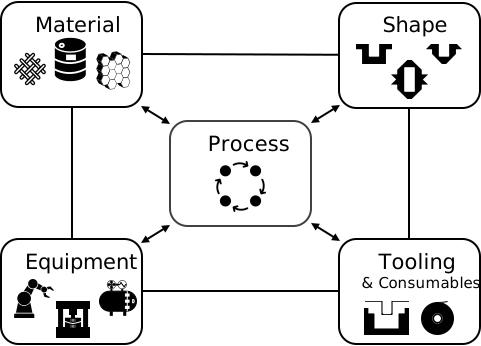
Interrelationship of Function, Shape, Material & Process
Design for manufacturing is critical to ensuring the producibility of a part. Trouble arises when it is considered too late or not at all in the design process. Conversely, process design (controlling the interactions between shape, material, tooling & consumables and equipment to achieve a desired outcome) must always consider the shape and material of the part. Ashby has developed and popularized the approach linking design (function) to the choice of material and shape, which influence the process selected and vice versa, as shown below:
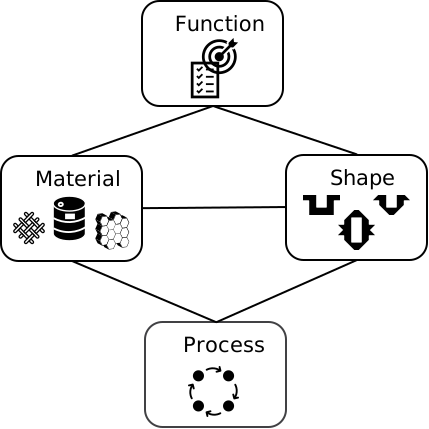
Within the Knowledge in Practice Centre the same methodology is applied but the process is more fully defined by also explicitly calling out the equipment and tooling & consumables. Note that in common usage, a process which consists of many steps can be arbitrarily defined by just one step, e.g. "spray-up". Though convenient, this can be misleading.

Workflows
The KPC's Practice and Case Study volumes consist of three types of workflows:
- Development - Analyzing the interactions between MSTE in the process steps to make decisions on processing parameters and understanding how the process steps and factory cells fit within the factory.
- Troubleshooting - Guiding you to possible causes of processing issues affecting either cost, rate or quality and directing you to the most appropriate development workflow to improve the process
- Optimization - An expansion on the development workflows where a larger number of options are considered to achieve the best mixture of cost, rate & quality for your application.
To use this website, you must agree to our Terms and Conditions and Privacy Policy.
By clicking "I Accept" below, you confirm that you have read, understood, and accepted our Terms and Conditions and Privacy Policy.

