
Hydrothermal Aging of Fibers and Polymers - Mechanisms and Experimental Insights - C130
| Hydrothermal Aging of Fibers and Polymers - Mechanisms and Experimental Insights | |||||||
|---|---|---|---|---|---|---|---|

| |||||||
| Document Type | Case study | ||||||
| Document Identifier | 130 | ||||||
| Themes | |||||||
| Tags | |||||||
| Objective functions |
| ||||||
| MSTE workflow | Development | ||||||
Introduction[edit | edit source]
The aging process in fiber and polymer materials occurs by different factors, as it is mentioned in previous articles. Therefore, this article enters in the same area as Aging mechanisms in fibers and polymer materials - A427. In the case of this article, detail study cases are given for fully understanding in the process of choosing the suitable experimental method for evaluating aging effects. Therefore, prior to the selection of any material systems, it is crucial to identify, evaluate, and validate the constituent materials for their compatibility with the service conditions in demanding settings. Analyses can be performed utilizing accelerated aging procedures to replicate long-term effects.
Significance[edit | edit source]
As it was mentioned in Aging mechanisms in fibers and polymer materials - A427, understanding material aging is essential for readers because it directly affects the performance, safety, and reliability of products over time. Therefore, to give practical context with high quality experimental and theoretical methodology to the end-users, it is a crucial and important step to the readers to plan every step in their investigation by making informed decisions in every step of the experimental process, thus, as it was mentioned in the previous articles, helping to ensure cost-effective, durable, and safe designs in future structures or composite materials.
Scope[edit | edit source]
To give practical context of the previous theoretical parts to the end-users, this document explores some case studies on hydrothermal aging of fibers (i.e. glass, carbon or basalt fiber) up to 82 °C[1][2] and thermoplastics in aging fluids at elevated temperatures up to 95 °C[3].
Background[edit | edit source]
The durability of structural materials in humid and aqueous environments is a critical factor for engineering design across multiple industries, including energy, offshore, transportation, and civil infrastructure. While fiber-reinforced polymer composites (FRPCs) have widely been studied, there is increasing recognition that the individual constituents, fibers and thermoplastic matrices, must be examined independently to truly understand environmental degradation mechanisms. Fibers such as E-glass, carbon, and basalt are primary load-bearing reinforcements, while thermoplastics including polypropylene (PP), polyphenylene sulfide (PPS), and polyvinylidene fluoride (PVDF) serve as matrices or stand-alone materials in demanding service environments.
Hydrothermal aging, caused by the combined action of moisture and elevated temperature, is one of the most aggressive degradation mechanisms for both fibers and thermoplastics. It involves water absorption, plasticization, leaching of chemical species, hydrolysis of polymer chains, and microstructural changes that collectively reduce tensile strength, stiffness, and toughness. Understanding these processes is essential for accurate service-life predictions, the development of accelerated testing protocols, and the design of reliable structures[1][2][3][4][5][6][7][8]. This article synthesizes insights from three different scenarios on E-glass fibers under hydrothermal exposure[1], on carbon and basalt fibers exposed to hot water and humidity[2], and on a broad suite of thermoplastics tested with in situ punch-shear under hydrothermal conditions[3]. Together, these works provide a holistic view of hydrothermal aging for fiber and polymer constituents, establishing a knowledge base for reliability assessment and material selection in engineering applications.
Hydrothermal Aging of Fibers[edit | edit source]
E-glass fibers: dissolution and strength loss[edit | edit source]
E-glass is the most commonly used fiber reinforcement, accounting for over 95% of global composite production. Its silica-rich composition makes it vulnerable to hydrolytic attack, especially when exposed directly to water at elevated temperatures. E-glass fibers exposed to water at 60 °C, 71 °C, and 82 °C suffered of tensile strength degradation and surface morphology changes. As shown in Figure 1, the strength values dropped by 62% and 55% (tested in wet conditions) and 45% and 32% (tested in dry conditions) for fibers aged at 71 °C and 60 °C for 840 h (5 weeks), respectively. Similarly, when the drop-in strength values are compared for fibers aged at 82 °C, 71 °C, and 60 °C for 168 h (1 week), the reductions were 49%, 41%, 33% (wet conditions), and 32%, 23%, and 12% (dry conditions), respectively. The error bars represent one standard deviation from the mean values. Distinct differences in strength retention values were observed between ‘wet’ and ‘dry’ samples, that is, the ‘wet’ samples exhibited lower mechanical strengths compared to the ‘dry’ samples. It is hypothesized that water between the filaments acts like a lubricant when fibers are tested wet, which largely negates any load sharing between filaments. When tested dry, friction between fibers promotes load sharing between filaments and thus greater fiber strength, which is similar to filaments being embedded in a polymer matrix, but to a much lesser extent.
Some interesting facts about hydrothermal aging of E-glass fibers are explained as follows:
Mechanisms of degradation: FTIR analysis and mass dissolution studies show hydroxyl ions attack the SiO2 network, releasing ions such as Na, Ca, Mg, and Si. Scanning electron microscopy (SEM) images reveal surface pitting and microcracks, confirming chemical corrosion as the main driver of strength loss. More information is available in[1].
Note: Detailed information about predictive modeling frameworks using Arrhenius modeling for glass fibers can be found in[1]. Predictive modeling frameworks provide engineers with tools for estimating service life, reducing reliance on costly long-term testing.

Basalt and carbon fibers: comparative performance[edit | edit source]
Basalt and carbon fibers offer higher stiffness and corrosion resistance compared to glass fibers, but their durability under humid environments requires careful study. Basalt and carbon fibers were examined by immersion in water at 60 °C, 71 °C, and 82 °C, as well as under 90% relative humidity at 90 °C. Strength retention at 60 °C (Figure 2a) was higher than at 71 °C (Figure 2b), showing that retention declines significantly under higher temperature conditions. The most pronounced reduction occurred for basalt fibers aged at 82 °C for 28 days (Figure 3c), in which strength drops by 82% in the wet conditions and 84% after drying. For samples aged 7 days and tested after drying, strength losses are 9%, 17%, and 47% at 60 °C, 71 °C, and 82 °C, respectively. These results demonstrate a consistent decrease in strength with increasing aging temperature and duration. Exposure at 82 °C proves most damaging, as strength declines by 37% (dry condition) after only 3 days of water immersion.

Unlike basalt, carbon fibers retain their mechanical properties much more effectively across all three aging temperatures. Nevertheless, as illustrated in Figure 3a, strength retention at 60 °C was greater than at 71 °C (Figure 3b), a trend also observed in basalt fibers but to a milder extent under hydrothermal aging. The greatest decline occurs at 82 °C after 35 days of exposure (Figure 3c), in which carbon fibers lost about 26% of their strength in wet testing and 25% after drying. For basalt fibers, the corresponding loss is nearly three times higher. Similarly, carbon fibers samples aged for 7 days at 60 °C, 71 °C, and 82 °C show strength reductions of 6%, 11%, and 20% after drying, respectively. Overall, the data indicate that higher aging temperatures led to progressively greater decreases in strength.

Figure 4 illustrates the strength retention of basalt and carbon fibers after exposure to 90 °C and 90% relative humidity, with testing conducted immediately upon removal from the aging environment. The error bars represent one standard deviation from the mean. After 28 days of aging, carbon fibers show a slight reduction in strength of about 5.5%, whereas basalt fibers demonstrate a modest improvement of roughly 9%. These results indicate that basalt fibers remain largely unaffected by the elevated temperature and humidity, while carbon fibers undergo a minor loss in strength. The exact cause of this reduction is uncertain, though it may be linked to fatigue or stress corrosion induced by continuous humid air circulation and fiber agitation in the environmental chamber. Moreover, unlike hydrothermal aging, where only the gauge length is immersed, the humidity exposure affects the entire fiber length, possibly leading to additional weakening and premature damage during mounting in the grips. Nonetheless, the observed decline in carbon fibers strength is far less severe than under hydrothermal conditions, reinforcing the view that hydrolysis is the primary mechanism driving the more significant losses seen in such environments

Some interesting facts about hydrothermal aging of basalt and carbon fibers are explained as follows:
- Basalt fibers are more vulnerable, with pronounced strength reductions due to silicate composition.
- Carbon fibers are more resistant to hydrolysis, but surface sizing degradation and microcracking is observed.
- Humidity exposure: Vapor-phase moisture is also detrimental, inducing plasticization and microstructural changes comparable to direct immersion.
- In general, hydrothermal exposure is universally detrimental, but severity depends on fiber chemistry.
Note: As previously mentioned for glass fibers, detailed information about predictive modeling frameworks using Arrhenius modeling for basalt and carbon fibers can be found in[2].
Hydrothermal Aging of Thermoplastic Polymers[edit | edit source]
Water Uptake, Plasticization, and Chain Scission[edit | edit source]
Unlike thermosets, which are crosslinked and relatively water-resistant, thermoplastics typically absorb moisture more readily. Hydrothermal exposure induces plasticization, whereby absorbed water increases free volume, lowering stiffness and strength[3][4][5][6][7]. A broad suite of thermoplastics (high-density polyethylene (HDPE), polypropylene (PP), polyphenylene sulfide (PPS), polyvinylidene fluoride (PVDF), polyamide-6 (PA6), polyamide-12 (PA12), ethylene-vinyl alcohol copolymer (EVOH)) were investigated subjecting them to immersion in deionized (DI) water at 95 °C until saturation. A novel in situ punch–shear device enables direct mechanical testing under immersion, avoiding misleading results. Tensile testing was also evaluated to correlate yield and modulus.
To evaluate how water absorption influences mechanical property measurements, two representative polymers were selected from the midrange of their respective categories: (i) PA6, which shows significant absorption, and (ii) PVDF, which displays only slight but noticeable absorption. The results are presented in Figure 5 as horizontal bar graphs, designed to highlight consistent testing conditions. Along the vertical axis, the measurement temperature and treatment code are indicated for clarity. Within each panel, solid bars on the left represent punch-shear measurements, while the corresponding tensile results are shown as hatched bars on the right; separate panels display modulus and yield data. Bars extending from the mirrored horizontal axis depict absolute values, whereas relative percentages, normalized against pristine conditions at 23 °C, are labeled directly next to their respective bars.

Thermoplastics exhibited a wide spectrum of hydrothermal durability, and their performance under combined heat and moisture exposure is strongly dependent on their chemical structure and polarity. Some key factors are discussed as follows:
- PP and HDPE generally show very low water absorption due to their nonpolar molecular backbone. This makes them resistant to swelling and hydrolysis. However, their long-term stability is compromised by oxidative degradation, particularly at elevated temperatures, where oxygen and moisture can accelerate chain scission and embrittlement.
- Polyamides, by contrast, are highly hygroscopic because of the presence of amide groups that readily form hydrogen bonds with water. Moisture uptake in polyamides leads to plasticization, dimensional instability, and reductions in stiffness. Extended hydrothermal exposure, however, promotes hydrolysis, which progressively weakens the polymer chains.
- High-performance thermoplastics like PPS and PVDF stand out for their superior stability. PPS is inherently resistant to both moisture and oxidative attack due to its aromatic, highly crystalline structure, while PVDF combines low water absorption with excellent chemical and thermal resistance. These attributes make them particularly suitable for demanding environments such as marine and chemical processing applications.
- EVOH, on the other hand, represents the opposite extreme: It is extremely moisture-sensitive because of its high content of hydroxyl groups. Even modest humidity levels can drastically reduce its barrier properties and mechanical integrity, limiting its use in high-humidity environments unless adequately protected by multilayer structures or coatings.
These differences highlight that hydrothermal performance in thermoplastics cannot be generalized but must be evaluated case by case, with attention to molecular structure, polarity, and potential degradation pathways.
Comparative Analysis: Fibers vs. Thermoplastics[edit | edit source]
Common Mechanisms[edit | edit source]
Under hydrothermal aging, both fibers and thermoplastics are subjected to a set of overlapping degradation mechanisms that progressively compromise their structural integrity. A primary process is plasticization, in which absorbed water molecules act as a temporary plasticizer, reducing stiffness and strength by increasing chain mobility in polymers or weakening interfacial bonds in fibers. Leaching of low-molecular-weight species, additives, or sizing agents further accelerates property loss, especially when the surrounding water is continuously refreshed. Additionally, surface degradation is a recurring phenomenon: SEM frequently reveals the formation of microcracks, pits, and cavities, while Fourier-transform infrared spectroscopy (FTIR) detects chemical shifts associated with hydrolysis, oxidation, or the removal of functional groups. Together, these findings point to a common pattern of structural and chemical deterioration, even though the severity and reversibility differ between fibers and thermoplastics.
Distinctive Behaviors[edit | edit source]
Despite the shared mechanisms, fibers and thermoplastics exhibit distinctive hydrothermal aging pathways dictated by their composition.
Fibers:
- Glass and basalt fibers primarily degrade through dissolution, where silica-rich phases are gradually leached into water, reducing fiber strength and creating surface flaws that act as crack initiation sites.
- Carbon fibers are chemically more stable but depend heavily on the integrity of their surface sizing. Hydrothermal exposure can degrade the sizing layer, leading to loss of interfacial adhesion with the matrix in composite applications, even if the carbon filaments themselves remain intact.
Thermoplastics:
- Polymers experience water absorption, which varies with polarity and crystallinity. Hydrophilic polymers like polyamides (PA6, PA12) show significant uptake, while hydrophobic systems such as PPS or PVDF absorb far less.
- Prolonged exposure can induce chain scission, particularly in polymers susceptible to hydrolysis, such as EVOH or polyesters. This results in permanent loss of molecular weight, embrittlement, and dimensional instability.
Material selection[edit | edit source]
From a design perspective, the implications of hydrothermal aging are highly material-specific:
- Glass and basalt fibers should generally be avoided in applications involving direct or prolonged water contact unless protected by barrier coatings or hydrophobic treatments. Their dissolution-driven strength loss is difficult to arrest once initiated.
- Carbon fibers, owing to their chemical inertness, are preferable in humid environments, provided that durable and hydrothermally stable sizing systems are employed to maintain interfacial strength.
- Thermoplastics show a broad range of suitability. High-performance polymers such as PPS and PVDF stand out as top candidates for hydrothermal durability due to their low water uptake and chemical resistance. In contrast, polyamides (PA6, PA12) and EVOH are unsuitable for hydrothermal environments, as they suffer severe plasticization, swelling, and irreversible hydrolysis.
In practice, the careful matching of fiber or polymer chemistry with environmental exposure conditions is critical to ensuring long-term reliability. Hydrothermal aging data provide engineers with essential guidance for material selection, structural design, and service-life estimation in demanding applications such as marine, offshore, and chemical-processing systems.
Related pages[edit | edit source]
- Aging mechanisms in fibers and polymer materials - A427
- A429
- Experimental characterization for aging effects of polymers and fibers, and material selection for environmental performance - P178
Related pages
References
- ↑ 1.0 1.1 1.2 1.3 1.4 [Ref] Empty citation (help)
- ↑ 2.0 2.1 2.2 2.3 [Ref] Empty citation (help)
- ↑ 3.0 3.1 3.2 3.3 [Ref] Empty citation (help)
- ↑ 4.0 4.1 [Ref] Empty citation (help)
- ↑ 5.0 5.1 [Ref] Empty citation (help)
- ↑ 6.0 6.1 [Ref] Empty citation (help)
- ↑ 7.0 7.1 [Ref] Empty citation (help)
- ↑ [Ref] Empty citation (help)
 |
 |
| About | Help |

Welcome
Welcome to the CKN Knowledge in Practice Centre (KPC). The KPC is a resource for learning and applying scientific knowledge to the practice of composites manufacturing. As you navigate around the KPC, refer back to the information on this right-hand pane as a resource for understanding the intricacies of composites processing and why the KPC is laid out in the way that it is. The following video explains the KPC approach:
Understanding Composites Processing
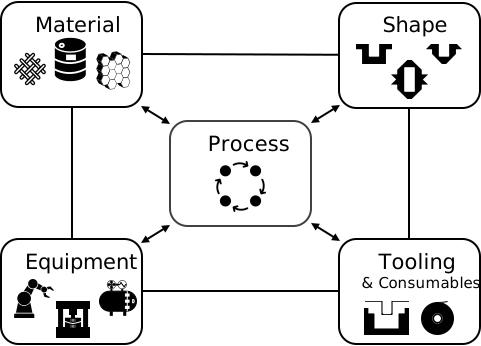
The Knowledge in Practice Centre (KPC) is centered around a structured method of thinking about composite material manufacturing. From the top down, the heirarchy consists of:
- The factory
- Factory cells and/or the factory layout
- Process steps (embodied in the factory process flow) consisting of:
The way that the material, shape, tooling & consumables and equipment (abbreviated as MSTE) interact with each other during a process step is critical to the outcome of the manufacturing step, and ultimately critical to the quality of the finished part. The interactions between MSTE during a process step can be numerous and complex, but the Knowledge in Practice Centre aims to make you aware of these interactions, understand how one parameter affects another, and understand how to analyze the problem using a systems based approach. Using this approach, the factory can then be developed with a complete understanding and control of all interactions.
Interrelationship of Function, Shape, Material & Process
Design for manufacturing is critical to ensuring the producibility of a part. Trouble arises when it is considered too late or not at all in the design process. Conversely, process design (controlling the interactions between shape, material, tooling & consumables and equipment to achieve a desired outcome) must always consider the shape and material of the part. Ashby has developed and popularized the approach linking design (function) to the choice of material and shape, which influence the process selected and vice versa, as shown below:
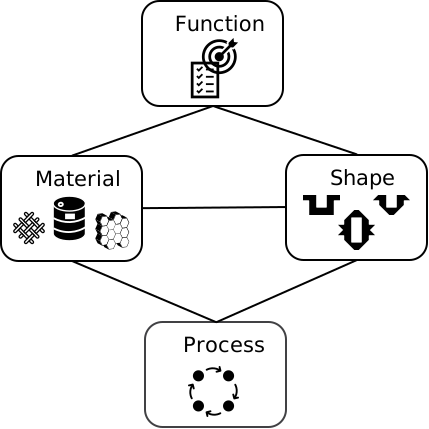
Within the Knowledge in Practice Centre the same methodology is applied but the process is more fully defined by also explicitly calling out the equipment and tooling & consumables. Note that in common usage, a process which consists of many steps can be arbitrarily defined by just one step, e.g. "spray-up". Though convenient, this can be misleading.

Workflows
The KPC's Practice and Case Study volumes consist of three types of workflows:
- Development - Analyzing the interactions between MSTE in the process steps to make decisions on processing parameters and understanding how the process steps and factory cells fit within the factory.
- Troubleshooting - Guiding you to possible causes of processing issues affecting either cost, rate or quality and directing you to the most appropriate development workflow to improve the process
- Optimization - An expansion on the development workflows where a larger number of options are considered to achieve the best mixture of cost, rate & quality for your application.
To use this website, you must agree to our Terms and Conditions and Privacy Policy.
By clicking "I Accept" below, you confirm that you have read, understood, and accepted our Terms and Conditions and Privacy Policy.

