
Out of Autoclave processing - A430
| Out of Autoclave processing | |
|---|---|
| Document Type | Article |
| Document Identifier | 430 |
| Prerequisites |
|
Introduction[edit | edit source]
Out-of-autoclave (OOA) prepreg processing involves curing pre-impregnated materials using a vacuum and oven only. It allows to achieve high performance composite parts by applying 0.1 MPa pressure from vacuum bag, in contrast to autoclave process, which applies 0.3 to 0.8 MPa of external consolidation pressure[1].
In OOA process, aerospace-grade performance is achieved with optimized prepregging process (ensuring proper fiber impregnation with resin) and controlled consolidation process conditions (ensuring no defects are formed).
OOA systems have demonstrated autoclave-equivalent porosity and mechanical standards under controlled processing. Adoption is driven by cost reduction, accessibility and scalability to very large structures.
Significance[edit | edit source]
In practice, OOA has made composite part manufacturing more accessible and initiated the development of new materials and processes. It overturned the long-standing assumption that high autoclave pressure is required for high-performance composites with the following advantages:
- Accessibility: removes capital and operating costs of autoclaves, broadening qualified composite production across the supply chain.
- Scalability: size of the part is no longer constrained by autoclave vessel limits, allowing to cure large components (fuselage barrels, wing covers, turbine blades).
- Performance credibility: despite low consolidation pressure, modern OOA systems achieve aerospace-grade porosity and mechanical strength. NASA and Boeing programs confirm comparability with autoclave baselines[2].
- Innovation driver: OOA process limitations (low pressure, out-time sensitivity, thermal gradients) pushed for higher quality of prepreg architecture, resin design, and predictive simulation, allowing to achieve high-performance parts under lower consolidation.
Scope[edit | edit source]
This page addresses OOA prepregs consolidated under vacuum-bag-only (VBO) conditions, with emphasis on aerospace-quality applications. The following topics are covered:
- Material design: microstructure, resin rheology, and evacuation pathways (EVaCs).
- Consolidation physics: resin infiltration, void evacuation, and sensitivity to vacuum quality, and cure cycle control.
- Geometry and tooling: bulk factor, forming behaviour, and thermal management in different tooling environments. An OOA process is compared with autoclave curing, inclusing insights from NASA and Boeing case studies.
Process Overview[1][edit | edit source]
OOA process manufactures composite parts by applying vacuum bag pressure, followed by curing in oven: consolidation happens under vacuum-bag-only (VBO) which provides 0.1 MPa pressure. Quality of the part depends on synchronising vacuum integrity, resin viscosity, gas evacuation, and thermal control.
Prepreg Layup[edit | edit source]
The process begins with the simple prepreg layup, the components for which are shown in Figure 1. It is essential to note that the quality of the part directly depends on the quality of the layup[3]. The main difference in the layup with autoclave process is that OOA process includes:
- Edge breathing dams: for better resin flow. If not included, EVaCs will dry out, leaving no space for resin to escape[1].
- Release film: perforated to help volatiles to escape into the breather cloth.

Consolidation[edit | edit source]
Consolidation is the next step, which progresses through three stages, illustrated in Figure 2.
Stage I: Room-Temperature Vacuum Hold (A → B)
- After layup (A), the laminate contains macro- and micro-voids.
- A high vacuum (more than 28 in Hg, 95%) is applied and held, compacting plies and initiating air andmoisture removal (B)[3].
- Resin remains highly viscous (more than 10⁵ Pa·s), resulting in negligible flow of resin; evacuation relies on the open microstructure.
Stage II: Heating and Infiltration (B → C)
- Controlled heating lowers viscosity by two to three orders of magnitude, allowing resin infiltration into tow interiors and interlaminar regions (C).
- Thickness reduces as dry regions are filled.
- This is the final effective window for volatiles to escape before channels close.
Stage III: Cure and Vitrification (C → D)
- As cure advances, resin gels (50% conversion) and vitrifies, locking fibre architecture in place (D).
- Any remaining voids are frozen into the laminate.
- A post-cure is often applied to maximise glass transition temperature (Tg) and mechanical performance.


Factors Affecting OOA Process[edit | edit source]
The success of OOA prepreg processing depends on material architecture, part geometry, tooling, environmental sensitivity, and the applied process. Each of these dimensions must be carefully managed, since the absence of high consolidation pressure removes the “safety margin” normally provided by autoclave curing. The following sections expand on these considerations using the MSTEP framework.
Material[edit | edit source]
OOA prepregs use partially impregnated fibre beds with engineered vacuum channels (EVaCs). These open paths provide much higher in-plane permeability than through-thickness, enabling gases to escape under only vacuum pressure.
- Viscosity control: At room temperature, the resin is highly viscous, keeping vent paths open. Upon heating (80-120 °C), viscosity drops, allowing fibre wet-out before gelation (refer Viscosity in Composites).
- Permeability anisotropy: In-plane venting dominates over through-thickness, with much higher permeability (refer Permeability in Composites).
- Channel closure: EVaCs must remain open until resin flow begins; if they seal too early, volatiles cannot escape and porosity rises. In autoclaves, high pressure compensates for that.
- Resin content: OOA prepregs are designed as no-bleed systems, with carefully metered resin that achieves 55-60% fibre volume fraction after cure[1][3].
Success in OOA depends on keeping EVaCs open just long enough for resin viscosity to fall into the infiltration window. Without autoclave pressure, this synchronisation will result in porous defects.
Shape and Tooling[edit | edit source]
OOA prepregs typically exhibit a higher bulk factor (1.1-1.4) than autoclave systems (1.05) due to partially impregnated fibre beds and EVaCs. During cure, laminate thickness reduces significantly as dry regions are filled - beneficial for evacuation, but challenging for forming. In flat laminates, thickness reduction is uniform. However, forming defects, such as thick spots, wrinkles, bridging and local fibre distortion arise in parts with more complex tool geometries.
In OOA prepregs, tools are only necessary at initial cure stages: as cure reaches 120-130°C, resin crosslinks, becoming firm enough to hold shape. This allows to remove the tool (composite, polymeric, or even wooden) and proceed cure without it. The tool’s heat conductivity also affects part’s quality. For example, invar and aluminum offer high conductivity, allowing for better thickness control and reduce exotherm risk. On the other hand, CFRP shows low conductivity, often resulting in uneven cure and overshoot in ovens. Heated blankets can stabilise cure locally, particularly in thick or ply-drop regions.
In OOA, geometry and tooling are inseparable. Laminate loftiness interacts with tool-induced stresses, so consolidation quality depends on bulk reduction and heat transfer behaviour. Mitigation measures include ply staggering, intermediate debulks, and careful tool material selection.
Equipment[edit | edit source]
OOA prepregs are designed to cure without autoclaves, allowing processing in ovens, heated tools, or heating blankets. This shifts responsibility for laminate quality onto vacuum integrity and thermal management.
Vacuum Quality[edit | edit source]
Consolidation is limited to vacuum pressure, so a stable vacuum of larger than 28 in Hg is essential. Even minor leakage elevates void content, as there is no external overpressure to collapse bubbles. Consumables, such as edge dams and well-designed breather networks are therefore critical (refer to Vacuum Bagging for Prepregs and Debulking).
Thermal Management and HTC-Thickness Interaction[4][edit | edit source]
The heat transfer coefficient (HTC) governs how quickly and uniformly heat penetrates the laminate, affecting resin viscosity, volatile removal, impregnation, and exotherm dissipation.
- Autoclaves (3–7 bar): HTC of 60–200 W·m⁻²·K⁻¹, driven by forced convection and pressurized gas. Rapid heating but chamber gradients may exist.
- Ovens (1 bar): HTC of 10–60 W·m⁻²·K⁻¹, relying on natural convection. Slower but often more uniform.
(Refer to Effect of Equipment in Thermal Management).
Practical Design Guide[edit | edit source]
- Thin laminates (<10 mm): oven or autoclave both viable; thermal response nearly identical.
- Medium laminates (10–20 mm): ovens feasible but require tailored ramps or dwells; autoclaves more forgiving.
- Thick laminates (>25 mm): oven curing carries high exotherm risk, especially with CFRP tooling. Autoclaves with conductive tools (e.g., Invar ≥5 mm) strongly recommended.
- Tooling conductivity: Invar lowers overshoot by 5 to 10°C compared to CFRP. Tool thickness (>5 mm) further stabilizes cure.
Simulation Note (Parametric RAVEN Study)[edit | edit source]
A 1D transient thermal model (MTM45, 5–50 mm thickness) was run with variable HTC and tooling conductivity (see Figure 4):
- Oven conditions (HTC 10–60): overshoot rose sharply with thickness. CFRP tools showed more than 40°C overshoot at 40 to 50 mm; Invar reduced peaks by 5 to 10°C but did not eliminate risk.
- Autoclave conditions (HTC 60–200): higher HTC stabilised cure response. Even at 50 mm, overshoot remained les than 30°C.
- Worked example: a 40 mm laminate on a CFRP tool in an oven (HTC = 10) overshot by 45°C, far above the acceptable 20 to 25°C. The same part in an autoclave (HTC = 120) on Invar showed only 22°C overshoot, within limits. Worked examples are provided to illustrate design decision thresholds rather than precise predictive values.

Process[edit | edit source]
OOA curing mirrors autoclave processes but demands stricter control due to the absence of external pressure.
- Layup & Debulking: each ply must be compacted carefully; entrapped air is the main porosity source. Intermediate debulks (5–20 min every 1–3 plies) reduce loft and release air. Automated fibre placement adds localized heat and pressure, but controlled hand layup remains common.
(Refer to Debulking).
- Room-Temperature Vacuum Hold: after layup, laminates are held under full vacuum for hours. Resin viscosity prevents cold flow, keeping evacuation channels open. This stage enables further gas and moisture removal before heating.
- Heating and Infiltration: for oven cure, an extra hold is needed to give pores enough time to escape and to ensure fibers are fully saturated in resin before gelation begins. Conversely, autoclave does not have this concern, so faster heating cycle is appropriate.

- Cure and Vitrification: as cure proceeds, viscosity rises, gelation occurs, and vitrification locks fibre architecture. Remaining voids are trapped. Post-cure may raise Tg.
- Process Risks (OOA vs Autoclave): in Stage I, vacuum leaks immediately raise voids (no external compensation). In Stage II, an early channel closure seals pathways prematurely. In Stage III, slow heating of thick parts in ovens can trap volatiles via exotherm overshoot.
Applications[edit | edit source]
OOA prepreg processing has progressed from laboratory trials to serialised production in multiple sectors. Its appeal lies in eliminating autoclaves while still achieving aerospace-grade laminate quality.
General Aviation - Serialised Production[5][edit | edit source]
The Cirrus SR-22 is a benchmark program: its fuselage and wing structures are manufactured entirely from OOA prepregs, at production rates over 500 aircrafts per year. The program demonstrates that OOA laminates can meet FAA certification standards for safety-critical structures.
Marine & Renewable Energy - Large Structures[6][edit | edit source]
The SeaGen tidal turbine (1.2 MW, 2008-2019) incorporated OOA blades fabricated at full scale. Achieving void contents below 2% in thick laminates validated OOA for harsh marine environments. Similar approaches are now used in yacht construction and wind turbine blades, where autoclave size and cost are prohibitive.
Space & Defense - Advanced Demonstration[7][edit | edit source]
NASA’s Composite Cryotank Technology Demonstration produced large OOA cryogenic tanks that passed full-scale ground testing under cryogenic conditions. Although not yet in serialised service, the program confirmed that OOA can achieve aerospace-grade performance at very large scales where autoclaves are impractical.
Consumer Products - Commercial Adoption[8][edit | edit source]
We Are One Composites manufactures high-performance bicycle frames and components using OOA prepregs. These are sold commercially, proving that OOA can meet both structural and economic demands in consumer goods.
In practice, OOA is strongest for thin-to-moderate laminates and large structures, while autoclaves remain preferred for very thick or safety-critical parts.
Conclusion[edit | edit source]
OOA prepreg processing is a viable alternative to autoclave curing when its unique constraints are managed. It lowers cost and removes vessel size limits, enabling broader adoption, but demands strict control of vacuum integrity, cure cycles, and thermal management. In practice, OOA is best suited for thin-to-moderate laminates, while autoclaves remain preferred for thick or highly critical structures.
Prerequisites[edit | edit source]
Recommended documents to review before, or in parallel with this document:
References
- ↑ 1.0 1.1 1.2 1.3 [Ref] Hubert, Pascal et al. (2018). "Out-of-Autoclave Prepreg Processing". 2. Elsevier. doi:10.1016/B978-0-12-803581-8.09900-8. ISBN 9780081005330. Retrieved 20 March 2026. Cite journal requires
|journal=(help)CS1 maint: extra punctuation (link) CS1 maint: uses authors parameter (link) - ↑ [Ref] Sutter, James K. et al. (2010), Comparison of Autoclave and Out-of-Autoclave Composites
|access-date=requires|url=(help)CS1 maint: extra punctuation (link) CS1 maint: uses authors parameter (link) CS1 maint: date and year (link) - ↑ 3.0 3.1 3.2 [Ref] Centea, T. et al. (2015). "A review of out-of-autoclave prepregs – Material properties, process phenomena, and manufacturing considerations". 70. Elsevier. doi:10.1016/j.compositesa.2014.09.029. ISSN 1359-835X. Retrieved 20 March 2026. Cite journal requires
|journal=(help)CS1 maint: extra punctuation (link) CS1 maint: uses authors parameter (link) - ↑ [Ref] Fisher, Adam et al. (2023). "Effects of heat transfer coefficient variations on composite curing". 57 (3). SAGE Publications Ltd. doi:10.1177/00219983221145506. ISSN 1530-793X. Retrieved 20 March 2026. Cite journal requires
|journal=(help)CS1 maint: extra punctuation (link) CS1 maint: uses authors parameter (link) - ↑ [Ref] "Application of Out of Autoclave (OOA) Composite Prepregs". Retrieved 20 March 2026.
- ↑ [Ref] "SeaGen Turbine, Northern Ireland, UK". Retrieved 20 March 2026.
- ↑ [Ref] Jackson, Justin R. et al. (2015), Composite Cryotank Technologies and Development 2.4 and 5.5M out of Autoclave Tank Test Results
|access-date=requires|url=(help)CS1 maint: extra punctuation (link) CS1 maint: uses authors parameter (link) CS1 maint: date and year (link) - ↑ [Ref] "404 Not Found – We Are One Composites". Retrieved 20 March 2026.
 |
 |
| About | Help |

Welcome
Welcome to the CKN Knowledge in Practice Centre (KPC). The KPC is a resource for learning and applying scientific knowledge to the practice of composites manufacturing. As you navigate around the KPC, refer back to the information on this right-hand pane as a resource for understanding the intricacies of composites processing and why the KPC is laid out in the way that it is. The following video explains the KPC approach:
Understanding Composites Processing
The Knowledge in Practice Centre (KPC) is centered around a structured method of thinking about composite material manufacturing. From the top down, the heirarchy consists of:
- The factory
- Factory cells and/or the factory layout
- Process steps (embodied in the factory process flow) consisting of:
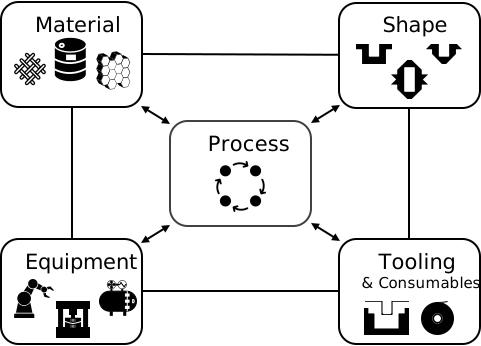
The way that the material, shape, tooling & consumables and equipment (abbreviated as MSTE) interact with each other during a process step is critical to the outcome of the manufacturing step, and ultimately critical to the quality of the finished part. The interactions between MSTE during a process step can be numerous and complex, but the Knowledge in Practice Centre aims to make you aware of these interactions, understand how one parameter affects another, and understand how to analyze the problem using a systems based approach. Using this approach, the factory can then be developed with a complete understanding and control of all interactions.
Interrelationship of Function, Shape, Material & Process
Design for manufacturing is critical to ensuring the producibility of a part. Trouble arises when it is considered too late or not at all in the design process. Conversely, process design (controlling the interactions between shape, material, tooling & consumables and equipment to achieve a desired outcome) must always consider the shape and material of the part. Ashby has developed and popularized the approach linking design (function) to the choice of material and shape, which influence the process selected and vice versa, as shown below:
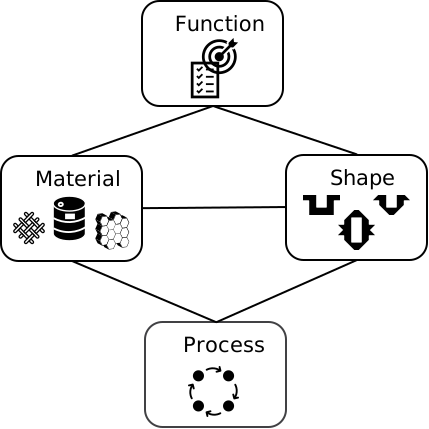
Within the Knowledge in Practice Centre the same methodology is applied but the process is more fully defined by also explicitly calling out the equipment and tooling & consumables. Note that in common usage, a process which consists of many steps can be arbitrarily defined by just one step, e.g. "spray-up". Though convenient, this can be misleading.

Workflows
The KPC's Practice and Case Study volumes consist of three types of workflows:
- Development - Analyzing the interactions between MSTE in the process steps to make decisions on processing parameters and understanding how the process steps and factory cells fit within the factory.
- Troubleshooting - Guiding you to possible causes of processing issues affecting either cost, rate or quality and directing you to the most appropriate development workflow to improve the process
- Optimization - An expansion on the development workflows where a larger number of options are considered to achieve the best mixture of cost, rate & quality for your application.
To use this website, you must agree to our Terms and Conditions and Privacy Policy.
By clicking "I Accept" below, you confirm that you have read, understood, and accepted our Terms and Conditions and Privacy Policy.

