
Prepreg preparation - A181
| Prepreg preparation | |
|---|---|
| Document Type | Article |
| Document Identifier | 181 |
| Tags | |
Overview[edit | edit source]
Preparation and staging is one of the most critical phases of any composite layup operation because it determines whether manufacturing proceeds smoothly, repeatably, and without avoidable delays. In prepreg processing, plies are cut before layup, then labeled, sorted, and staged for subsequent operations, so poor preparation directly affects labour efficiency, material control, and the risk of orientation or placement errors.
This stage is especially important for materials, consumables, tooling, and equipment because all of these must be ready before deposition begins. Hand layup is commonly performed in a cleanroom environment, and both cutting and deposition require controlled handling to limit contamination, preserve tack, and maintain part quality.
Preparation is also where many non-value-added delays can either be removed or built into the process. When plies, templates, tools, backing materials, vacuum consumables, and operator aids are prepared in advance and positioned at the point of use, the layup step becomes more reliable, traceable, and easier to standardize.
Scope[edit | edit source]
This page provides an overview of the preparation activities required before hand layup in a prepreg factory. It focuses on the readiness of workspaces, consumables, materials, and equipment, and it links those preparation tasks to the child pages covering cutting, cutting tools, automated cutting, kitting, layup workstations, and laser-assisted layup. The objective is to help readers understand not only what must be prepared, but also why those preparations matter from a factory and MSTEP perspective. A strong understanding of these elements helps in designing efficient work areas, identifying bottlenecks, and recognizing tasks that may be automated to improve throughput and reliability.
Why this step matters[edit | edit source]
In prepreg manufacturing, layup quality depends on correct ply sequence, fibre orientation, ply position, and compaction, and errors introduced early can be difficult to detect later and may result in scrap or reduced structural performance. Because prepreg hand layup remains a largely labour-based process, preparation and staging are essential for reducing operator burden and improving repeatability.
Preparation also supports process selection and scaling decisions. KPC guidance notes that manual hand layup, template-assisted layup, and laser-guided layup differ significantly in productivity, traceability, labour content, and capital cost, so staging must be designed to match the intended production approach.
The following pages address the major preparation activities associated with prepreg hand layup in a factory setting:
- Cutting prepreg - A401
- Manual Cutting Tools for Prepreg - A402
- Automated Cutter Tables - A403
- Nesting, Picking, and Kitting in Prepreg Processing Using Automated Cutters - A404
- Hand Layup in Prepreg Factory - A405
- Design Requirements for Hand Layup Workstation - A406
- Laser Projectors, Laser Assisted Layup technology - A407
Preparetion objectives[edit | edit source]
Before layup starts, preparation and staging should achieve the following outcomes:
- Materials are available in the correct form, condition, and quantity for the planned work order.
- Plies are cut accurately, identified clearly, and staged in the intended layup sequence.
- Consumables are selected, cut, and organized for the bagging and consolidation strategy to be used.
- Tools, templates, and fixtures are clean, available, and verified for the job.
- Equipment such as cutters, projection systems, compacting tools, and heating aids is functional and ready for use.
- The layup workspace is clean and arranged to minimize contamination, motion waste, and operator confusion.
What must be prepared[edit | edit source]
Preparation in a prepreg layup environment typically includes four main categories: materials, consumables, workspace/tooling, and equipment. These categories interact closely, and incomplete preparation in one area often creates inefficiencies or quality risks in the others.
Materials[edit | edit source]
Prepreg material must be available at the correct stage of handling for the operation, then cut into the required ply shapes before layup. KPC guidance notes that cut plies are often labeled, sorted, and sent forward as kits, making material preparation inseparable from identification and sequencing. Material preparation should also account for fibre architecture, tack, conformability, and handling sensitivity. Heavier prepregs can be harder to form into complex features, while tack that is too low or too high can slow the operator and reduce layup consistency.
Consumables[edit | edit source]
Preparation is not limited to the reinforcement material itself. Release films, peel ply, porous layers, breather or bleeder materials, bagging films, and other vacuum consumables must be available in the correct dimensions and sequence for the part and process. This is especially important for out-of-autoclave prepregs, where vacuum bagging and permeable boundaries are central to air removal and compaction. If consumables are missing, incorrectly cut, or poorly staged, the process may lose time and increase the chance of bridging, porosity, or rework.
Workspace and tooling[edit | edit source]
Layup and cutting are typically performed in controlled clean environments because prepreg resin is tacky and vulnerable to contamination from dust and debris. The workspace therefore has to be prepared not only for convenience, but also for cleanliness, access, and controlled movement of materials into and out of the room. Tooling and workstation preparation should ensure that the operator can position plies accurately and compact them effectively. Depending on the process, this may involve rulers and guides, templates, locating features, or laser projection systems tied to CAD data.
Equipment[edit | edit source]
Equipment readiness includes both basic and advanced systems. At a minimum, cutting tools, rollers, squeegees, and handling aids must be available and maintained, while more advanced cells may require automated cutters, labeling systems, and laser projectors to support ply preparation and deposition. The selected equipment should reflect the target production volume, expected deposition rate, and quality requirements. KPC material describes a progression from measured hand layup to templates and laser-guided systems, showing how preparation methods evolve with automation level and throughput goals.
Role of staging[edit | edit source]
Staging is the practical bridge between preparation and execution. Once plies are cut, they should be arranged in a way that supports the intended layup order, reduces searching and handling time, and lowers the chance of placing the wrong ply, wrong side, or wrong orientation. Good staging also improves traceability. When cut plies are labeled and organized as kits before they reach the layup station, the process becomes easier to audit, easier to train, and more compatible with digital manufacturing tools.
Preparation in hand layup[edit | edit source]
For hand layup in a prepreg factory, preparation must recognize that the deposition step is still largely manual even when assisted by digital tools. Operators must place plies in the correct order, with the correct side up, in the correct location, and with adequate compaction, so preparation should reduce mental load and eliminate unnecessary measuring, marking, and material handling.
This is why preparation may include manual cutting, template creation, ply kits, workstation layout, and laser-assisted guidance. Each of these approaches changes the balance between labour, capital investment, productivity, and repeatability, but all depend on strong upstream preparation.
Relationship to automation[edit | edit source]
One of the major benefits of understanding preparation tasks in detail is that they reveal where automation can create value. KPC material notes that tools have been developed to reduce skill requirements, improve productivity, and increase traceability, even though physical layup is still often manual. Tasks such as ply cutting, labeling, nesting, picking, kitting, template generation, and visual guidance are often easier to automate than full ply deposition. For that reason, preparation and staging are often the first parts of a prepreg factory to benefit from process digitization and automation investment.
Explore this area further
 |
 |
| About | Help |

Welcome
Welcome to the CKN Knowledge in Practice Centre (KPC). The KPC is a resource for learning and applying scientific knowledge to the practice of composites manufacturing. As you navigate around the KPC, refer back to the information on this right-hand pane as a resource for understanding the intricacies of composites processing and why the KPC is laid out in the way that it is. The following video explains the KPC approach:
Understanding Composites Processing
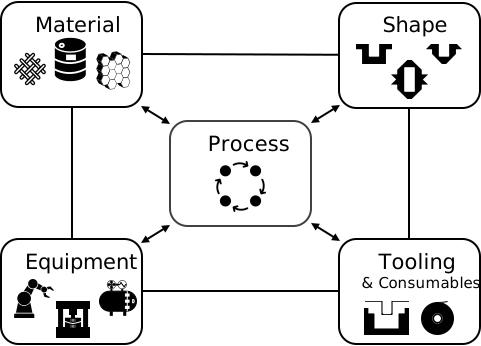
The Knowledge in Practice Centre (KPC) is centered around a structured method of thinking about composite material manufacturing. From the top down, the heirarchy consists of:
- The factory
- Factory cells and/or the factory layout
- Process steps (embodied in the factory process flow) consisting of:
The way that the material, shape, tooling & consumables and equipment (abbreviated as MSTE) interact with each other during a process step is critical to the outcome of the manufacturing step, and ultimately critical to the quality of the finished part. The interactions between MSTE during a process step can be numerous and complex, but the Knowledge in Practice Centre aims to make you aware of these interactions, understand how one parameter affects another, and understand how to analyze the problem using a systems based approach. Using this approach, the factory can then be developed with a complete understanding and control of all interactions.
Interrelationship of Function, Shape, Material & Process
Design for manufacturing is critical to ensuring the producibility of a part. Trouble arises when it is considered too late or not at all in the design process. Conversely, process design (controlling the interactions between shape, material, tooling & consumables and equipment to achieve a desired outcome) must always consider the shape and material of the part. Ashby has developed and popularized the approach linking design (function) to the choice of material and shape, which influence the process selected and vice versa, as shown below:
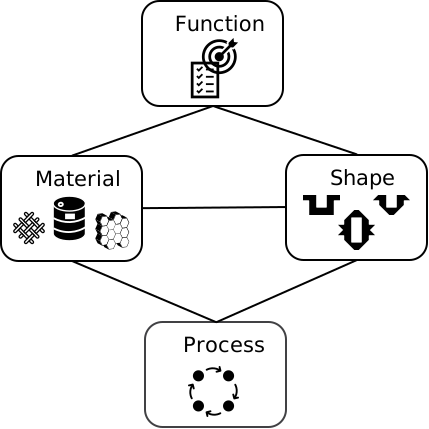
Within the Knowledge in Practice Centre the same methodology is applied but the process is more fully defined by also explicitly calling out the equipment and tooling & consumables. Note that in common usage, a process which consists of many steps can be arbitrarily defined by just one step, e.g. "spray-up". Though convenient, this can be misleading.

Workflows
The KPC's Practice and Case Study volumes consist of three types of workflows:
- Development - Analyzing the interactions between MSTE in the process steps to make decisions on processing parameters and understanding how the process steps and factory cells fit within the factory.
- Troubleshooting - Guiding you to possible causes of processing issues affecting either cost, rate or quality and directing you to the most appropriate development workflow to improve the process
- Optimization - An expansion on the development workflows where a larger number of options are considered to achieve the best mixture of cost, rate & quality for your application.
To use this website, you must agree to our Terms and Conditions and Privacy Policy.
By clicking "I Accept" below, you confirm that you have read, understood, and accepted our Terms and Conditions and Privacy Policy.

