
Nesting, Picking, and Kitting in Prepreg Processing Using Automated Cutters - A404
| Nesting, Picking, and Kitting in Prepreg Processing Using Automated Cutters | |
|---|---|
| Document Type | Article |
| Document Identifier | 404 |
| Tags | |
| Prerequisites | |
Introduction[edit | edit source]
Nesting is the process of positioning the ply shape on the material to be cut such that the part is cut with the correct orientation of the material fibers as designed for the part. This process is very important, as ensuring the accuracy of the orientation to ensure the parts have the correct mechanical properties is critical. Additionally, ensuring that the orientation and organization of these patterns to decrease material waste and save time is of great importance in the production of these parts.
Careful interlocking/nesting of the plies to be cut, cutting smaller parts in available gaps or even within circular cut outs can greatly affect profitability and material use. Different nesting approaches can be used depending on the desired result. The type of cutting approach, material usage efficiency, and kitting approach all affect the desired approach.
Significance[edit | edit source]
As these automated cutting machines are common place in industry due to their high speed and reduced labor requirements, having a good understanding of how to best set up these operations to reduce material waste and accelerate the kitting process is highly valuable.
Scope[edit | edit source]
This article covers the nesting and kitting, as it refers to the steps taken to determine the best way to cut and handle the plies from a large prepreg roll. Several nesting and kitting methods will be covered, with an emphasis of what is currently done in medium to large scale production facilities and a focus on emergent technologies.
Nesting[edit | edit source]
Nesting is the process of positioning the ply shape on the material to be cut such that the part is cut with the correct orientation of the fibrer as designed for the part. Careful interlocking/nesting of the plies to be cut, cutting smaller parts in available gaps or even within circular cutouts can greatly affect profitability and material use. The designed fibre direction limits the efficiency of the nest. Other factors such as cutting machine capability (shared cut lines or minimum distance between plies, overcuts and corner cuts) all affect the nest and material usage. Factory usage can also dictate the best nest to use. Different nesting approaches can be used depending on the desired result. The type of cutting approach, material usage efficiency, and kitting approach all affect the desired approach.
Static Nesting[edit | edit source]
Designed for either material efficiency or picking/unloading from the cutting table. It is for a known run of ply cutting and is typically reused regularly. Reusing the nest increases the efficiency of the picking and kitting process as operators picking parts can quickly learn the part sequence by heart.
Dynamic Nesting[edit | edit source]
Also referred to as Just In Time (JIT) nest is geared towards fluctuating product needs or effective material usage, based on using material available due to roll size or shelf life. The dynamic nest is likely not reutilized due to a changing production schedule, or differing roll sizes of material or expiry date of the material.
Nesting Pattern Example[edit | edit source]
Three examples/case studies of nesting are shown below to compare efficiency in terms of material usage.
Applied Dynamic Nesting[edit | edit source]
Optimized for material utilization. In this example 11.763 m of material is used to get the most plies from the piece of material to make 10 separate kits for part manufacture. This would be as compact a nest as possible for the 10 kits.

Standard progressive Nest[edit | edit source]
In this case the first few kits cut are largely grouped, and the remaining parts are more fitted in to the material remaining. This simplifies the picking and kitting process over a fully dynamic nest. Length 12.210 m of material used. Usage of +0.447 m more material than the baseline (of 11.763 m).

Fully progressive Nest[edit | edit source]
In a fully progressive nest, all kits are cut together. This nesting approach is the least efficient from a material usage point of view, but is the most efficient for the kit picking team to be able to visualize and pick the parts with the least running around and confusion of what parts to pick. Length 13.556 m of material used. Usage of +1.793m more material than the baseline (of 11.763 m)

Progressive Nest[edit | edit source]
In a hybrid progressive nest the nest is laid out largely in kits with a set distance allowable to insert parts outside of the kit area. This way, if a specific roll length is available and to be used (likely due to material expiration) then the software can allow some flexibility in placing the plies to remain within the overall roll length available in stock Length 12.445 m of material used. Usage of +0.682 m more material than the baseline (of 11.763 m)

Applying these methods depends predominately on the required throughput and the priorities of the system, these being the minimize material wasting or kitting time in the production process.
Picking and Kitting[edit | edit source]
Picking is the process of removing cut plies from the cutting table and grouping them into kits of plies belonging to the same part assembly, ready to be laid up in the correct sequence to manufacture the part. The goal of the picking and kitting process is to get a stack of plies in reverse sequence of layup ready to go for layup in the cleanroom. At this point, the kit, in a sealed and well marked package, can proceed to the layup floor, or to the freezer to wait for part manufacture. Picking can include removal of the plies by hand as quickly as possible to be sorted into kits later, to fully automated robotic systems that place the parts directly into kits. The next step is for the picking robot to layup the ply, effectively completing the layup process.

Considerations in picking to kit include the selection of the type of cutting machine and the nesting approach including;
A static table is easiest to pick and kit directly. This can, however affect the overall cycle time as the static table is tied up while the picking and sorting process take place. During that time, the cutting table may not be available to cut plies. In some cases, the cutting head can be moved to another static table to continue cutting while the picking takes place. Another solution is for long static cutting tables. Some as long as 36.5 m (120’). This allows picking at one end and cutting at another. A downside of this approach is the picking effort can be slow due to the length of the table and logistics of moving around it.
Conveyorized cutting systems do not offer an easy opportunity to pick to cut. They typically involve moving the ply pieces off the conveyor and sorting in kits at a separate table.

Manual Kitting[edit | edit source]
Once a piece is cut, it is grouped with other plies that make up the same part. This compilation of plies is then sorted in the freezer for future use, the process of creating these compilations is referred to as kitting.
Kitting is typically done manually by a person sorting the plies off the cutting table or by sorting a stack of cut plies. Plies are usually sorted in reverse order of application so that the kit starts with the first part on the top. Ply kits are usually done together to allow the plies to remain flat. Other roll materials are often kitted separately. Honeycomb or other core material, or even instruments are usually kitted separately. The kit of prepreg can be returned to the freezer to minimize the out-time of the prepreg, while non prepregs do not benefit and might be negatively affected by freezing.

Clear Table Kitting[edit | edit source]
In the first and simplest instance, the operator picks the parts from either a static or conveyorized table and places them on a separate table in stacks. A separate operator would take the pile of cut plies and organize them into kits or in the desired sort/ order for future layup.

The main advantage of this method is that it is by far the lowest capital investment method of making these kits. Additionally, operators are often able to memorize the plies and their location on the table, resulting in faster than otherwise expected processing times from a manual sorting method. The main downsides are the high labor requirements, frequency of errors, need for large tables to separate kits into, and the relative speed of other sorting approaches.
Static Table Kitting[edit | edit source]
Static tables can be cleared in an orderly fashion once cutting is complete. This often allows the operator to remove plies in reverse order and create the kit in the right sequence. Ply labelling/marking is important, but can be done more manually with a marker pen. This system possesses many of the advantages of the clear table kitting, while simultaneously further reducing the number of non-value added steps in the kitting process. However, cutting actively needs to be stopped when the operators are relocating the plies from the cutting table, which decreases throughput.
Kitting from a conveyorized cutting table[edit | edit source]
Conveyorized cutting tables are not conducive to direct kitting unless the nest is fully progressive. Conveyorized systems are typically fast enough moving that two people just to unload the plies, are required. In the case of a conveyorized system, stacking the parts on a separate area for kitting is usually necessary.
Ply labelling is an important factor in making the kitting process an efficient and accurate one. Care to ensure an accurate kit is produced is imperative to avoid confusion and mistakes on the layup floor. Table size for kitting will depend on the nesting and part removal process from the cutting table.
The advantages of this method are similar to the clear table kitting, as the process is very similar, with the main difference being the faster speed required to account for the speed of the conveyor belt system. The main drawback is that this results in even higher layout requirements, often needing additional personnel specifically for the kitting step; it is also more error prone.
Hand pick to kit[edit | edit source]
With Hand pick to kit, the operator picks the parts and places them directly in the kit. To make this possible, a fully progressive kit is desirable, to avoid wasted time locating the right “next ply” to pick. In a fully progressive kit, the plies are nested together as a single kit, allowing the operator to pick all parts in a specific area.
Incorporation of Assistance and Automation in Kitting[edit | edit source]
A basic simplification is to add a visible map of the picking sequence, either on paper, for high volumes of kits to pick, or an electronic screen either showing a map of the complete nest and highlighting the next ply to pick. In the electronic version, a controller is required to advance to the next ply. Several checks can be put in place with an electronic system to ensure a correct kit of plies is assembled.
A further step in automation is to provide a laser or video projector that points to the correct ply to pick. The light guides the operator through the cut plies to pick on the table surface in the reverse order of the kit sequence. Several video and laser projection systems are available to improve the manual kitting process. These are designed for static table picking. Both Zund and Airborne manufacture such a system. The video projection system is installed over the cut nest and has a method to index the nest to the projection. The video projector provides direction to the person removing cut plies as to the sequence of plies to pick. This is designed to result in a direct process of picking parts directly to kit stacks of plies.
Automated / Robotic Kitting[edit | edit source]
Several automated picking systems have been developed over the last few years. Typically the systems required large reach robotic arms or gantry systems that move across the cutting table and cut nest, picking plies in the correct order and stacking them in a kit for layup. All are expensive, and to date, slower than a human. The use of robots also complicates the assistance of humans to help the process. Cobots will likely make this more accessible. Robotic systems typically kit to a tray, that can be in a kit cart. Several advanced systems are available from Airborne (NL), ARM Automation (Austin, Tx). Some features that exist include ply inspection, automatic kit cart loading. Uncut fibres in a cut nest can cause a pull up of the whole nest if there isn’t a proper verification system in place. Depending on the system, some systems are not able to pick large and small plies from the same head.
This system allows for the potential to fully automate the kitting process, thus eliminating operator error and significantly reducing the labor associated with this process. The main concern with these systems is the existence of uncut fibers in the plies. Since the machine is unable to detect this the entire sheet gets pulled from the table, resulting in damaged plies and requiring manual kitting.
 |
 |
| About | Help |

Welcome
Welcome to the CKN Knowledge in Practice Centre (KPC). The KPC is a resource for learning and applying scientific knowledge to the practice of composites manufacturing. As you navigate around the KPC, refer back to the information on this right-hand pane as a resource for understanding the intricacies of composites processing and why the KPC is laid out in the way that it is. The following video explains the KPC approach:
Understanding Composites Processing
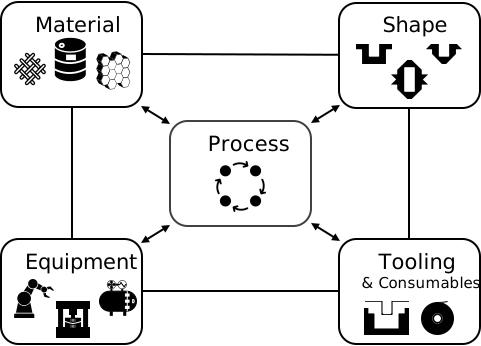
The Knowledge in Practice Centre (KPC) is centered around a structured method of thinking about composite material manufacturing. From the top down, the heirarchy consists of:
- The factory
- Factory cells and/or the factory layout
- Process steps (embodied in the factory process flow) consisting of:
The way that the material, shape, tooling & consumables and equipment (abbreviated as MSTE) interact with each other during a process step is critical to the outcome of the manufacturing step, and ultimately critical to the quality of the finished part. The interactions between MSTE during a process step can be numerous and complex, but the Knowledge in Practice Centre aims to make you aware of these interactions, understand how one parameter affects another, and understand how to analyze the problem using a systems based approach. Using this approach, the factory can then be developed with a complete understanding and control of all interactions.
Interrelationship of Function, Shape, Material & Process
Design for manufacturing is critical to ensuring the producibility of a part. Trouble arises when it is considered too late or not at all in the design process. Conversely, process design (controlling the interactions between shape, material, tooling & consumables and equipment to achieve a desired outcome) must always consider the shape and material of the part. Ashby has developed and popularized the approach linking design (function) to the choice of material and shape, which influence the process selected and vice versa, as shown below:
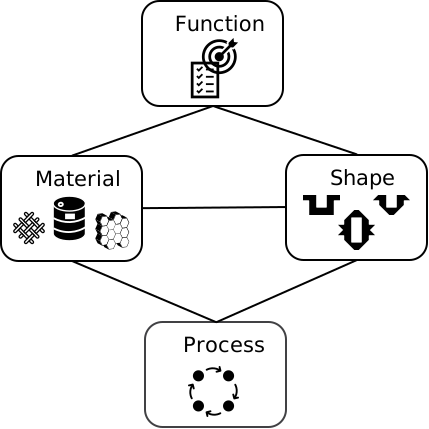
Within the Knowledge in Practice Centre the same methodology is applied but the process is more fully defined by also explicitly calling out the equipment and tooling & consumables. Note that in common usage, a process which consists of many steps can be arbitrarily defined by just one step, e.g. "spray-up". Though convenient, this can be misleading.

Workflows
The KPC's Practice and Case Study volumes consist of three types of workflows:
- Development - Analyzing the interactions between MSTE in the process steps to make decisions on processing parameters and understanding how the process steps and factory cells fit within the factory.
- Troubleshooting - Guiding you to possible causes of processing issues affecting either cost, rate or quality and directing you to the most appropriate development workflow to improve the process
- Optimization - An expansion on the development workflows where a larger number of options are considered to achieve the best mixture of cost, rate & quality for your application.
To use this website, you must agree to our Terms and Conditions and Privacy Policy.
By clicking "I Accept" below, you confirm that you have read, understood, and accepted our Terms and Conditions and Privacy Policy.

