
Cutting prepreg - A401
| Cutting prepreg | |
|---|---|
| Document Type | Article |
| Document Identifier | 401 |
| Tags | |
| Prerequisites | |
Introduction[edit | edit source]
Carbon fiber prepreg is a high performance material with an associated high relative cost. Optimizing the use and minimizing the waste are critical in a commercial composites environment. The cutting process is therefore important to accurately cut ply outlines with proper fiber orientation (unidirectional, warp and weft for weaves, and directions for braided materials). In a commercial production run it is also critical to maximize the use of material through careful nesting of the plies within the material roll. Prepreg has an expiry date, continually working against the manufacturing process.
Cutting plies from material rolls is an important part of composite manufacturing. As materials are expensive, the use of materials should be optimized in line with the work to be accomplished. The accuracy of each ply will determine the overall benefit of weight and performance of the final part. Once the ply is cut and markings on the backer plies removed, the only reference for positioning/laying up the part are the edge features and weave direction. Depending on the positioning technology used, the weave direction and edge cutting accuracy will determine how accurately the ply can be positioned. Prepregs in particular have been and still typically are, laid up by hand. One of the key processing steps in these hand layups is the preparation of the plies before the layup, either it be by hand or automated cutting.
Significance[edit | edit source]
Materials and labor have increased at a much faster rate than productivity. Aerospace and defense, wind energy, sports equipment are all increasing their use of composites and there is a continued push to reshore manufacturing, resulting in the need of automation to compete with low cost and often highly skilled and productive offshore labor. The introduction of new and more advanced materials is also creating new manufacturing challenges.
Each major step in the prepreg manufacturing process can result in expensive failures, most of them non-repairable and increasingly expensive as the process progresses. Careful management of the cutting process can be an opportunity for savings. Whereas layup, cure and post processing can all result in a failed part (some repair is possible), diligent management of the “cutting” process can salvage materials with flaws and/ or materials close to expiry. It can also maximize material use.
Scope[edit | edit source]
This article focuses on presenting the cutting of pre-preg materials in composite processing facilities. Cutting technologies covered here range from artisanal, low volume hand cutting to CNC-cut, 2D plies include razor knife cutting, scissors cutting and automated 2D CNC cutting tables. Images from factories are used as reference to show both hand cutting and automated cutting machines in large composite processing facilities.
Cutting Methods[edit | edit source]
Cutting technologies covered here range from artisanal, low volume hand cutting to CNC cut, 2D plies include razor knife cutting, scissors cutting and automated 2D CNC cutting tables. Further steps in automation such as ATL, AFP, FPP have integrated cutting systems as part of the automation and are not covered within.
The progression in cutting approaches from artisanal to fully robotic (including layup) is outlined below:

Manual Cutting[edit | edit source]
At the most basic level, plies can be made by hand-cutting of materials using a razor knife or scissors. This is the lowest form of capital investment possible to cut plies.
In manual hand cutting, ply part accuracy is based on operator skill in conjunction with the guides and templates used to guide the operator. This is also typically the least productive approach to making plies in terms of production output.
Hand cutting should be done by:
Marking the material, including cut outline, correct warp and weft direction, top or bottom (assuming top is the marked side). Marking should be done with an approved marking material. Mark the material cut path using a customer or internally approved marker. Paper or sepia templates are often the easiest way to trace accurate outlines, again taking care to align the material fibre direction (warp and weft).
With a knife or scissors (detailed below), cut along the marker line, being careful to keep to the outside of the line to avoid any undercutting. Overcut can always be corrected later with scissors.
Tools For Manual Cutting[edit | edit source]


Olfa™ and X-ACTO™ razor knives are the most basic cutting tool, the easiest to implement, but are the slowest and hardest to achieve accurate parts. Techniques exist to produce the most accurate cut possible within the approach. The blade should be kept clean of resin using the approved correct solvent for the resin. The blade should also be regularly inspected for accumulation of resin or for blade wear. Wiss™ scissors or proper industrial scissors can be used to cut plies and loose fibres. The same general cutting guidelines that apply to razor blade cutting apply to cutting with scissors.
Knives are typically used in conjunction with a rubber cutting pad or glass plate. The cutting surface employed should not produce any foreign objects that could get into the material as in the case of a wood countertop. Cutting surfaces should be kept clean and are typically wiped down before use to avoid cross contamination of dust and oils/grease/other chemicals.
Safety is also a top priority when cutting with razor knives. Using cut resistant gloves, and never aligning a hand, arm or body with the razor edge travel is important. Detailed safety rules and training should be given prior to starting production cutting with a razor knife. Best practices and safety considerations of using these cutting tools for prepregs in industrial settings can be found in the page: Manual Cutting Tools for Prepreg.
Even when utilizing an automated cutting system, the presence of hand cutting tools is essential, as the machines are not always able to fully cut through the material.
Automated Cutting[edit | edit source]
Ply cutting machines were developed in the late 60’s by Joseph Gerber. The first 2D CNC cutting machine is located in the Smithsonian in Washington, DC. The composites industry introduced multi layer cutting tables of material with reciprocating saws and ultrasonic blades, known as multi-ply cutters quite a bit later. Due to the high initial cost and slow cutting speed of the technology available at the time, ultrasonic cutting of multi layers was deemed the best approach. A minimum volume of parts to cut, production rates, and materials to be cut, were all parameters to validate the return on investment.
Certain heavier carbon materials as well as multi-ply cutting are best cut with an ultrasonic system. Many companies remain committed to ultrasonic cutting in spite of a slower cut rate and not using the heavier materials. In typical applications the difference is cut quality is negligible.
As CNC cutting tables became more mainstream in the aerospace industry, and the need for composite parts in aviation, CNC cutter demand increased significantly as well as the need for lower cost solutions. Static, single ply cutters and conveyorized single ply cutters were developed and are now the standard in the industry.
Static tables are typically used where space is available due to the high speed of cutting, the accuracy and quality of cut in addition to the lower cost of implementation. Conveyorized systems are more expensive but use a smaller footprint in the factory to provide a high level of cutting speed and cut ply output. The four steps to automated cutting include:
1. Creating the data
2. Nesting the plies
3. Cutting and marking the plies
4. Kitting the plies into kits
There are dedicated software packages available to create the data and patterns such that the least amount of material is required. Many innovations have occurred in the last 20 years regarding the performance (quality and productivity) of these systems to improve the efficency of composite processing. More about these systems can be learned in the following page: Nesting, Picking, and Kitting in Prepreg Processing Using Automated Cutters.
Ply Cutting Methods and Technologies[edit | edit source]
Cutters today are typically single ply, straight knife cutters. Some of these tables are also equipped with a pizza wheel, a notch punch, and a marking method for pieces. Ultrasonic and high frequency knife systems are also still in use, particularly with materials with high/heavy tow, posing a challenge for the standard straight knife mechanisms. The Ultrasonic cutting systems have the additional benefit of being able to processes multiple layers at a time. These advantages over straight knife cutters however, are heavily outweighed by the additional cost of these systems.
More information about straight knife automated cutters can be found in the page: Automated Cutter Tables.

In all cases, similar to a razor knife or scissors, the blades must be kept clean and sharp. Blades must be replaced once they accumulate resin. They can also be cycled through a soak in a resin cleaning bath to always have resin free blades available. Depending on the manufacturer, the cutting requirements and the sharpening capabilities, the cutting blades can either be sharpened and reused or discarded and replaced. Due to the high frequency vibration of ultrasonic cutters, the resin can sometimes migrate up the blade. This has the advantage of requiring less cleaning and less need for blade change, however more rigor to keep the holding mechanism clean, is required.
Explore this area further
 |
 |
| About | Help |

Welcome
Welcome to the CKN Knowledge in Practice Centre (KPC). The KPC is a resource for learning and applying scientific knowledge to the practice of composites manufacturing. As you navigate around the KPC, refer back to the information on this right-hand pane as a resource for understanding the intricacies of composites processing and why the KPC is laid out in the way that it is. The following video explains the KPC approach:
Understanding Composites Processing
The Knowledge in Practice Centre (KPC) is centered around a structured method of thinking about composite material manufacturing. From the top down, the heirarchy consists of:
- The factory
- Factory cells and/or the factory layout
- Process steps (embodied in the factory process flow) consisting of:
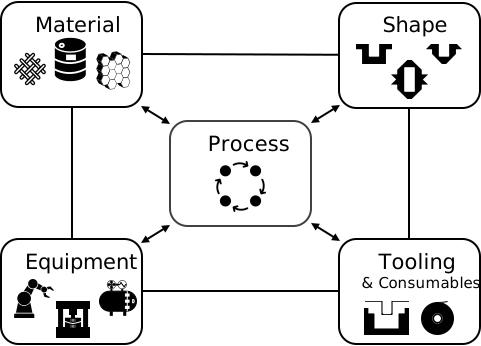
The way that the material, shape, tooling & consumables and equipment (abbreviated as MSTE) interact with each other during a process step is critical to the outcome of the manufacturing step, and ultimately critical to the quality of the finished part. The interactions between MSTE during a process step can be numerous and complex, but the Knowledge in Practice Centre aims to make you aware of these interactions, understand how one parameter affects another, and understand how to analyze the problem using a systems based approach. Using this approach, the factory can then be developed with a complete understanding and control of all interactions.
Interrelationship of Function, Shape, Material & Process
Design for manufacturing is critical to ensuring the producibility of a part. Trouble arises when it is considered too late or not at all in the design process. Conversely, process design (controlling the interactions between shape, material, tooling & consumables and equipment to achieve a desired outcome) must always consider the shape and material of the part. Ashby has developed and popularized the approach linking design (function) to the choice of material and shape, which influence the process selected and vice versa, as shown below:
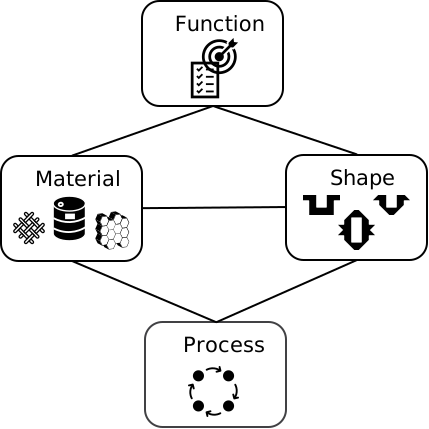
Within the Knowledge in Practice Centre the same methodology is applied but the process is more fully defined by also explicitly calling out the equipment and tooling & consumables. Note that in common usage, a process which consists of many steps can be arbitrarily defined by just one step, e.g. "spray-up". Though convenient, this can be misleading.

Workflows
The KPC's Practice and Case Study volumes consist of three types of workflows:
- Development - Analyzing the interactions between MSTE in the process steps to make decisions on processing parameters and understanding how the process steps and factory cells fit within the factory.
- Troubleshooting - Guiding you to possible causes of processing issues affecting either cost, rate or quality and directing you to the most appropriate development workflow to improve the process
- Optimization - An expansion on the development workflows where a larger number of options are considered to achieve the best mixture of cost, rate & quality for your application.
To use this website, you must agree to our Terms and Conditions and Privacy Policy.
By clicking "I Accept" below, you confirm that you have read, understood, and accepted our Terms and Conditions and Privacy Policy.

