
Hand Layup in Prepreg Factory - A405
| Hand Layup in Prepreg Factory | |
|---|---|
| Document Type | Article |
| Document Identifier | 405 |
| Tags | |
| Prerequisites | |
Introduction[edit | edit source]
Ply layup is the act of placing the plies and compacting them prior to curing the part. It is a critical step, as an incorrectly placed ply can be difficult to identify and can result in a scrap part. If it slips through, it will affect the part's performance. The methods of layup range from painstaking hand layup to fully automated standard processes (FW, ATL, AFP) and/or custom robotic solutions.
Even so, the most common form of layup still found in industry is still hand layup. As a result, it is imperative to have a good understanding of the process and associated technologies used to assist operators in a factory setting.
Significance[edit | edit source]
Prepreg hand layup remains a largely labour based process. Due to the dexterity required to apply prepreg plies, along with production volumes that typically do not justify highly automated processes, the use of hand labour remains the mainstay of prepreg part layup. Accuracy of order, orientation of the fibres, position and compaction are all critical to make a good part. The accurate ply shape/ outline (be it exactly cut, overcut or even undercut) is also critical to the performance and can be a contributor to the mass of the part. Understanding the limitations and technologies that are available to aid operators in the laminating process is key when designing a process.
Scope[edit | edit source]
This article covers details related to hand layup in the factory setting, while the specifics of hand laminating are covered here. Details include layup process selection, MSTEP and prepreg, and details, requirements, and goals of a hand layup workstation. The goal of this page is to provide an overview of how the process looks in a factory setting.
Process Selection for Layup[edit | edit source]
Hand forming and compaction/debulking of each ply into its final shape must be done with care and consistency with the design requirements. The goal is to prepare well-compacted parts built to specification, ready for cure. It is important to perform the layup in the right order, with the correct side up, fibre orientation in the correct direction, and in the right position.
The majority of prepreg composite parts are assembled/laid up by hand. Tools have been developed to decrease the skill requirements and tediousness of layup, as well as increase the productivity, quality and traceability. The physical layup process, however, is still largely a manual operation.
The degree of automation to implement is defined early on in the part definition and is typically selected based on return on investment, which in turn is a result of volumes to manufacture and program life. Productivity and efficiency are often measured in kg prepreg/hour of work against the capital and operating costs involved. Layup rates can range greatly, however, general guidlines are provided below:
| Approach | kg/ hour deposition (Est. range) |
|---|---|
| Manual measured hand Layup | 0.5 to 3.0 |
| Hand layup with templates | 2.0 to 5.0 |
| Laser guided hand layup | 3.0 to 10.0 |
| Filament winding | 15 to 100+ |
| Auto tape layup ATL | 100 |
| Auto fibre placement AFP | 75 |
In each case, the cost of labor versus the capital investment is a key criterion in selecting the process to be used. Once a layup process/method is selected and a process certified, the commitment to maintain the process is established. For this reason, important decisions early on in the bidding process can have large overall impacts on the success of a program. Once started, the opportunities are usually in reducing the labour and increasing the automation level involved in the manufacturing process.
At scale, the introduction of automated technologies and aids for operators can be thought of as belonging to the categories shown in the figure below. The corresponding selection of these is dependent on the desired throughput and quality requirements of the part being made.

MSTEP approach in Prepreg Hand Layup[edit | edit source]
The following figure shows the application of the MSTEP approach to composite processing, specifically to the hand layup of prepreg composite materials.

Hand Laminating Workstation[edit | edit source]
Most composite layups are done in a cleanroom, as the resin is sticky and dust and foreign objects can easily adhere to the material. UV exposure can may be an issue when working with prepreg and levels are typically restricted. Prepreg enters the clean room with backer plies on both sides and in hermetically sealed kit bags. The part leaves the clean room in a vacuum bag, debulked, ready for cure. The layup room requires cleanroom conditions to avoid contaminating the resin and prepreg. The manufacturing process also creates dust and debris that must be minimized to avoid creating a scrap part. Cleanrooms are accessed by airlock where possible, or by cleanroom “garage” doors, which are tightly sealed and have a fast open and close cycle to minimize the possibility of dirt entering. More about specific requirements for layup clean rooms can be found in the following page:Design Requirements for Hand Layup Workstation.
Hand Layup[edit | edit source]
Manual prepreg part manufacturing by hand layup is the most laborious way to make parts. Plies are positioned by hand using a ruler and marking the location where the files should be placed. The part must be placed with the designated side up to ensure fibres, the key structural criteria, are positioned correctly.

Hand layup using nothing but basic tools such as a measuring tape, rulers, and straightedges, is largely artisanal manufacturing. In parts with higher requirements for performance, quality, etc., a high degree of skill and understanding is required to achieve the desired results.
Pros:
- Low capital cost
- Low barrier to entry approach
- No expensive templates or templating tools to make and maintain
- Suitable for low-volume production
- Allow for introduction of digital tools
Cons:
- Low/slow production
- Highly skilled operators required
- Repeatability can be a challenge
- Traceability can be low, and undocumented tribal knowledge can affect repeatability.
Template Assisted Hand Layup[edit | edit source]
Making paper, sepia or other material templates with marking lines is a method to make repeatable parts without the higher cost of tools. Manual templates are typically Mylar or other material with slots cut in them to mark the position of layup. Templates are typically cut on a 2D cutting table to obtain the necessary accuracy. Features on the template and associated tool are required to align the template with the tool. Once done, the ply position is marked on the existing surface, and once the template is removed, the next ply is applied.

Pros:
- Higher degree of productivity and traceability
- Low cost and relatively high accuracy
- Some degree of skill required, much lower than hand hand-measured layup alone
Cons:
- Template manufacturing can be costly, with long lead times, and difficult to maintain
- Template storage, management, including revision upgrades, and maintenance is costly
- 25-year maintenance of files and templates can be cumbersome
- Any design changes involve manufacturing of new templates
Laser Assisted Hand Layup[edit | edit source]
To increase productivity, accuracy and traceability of composite part manufacture, laser projectors were developed to replace the most error prone and slow step in hand layup. With a laser projector, the outline of the ply is projected from the laser on to the layup surface, so that the operator does not need to measure and mark the ply. The operator merely positions the ply within the laser light being drawn, then moves on to the next ply. This eliminates a considerable amount of non-value added operations, increasing throughput and labour efficiency. An early analysis by Lockheed Corporation identified the savings graphically.

With a laser templating system, the tool has a minimum of four tooling target locations against which the part is positioned. High-accuracy targets are placed in the precision-machined tooling locations. The targets are covered in silver retro-reflective targets.
When the laser light hits the retroreflective target, it receives the signal reflected back to the laser, resulting in an auto-collimated location of the tooling. Once the four or more tooling balls are located, the laser can triangulate the outline of the ply from the CAD file.
Once the operator has placed the ply, a simple controller (handheld, foot pedal, or other) moves the projection to the next ply to allow the operator to position the subsequent plies. The typical laser projection system covers an area 4.57 m (15') x 4.57 m (15') when the laser projector is 4.57 m (15') from the surface. The laser works best perpendicular to the surface.
Various laser systems continue to innovate and offer additional features, such as:
- Multi-tasking is a benefit where one projector system can project on multiple parts in parallel. This allows the investment in a laser projection system to be shared multiple-fold over many part, offering multiples times in productivity. An adaptation of the analysis above becomes;
- Text projection on the part, to give additional information to the operator,
- Retro-reflective control, using the return signal of retroreflective material as a controller,
- Using the computer driving the laser to give additional information and control over the layup operation.

Pros:
- Higher degree of productivity, traceability, and quality
- Lower degree of skill required
- Can be done in a paperless fashion
- No templates to store
Cons:
- Capital cost
- Computer infrastructure
- Basic training required (minimal IT knowledge required)
Learn more about laser guided systems here: Laser Projectors, Laser Assisted Layup technology.

Welcome
Welcome to the CKN Knowledge in Practice Centre (KPC). The KPC is a resource for learning and applying scientific knowledge to the practice of composites manufacturing. As you navigate around the KPC, refer back to the information on this right-hand pane as a resource for understanding the intricacies of composites processing and why the KPC is laid out in the way that it is. The following video explains the KPC approach:
Understanding Composites Processing
The Knowledge in Practice Centre (KPC) is centered around a structured method of thinking about composite material manufacturing. From the top down, the heirarchy consists of:
- The factory
- Factory cells and/or the factory layout
- Process steps (embodied in the factory process flow) consisting of:
The way that the material, shape, tooling & consumables and equipment (abbreviated as MSTE) interact with each other during a process step is critical to the outcome of the manufacturing step, and ultimately critical to the quality of the finished part. The interactions between MSTE during a process step can be numerous and complex, but the Knowledge in Practice Centre aims to make you aware of these interactions, understand how one parameter affects another, and understand how to analyze the problem using a systems based approach. Using this approach, the factory can then be developed with a complete understanding and control of all interactions.
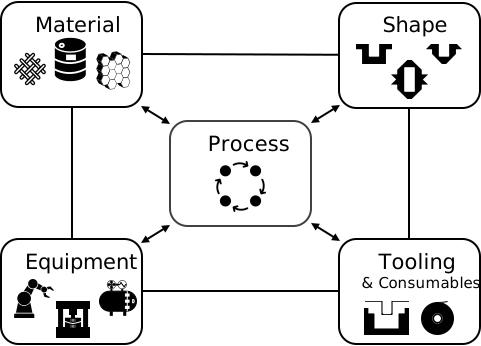
Interrelationship of Function, Shape, Material & Process
Design for manufacturing is critical to ensuring the producibility of a part. Trouble arises when it is considered too late or not at all in the design process. Conversely, process design (controlling the interactions between shape, material, tooling & consumables and equipment to achieve a desired outcome) must always consider the shape and material of the part. Ashby has developed and popularized the approach linking design (function) to the choice of material and shape, which influence the process selected and vice versa, as shown below:
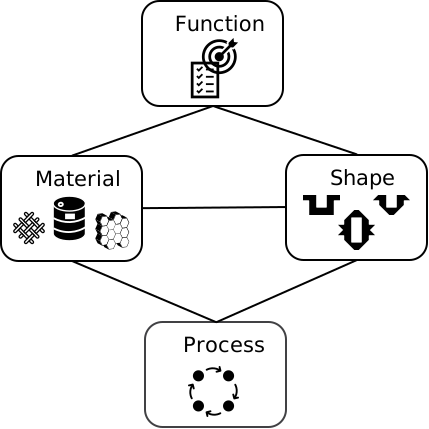
Within the Knowledge in Practice Centre the same methodology is applied but the process is more fully defined by also explicitly calling out the equipment and tooling & consumables. Note that in common usage, a process which consists of many steps can be arbitrarily defined by just one step, e.g. "spray-up". Though convenient, this can be misleading.

Workflows
The KPC's Practice and Case Study volumes consist of three types of workflows:
- Development - Analyzing the interactions between MSTE in the process steps to make decisions on processing parameters and understanding how the process steps and factory cells fit within the factory.
- Troubleshooting - Guiding you to possible causes of processing issues affecting either cost, rate or quality and directing you to the most appropriate development workflow to improve the process
- Optimization - An expansion on the development workflows where a larger number of options are considered to achieve the best mixture of cost, rate & quality for your application.
To use this website, you must agree to our Terms and Conditions and Privacy Policy.
By clicking "I Accept" below, you confirm that you have read, understood, and accepted our Terms and Conditions and Privacy Policy.

