
Design Requirements for Hand Layup Workstation - A406
| Design Requirements for Hand Layup Workstation | |
|---|---|
| Document Type | Article |
| Document Identifier | 406 |
| Tags | |
| Prerequisites | |
Introduction[edit | edit source]
The layup room is one of the most important areas of the composite factory. The room should provide an environment and space suitable for the material and production requirements. The workstations should provide the operator/ layup technician with the right environment to effectively produce parts.
Significance[edit | edit source]
The great majority of parts in industry are still made through hand layup. As a result, a good understanding of how these facilities are set up for production scale is essential. Some thought on the development of new technologies and process improvements to aid operators or identify areas for automation should be considered.
Scope[edit | edit source]
This article covers some of the equipment and design requirements that are used when setting up a layup room and setting up workstations for hand layup. Images of facilities with small to medium production volumes are included.
Layup Workstation[edit | edit source]
The more distributed and self-sufficient the workstation is, the more effective the operator and production. An example of a workstation setting is shown below, illustrating a possible layout of the work cell-style design that would be found on a production floor.

The layup room is often filled with larger and smaller layup workstations for part manufacturing, depending on the products being built. Each layup workstation should be equipped with the following features:
- Space and access for the part tool with room to move around the tool and access to the room aisle to move the tool in and out. A padded floor mat is sometimes used to reduce operator fatigue from standing.
- Each workstation should be equipped with an overhead power cord and vacuum hose. Both should be retractable to avoid getting in the way during layup. The vacuum hose is for part debulk, and the power cord can be used for different tools, in particular, heat guns.
- If the part tool is smaller, an adjustable height workstation is a proven way to minimise back and other strain area problems, reducing personnel health problems.
- A consumables rack as shown below, holding rolls of regularly used materials such as bagging material, breather material, peel ply, parchment paper, release films, breathers, debulk valves,
- Thermocouples (may be in the kit), bagging tape, bagging materials, and, depending on the specific parts being built, string bleeders, edge dams, peel ply and other more specific materials and other regularly consumed materials that are used in making parts.
- A shadowboard of hand tools including Scissors, razor knife with spare blades, material spatulas, debulk timer, pressure check valve, and tape dispenser.
- Waste disposal bins are necessary. As a lot of the materials are discarded during the process, sorted disposal cans for paper, plastic and landfill should be available at each station. The operator should be instructed as to each material disposal process to minimise the amount of material going into landfill.

Layup Cleanroom Room Design[edit | edit source]
It is important to keep the work area clean and orderly. Aerospace layup cleanrooms are typically class 100,000, meaning 100,000 particles of 0.5 micrometers or less per cubic meter of volume. This is typically deemed a sufficiently clean environment to not impact the part with airborne debris. These rooms are also temperature and humidity controlled and usually positively pressurized where possible. Each cleanroom should be equipped with a vacuum (cleaning) system and a dry mop to keep the entire area free from debris.
Due to the infrastructure cost of building a cleanroom, an oversized layup room with flexible/movable walls can be a great setup for long term growth, is desired. Cleanrooms are not just about filtered air but also include regular floor cleaning and cleanliness , and orderliness practices. The layup room door needs to be large enough for the largest part to enter and exit as well as any handling equipment such as a forklift.
Layup Room Desing Considerations[edit | edit source]

- Room for production: Each work area requires room for the tool size expected to be worked on, space for a work table, and possible kit carts. Room for a shadowboard holding tools, consumable material racks, wastebins, and sufficient space to navigate around the part comfortably to work on the part are key considerations.
- Hallways for tool access: Ideally, the main aisle/hallway should be twice the largest tool size so two tools can pass each other. As a minimum, enough width for the largest tool to be built, and its holding method and transportation method, is required. This should take into consideration the necessary equipment (such as forklifts) and sufficient room to maneuver the tool into an adequate location. The aisle/hallway can also be a place where parts are kept during debulk and when awaiting the cure cycle.
- Ceiling height: Depending on the size of parts to be manufactured and the tooling involved, the ceiling height can vary, particularly if a forklift is used to transport parts and tools. Any manufacturing equipment, such as laser projectors, robots, or others, need a minimum ceiling height to operate. Having sufficient clearance for laser projectors or other manufacturing aids can greatly benefit from this kind of planning.
- Adequate lighting and UV considerations: The higher the ceiling, the more lighting power is required. Many prepreg resins are sensitive to UV light, which may require the use of specific light builbs and blocking of natural/ambient light.
- Project-specific layup rooms: Certain customers may demand project-dedicated areas. Having flexible/movable inner walls within the main layup room can be hard to retrofit and easier to design. Consideration of the present and future contract demands can greatly help in the planning phase of building a layup room.
- Production goal (output volume): The layup room needs to be designed with a production goal in mind. Estimating the hours of layup (including debulk) will give a cycle time for parts, along with the production needs of the customer can be an easy way to estimate the number of workstations required. Verifying this against other chokepoints, such as cutting capacity and cure capacity, will help give a good estimate of production needs. A facility loading factor should also be applied for the number of shifts planned, variation in layup technician output and mishaps, should be applied. An example previously used is 50% for single point failures (example: One autoclave) or 75% where redundant systems exist. (example: Multiple Autoclaves).
- Availability of all necessary materials: The layup process also includes a variety of materials and processes in the construction of composite parts. Beyond the prepreg, there are other materials such as honeycomb cores, lightning strike, and other specialty materials built in to the typical composite part. It is important that all of these are prepared beforehand and are easily available to the operator when performing the layup.
- Vacuum houses: Access to a vacuum line is critical for debulking and testing the quality of bagging seal prior to cure. These can be placed conveniently overhead on retractable holding systems to keep them out of the work area when not required, while providing easy access for regular use.
- Retractable power line: Each workstation should have an accessible power line for hand tools, especially hot guns.
- Computre workstation: Elimination of paperwork through improved digital tools is an important goal in the planning process. Certain automation tools, such as laser projectors, also require a computer workstation to run them.
- Other common resources and tools: Typical shared items in a layup room include a wardrobe/locker area just outside for personnel's outerwear. Inside the entrance should be an area for work lab coats, hairnets, and shoe covers where required. An eye wash, and any safety requirements should also be centralized, and personnel should be aware of and trained of its use.

Welcome
Welcome to the CKN Knowledge in Practice Centre (KPC). The KPC is a resource for learning and applying scientific knowledge to the practice of composites manufacturing. As you navigate around the KPC, refer back to the information on this right-hand pane as a resource for understanding the intricacies of composites processing and why the KPC is laid out in the way that it is. The following video explains the KPC approach:
Understanding Composites Processing
The Knowledge in Practice Centre (KPC) is centered around a structured method of thinking about composite material manufacturing. From the top down, the heirarchy consists of:
- The factory
- Factory cells and/or the factory layout
- Process steps (embodied in the factory process flow) consisting of:
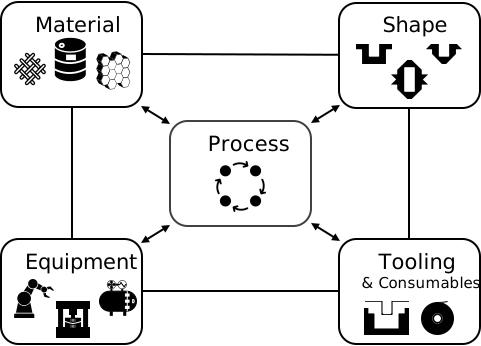
The way that the material, shape, tooling & consumables and equipment (abbreviated as MSTE) interact with each other during a process step is critical to the outcome of the manufacturing step, and ultimately critical to the quality of the finished part. The interactions between MSTE during a process step can be numerous and complex, but the Knowledge in Practice Centre aims to make you aware of these interactions, understand how one parameter affects another, and understand how to analyze the problem using a systems based approach. Using this approach, the factory can then be developed with a complete understanding and control of all interactions.
Interrelationship of Function, Shape, Material & Process
Design for manufacturing is critical to ensuring the producibility of a part. Trouble arises when it is considered too late or not at all in the design process. Conversely, process design (controlling the interactions between shape, material, tooling & consumables and equipment to achieve a desired outcome) must always consider the shape and material of the part. Ashby has developed and popularized the approach linking design (function) to the choice of material and shape, which influence the process selected and vice versa, as shown below:
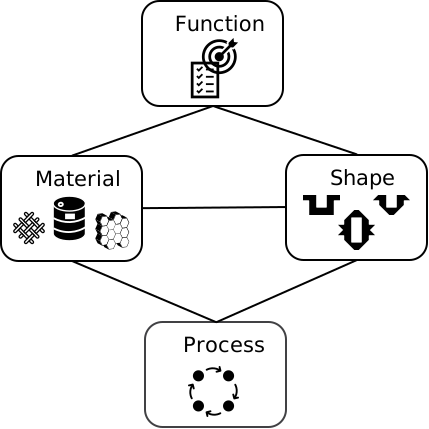
Within the Knowledge in Practice Centre the same methodology is applied but the process is more fully defined by also explicitly calling out the equipment and tooling & consumables. Note that in common usage, a process which consists of many steps can be arbitrarily defined by just one step, e.g. "spray-up". Though convenient, this can be misleading.

Workflows
The KPC's Practice and Case Study volumes consist of three types of workflows:
- Development - Analyzing the interactions between MSTE in the process steps to make decisions on processing parameters and understanding how the process steps and factory cells fit within the factory.
- Troubleshooting - Guiding you to possible causes of processing issues affecting either cost, rate or quality and directing you to the most appropriate development workflow to improve the process
- Optimization - An expansion on the development workflows where a larger number of options are considered to achieve the best mixture of cost, rate & quality for your application.
To use this website, you must agree to our Terms and Conditions and Privacy Policy.
By clicking "I Accept" below, you confirm that you have read, understood, and accepted our Terms and Conditions and Privacy Policy.

