
Mechanical characterization of welded or bonded joints - A412
| Mechanical characterization of welded or bonded joints | |
|---|---|
| Foundational knowledge article | |
| Document Type | Article |
| Document Identifier | 412 |
| Tags | |
| Prerequisites | |
Introduction[edit | edit source]
Welded and bonded joints are widely used in engineering structures, and their mechanical performance often controls the overall behaviour and reliability of the assembly. Mechanical characterization is therefore required to evaluate strength, stiffness, and failure behaviour under service loading.
A broader overview on this topic is provided in the following webinars: Introduction to Adhesive Bonding - Part I - A354, Introduction to Adhesive Bonding - Part II - A355 and Introduction to the welding of thermoplastic composites - A323.
Scope[edit | edit source]
This article focuses on the mechanical characterization of welded or bonded joints through lap shear and cantilever beam tests. While many other test methods exist to measure the strength or fracture toughness of bonded or welded joints, these two tests are the most commonly used.
Significance[edit | edit source]
The study of welded and bonded joints is important because joints are often the weakest or most critical part of a structure. Accurate characterization supports better design, safer operation, and improved prediction of structural integrity and service life.
Single Lap Shear (SLS) Test[edit | edit source]
Introduction[edit | edit source]
This test is designed to measure the bonding characteristics of adhesives for joining fibre reinforced polymers to themselves or to metals. It is also used to measure the bonding characteristics of thermoplastic composite welded joints. This page is based on the testing standards ASTM D5868: “Standard Test Method for Lap Shear Adhesion for Fiber Reinforced Plastic (FRP) Bonding” which is inspired from ASTM D1002: “Standard Test Method for Apparent Shear Strength of Single-Lap-Joint Adhesively Bonded Metal Specimens by Tension Loading (Metal-to-Metal)” [1] [2]. In this test, two rectangular strips of composite laminates are joined over a certain overlap area. The joining can be done by adhesive bonding or welding in the case of thermoplastic composites. The assembly is loaded into a test frame by grips clamping each end of the specimen. The load frame applies a constant displacement in tension and records the force. This can then be used to calculate an “apparent lap shear strength” which is obtained by dividing the maximum load recorded during the test by the specimen assembly overlap area. This apparent lap shear strength can be useful to compare different adhesives, different surface treatments or different welding parameters, but it is not to be used as a design allowable stress. In fact, the stress state in the overlap area of a bonded or welded joint involves both shear and peel stresses and important stress concentration at the edges.
Test Specimen[edit | edit source]
Two fibre reinforced polymer composite rectangular strips 100 mm long and 25 mm wide are used as substrates (adherents). The substrates are bonded or welded over an overlap area 25 mm x 25 mm. Overlap areas of 12.5 mm x 25 mm are also sometimes used. The geometry of the test specimens is shown on Figure 1:

The thickness of the adherents is not specified but the assembly should be designed so that failure occurs in the bonded or welded overlap area. Tabs should be bonded to the ends of the substrates to avoid bending of the specimen when it is gripped in the load frame. Alternatively, one grip can be shifted by the substrate thickness to grip it without inducing bending. For simplicity, the tabs are often made of a piece of the same composite material as the substrate. The bonding of the tabs to the adherents is not as important as it is for a tensile test (see Tensile Testing - M117). Here the tabs serve to align the specimen in the testing machine. The load will normally be transferred properly to the adherents and the bond area and no failure is usually reported in the vicinity of the testing machine grips. Table 1 summarizes the specimen geometric parameters.
| Specimen geometric parameter | Requirement |
|---|---|
| Adherent length | 100 mm |
| Adherent width | 25 mm |
| Adherent thickness | Designed so that failure occurs in bond area |
| Overlap length | 25 mm or sometimes 12.5 mm |
| Tabs length (if needed) | No requirement. Typically 25 mm |
| Tabs thickness (if needed) | Adherent + bond thicknesses |
Procedure[edit | edit source]
Once the specimen is ready, it is loaded into the test frame. It is important that the specimen is aligned precisely with the grips and not loaded at an angle. The test is conducted under displacement control, at a crosshead speed of 13 mm/min. The force and displacement are recorded until failure of the bonded assembly. The maximum recorded force is used to calculate the apparent lap shear strength as follows\[ Apparent LSS = \frac{F_{max}}{wl} \]
where \(LSS\) stands for lap shear strength (MPa), \(F_{max}\) is the maximum recorded force during the test (N), \(w\) is the specimen width (mm) and \(l\) is the overlap length (mm). The apparent LSS is useful to compare various adhesives, surface preparation techniques or various welding parameters. However, the values are not to be used as design allowable. It is known that the state of stress at the joint interface involves shear and peel stresses with important stress concentrations at the joint’s ends. Figure 2 below shows typical evolutions of the shear and peel stresses in such a bonded or welded joint. The specific evolution of the stresses along the overlap length depends on a number of factors, including the adherents thickness and stiffness.

Failure Modes[edit | edit source]
The single lap shear specimens can experience different failure modes (see Figure 3). They are generally classified as adherent, cohesive and adhesive failure modes. Adherent failure means that failure has occurred outside of the bond area, in one of the two adherents. This failure mode does not give an indication of the strength of the bonded or welded joint. It may involve delamination of the adherent in the vicinity of the joint due to peel stresses. If the adherent is not properly designed for the lap shear test (too thin for example), it is possible to obtain failure of the laminate in tension. The cohesive failure mode occurs inside the adhesive (or weld line the case of a welded joint). This failure can be due to shear or peel stresses or a combination of the two. Finally, the adhesive failure mode involves debonding of one of the two adherents. This is generally an indication of a weak joint and can be due to improper welding parameters or poor surface treatment in the case of adhesive bonding.

Double Cantilever Beam (DCM) Test[edit | edit source]
Introduction[edit | edit source]
This test is designed to measure the Mode I interlaminar fracture toughness, \(G_{Ic}\), of continuous fibre-reinforced composites. The test is limited to unidirectional composites with fibre aligned along the length of the specimens. The test is also sometimes used to verify the bonding characteristics of adhesively-bonded, or welded, joints. In the double cantilever beam, or DCB test, load is applied to a notched specimen, creating a growing crack that propagates between the composite plies or along the adhesive layer under Mode I (opening mode) loading. This page is based on the ASTM D5528 Standard Test Method for Mode I Interlaminar Fracture Toughness of Unidirectional Fiber-Reinforced Polymer Matrix Composites [3]. This standard is often adapted to be used for bonded or welded joints. Mode I crack opening is a fracture mode in which the delamination faces separate by opening away from each other. The energy loss \(dU\) per unit of specimen width for an infinitesimal increase in delamination length \(da\) is the energy release rate, referred to as \(G\) \[ G = - \frac{1}{b}\frac{dU}{da} \]
with \(U\) the total elastic energy in the test specimen, \(b\) the specimen width and \(a\) the delamination length. The test is used to determine the Mode I interlaminar fracture toughness \(G_{Ic}\) which is the critical value of \(G\) for delamination growth. In the case of bonded or welded joints, the DCB and single lap shear (see Figure 1) tests give complementary information on the joint mechanical performance. Very often, bonded and welded joints offer a good resistance to shear forces (mostly measured by the SLS test) but poor resistance to crack propagation due to opening forces (measured with the DCB test).
Test Specimen[edit | edit source]
When this test is used to measure the interlaminar fracture toughness of bonded or welded joints, two rectangular strips of composite laminates are joined over a certain area and left unbonded over a length \(a_o\) to serve as a crack initiator. In addition to the length \(a_o\), an additional length is left unbonded to affix hinges or blocks that are used to apply the opening load (see Figure 4). These hinges or blocks must be at least as wide as the specimen to which they are fixed. The total specimen unbonded or unwelded length is approximately 63 mm, including the initial delamination length \(a_o\) of 50 mm plus the extra length required to bond the piano hinges or blocks. The composite laminates are at least 125 mm long and 20 to 25 mm wide. The two laminates (substrates) that are bonded or welded together must be of the same nature, have the same number of plies and same lay-up, making the DCB specimen symmetrical relative to the bondline.

When performing the DCB test on a consolidated specimen with crack occurring between two plies, a non adhesive film is usually placed at mid thickness during the manufacturing of the specimen to serve as a notch. In the case of a bonded or welded joint, such a film is not always necessary as bonding or welding can be conducted only over a certain length of the specimen. Table 2 summarizes the specimen geometric parameters.
| Specimen geometric parameter | Requirement |
|---|---|
| Adherent length | At least 125 mm |
| Adherent width, \(b\) | 20 to 25 mm |
| Adherent thickness | Designed so that large deformation of the specimen is avoided |
| Initial delamination length, \(a_0\) | Approx. 50 mm |
Procedure[edit | edit source]
The load blocks or hinges are mounted in the grips of the testing machine. The load frame applies a constant displacement speed (typically 1.0 to 5.0 mm/min) and load is recorded. The opening displacement can be approximated by the displacement of the testing machine grips, if the machine does not deform significantly relative to the specimen, or measured by visual methods (camera) or by a gage attached to the specimen. The crack propagation must also be monitored. This is usually achieved using a camera or microscope. To facilitate tracking, white paint can be applied to the edge of the specimen with marks every mm for at least the first 5 mm of the bondline. The rest of the bondline can include marks every 5 mm. Other tracking methods such as DIC can be used, as long as the delamination front can be measured with a minimal accuracy of 0.5 mm. The delamination length is defined as the distance between the load line and the delamination crack front.
The test is conducted as two series of loading/unloading as follows:
- Load the specimen at a constant crosshead displacement rate between 1 and 5 mm/min.
- Record the load, crosshead (or specimen) vertical displacement and the location of the delamination front. Also record the point on the load-displacement curve at which the delamination growth onset was observed.
- Stop loading after a delamination crack growth of 3 to 5 mm.
- Unload the specimen at a crosshead speed of 25 mm/min.
- Repeat steps 1 to 4 for a delamination crack growth of 50 mm.
The ASTM D5528 standard gives additional details on the test procedure which should be followed to obtain meaningful results. If delamination propagates inside the laminates (and not at the bondline), then the test will be invalid and another sample will have to be used.
Calculations[edit | edit source]
An R-curve, showing the \(G_{1c}\) values as a function of delamination length a, is constructed. The \(G_{1c}\) values can be calculated based on a modified beam theory, compliance calibration method or modified compliance calibration method. Although the three methods give similar results, the modified beam theory is most often used. \(G_1\) is then calculated as\[ G_1 = \frac{3Pδ}{2ba} \]
where:
\(P\) = load (N)
\(δ\) = load point displacement (mm)
\(b\) = Specimen width (mm)
\(a\) = delamination length (mm)
The initial value of \(G_{1c}\) is reported for the onset of delamination growth when the specimen is first loaded. This initial value can be calculated from the load and displacement at the onset of non-linearity of the load/displacement curve. It can also be obtained from the load and displacement values recorded when the delamination is first visually observed to grow. Finally, another method uses the load and displacement values when the load/displacement curve has become non linear with a 5% increase in compliance from the original linear region. An example of an R-curve is given in Figure 5.

References[edit | edit source]

Welcome
Welcome to the CKN Knowledge in Practice Centre (KPC). The KPC is a resource for learning and applying scientific knowledge to the practice of composites manufacturing. As you navigate around the KPC, refer back to the information on this right-hand pane as a resource for understanding the intricacies of composites processing and why the KPC is laid out in the way that it is. The following video explains the KPC approach:
Understanding Composites Processing
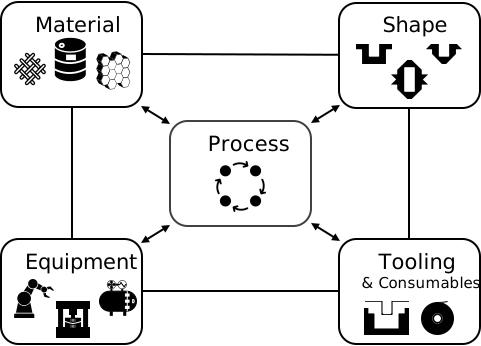
The Knowledge in Practice Centre (KPC) is centered around a structured method of thinking about composite material manufacturing. From the top down, the heirarchy consists of:
- The factory
- Factory cells and/or the factory layout
- Process steps (embodied in the factory process flow) consisting of:
The way that the material, shape, tooling & consumables and equipment (abbreviated as MSTE) interact with each other during a process step is critical to the outcome of the manufacturing step, and ultimately critical to the quality of the finished part. The interactions between MSTE during a process step can be numerous and complex, but the Knowledge in Practice Centre aims to make you aware of these interactions, understand how one parameter affects another, and understand how to analyze the problem using a systems based approach. Using this approach, the factory can then be developed with a complete understanding and control of all interactions.
Interrelationship of Function, Shape, Material & Process
Design for manufacturing is critical to ensuring the producibility of a part. Trouble arises when it is considered too late or not at all in the design process. Conversely, process design (controlling the interactions between shape, material, tooling & consumables and equipment to achieve a desired outcome) must always consider the shape and material of the part. Ashby has developed and popularized the approach linking design (function) to the choice of material and shape, which influence the process selected and vice versa, as shown below:
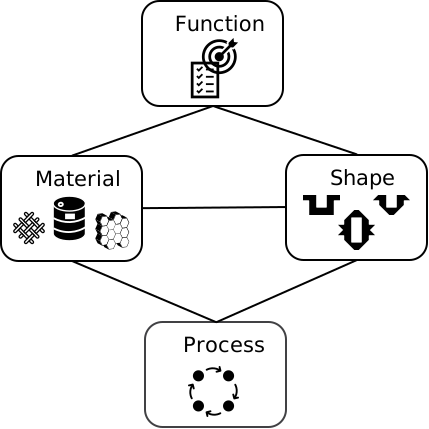
Within the Knowledge in Practice Centre the same methodology is applied but the process is more fully defined by also explicitly calling out the equipment and tooling & consumables. Note that in common usage, a process which consists of many steps can be arbitrarily defined by just one step, e.g. "spray-up". Though convenient, this can be misleading.

Workflows
The KPC's Practice and Case Study volumes consist of three types of workflows:
- Development - Analyzing the interactions between MSTE in the process steps to make decisions on processing parameters and understanding how the process steps and factory cells fit within the factory.
- Troubleshooting - Guiding you to possible causes of processing issues affecting either cost, rate or quality and directing you to the most appropriate development workflow to improve the process
- Optimization - An expansion on the development workflows where a larger number of options are considered to achieve the best mixture of cost, rate & quality for your application.
To use this website, you must agree to our Terms and Conditions and Privacy Policy.
By clicking "I Accept" below, you confirm that you have read, understood, and accepted our Terms and Conditions and Privacy Policy.

