
Thermoplastic welding - A408
| Thermoplastic welding | |
|---|---|
| Document Type | Article |
| Document Identifier | 408 |
| Tags | |
| Prerequisites | |
Introduction[edit | edit source]
Thermoplastic composite parts provide the unique ability to be welded together, providing many advantages over mechanical fasteners or conventional adhesive bonding. The development of the weld relies mostly on the quality of the contact between the parts, defined as the degree of intimate contact, and the diffusion of the polymer chain across the interface from one side to the other, defined as the degree of healing. A variety of welding techniques exist.
Scope[edit | edit source]
This page provides an overview of the process of thermoplastic welding. It first covers the theory of welding with its two main parts, intimate contact and healing, and how it differs from adhesive bonding, followed by an introduction to the main methods of welding and typical characterization techniques.
Significance[edit | edit source]
Thermoplastic welding is highly dependent on the applied temperature and pressure, as well as the process duration. The resulting mechanical properties are related to these process parameters. A good understanding of the welding mechanisms and good control of the process parameters is essential to ensure the completion of the welding process.
Overview[edit | edit source]
Thermoplastic composites can be joined using typical techniques such as adhesive bonding and mechanical fastening. However, these techniques present limitations in their use with thermoplastic composite parts. Extensive surface preparation is often required to use adhesives, which can be long and labor-intensive. The use of mechanical fasteners usually requires to drill holes in the composite parts, which can lead to delamination, stress concentration points and potential issues of galvanic corrosion [1].
An alternative joining method is available to thermoplastics by taking advantage of their fusible nature. Unlike thermosets, thermoplastics can be softened (in the case of an amorphous polymer) or molten (in the case of a semi-crystalline polymer) and reprocessed. When two parts in that softened/molten state are brought together under pressure, mobile polymer chains can cross the interface and join the two parts together. By keeping the parts in close contact during cooling, a solid joint is consolidated, and the two parts are joined. This is thermoplastic welding.
To achieve good mechanical properties in a welded joint, it is essential to understand which mechanisms are taking place to ensure to correct process parameters are selected.
Theory of Welding[edit | edit source]
When two parts to be welded, called adherends or substrates, are placed in close contact, the development of the weld relies mostly on two parameters: the quality of the contact between the parts, defined as the degree of intimate contact, and the diffusion of the polymer chain across the interface from one side to the other, defined as the degree of healing.
The surface of an adherend is not perfectly flat, it is typically made of asperities, or roughness, coming from the manufacturing process. The degree of intimate contact is defined as the fraction of the apparent contact surface that is really in contact at the microscopic level (see Figure 1). It varies from 0 to 1 (or 100%). When parts are brought together, only the top parts of the asperities are touching each other. This is defined as the initial degree of intimate contact. While temperature is increased and pressure is applied on the parts, the asperities start to deform and the contact increases (Figure 1). The degree of intimate contact increases, until eventually reaching 1 when the whole surface is in contact at the microscopic level. This happens when \(t = t_{\mathrm{ic}}\).

The second mechanism is the diffusion of polymer chains through the interface. This can only happen on surface areas where intimate contact has been reached. The mechanism relies on the polymer chain mobility, which is a function of temperature. At higher temperature, chains are more mobile and can cross the interface faster to bridge it and create a weld and “heal” the interface (Figure 2). This movement of the polymer chains across the interface is based on the polymer chain reptation theory, proposed by de Gennes in 1971 [2] . The strength of the interface increases during this process, and this increase in mechanical resistance is typically used to define the degree of healing. This value varies from 0 to 1, with 1 being the maximum strength of the interface, comparable to the bulk material strength.

Finally, the strength of the joint can also be expressed as the degree of welding. It corresponds to the joined evolution of both intimate contact and healing. It ranges from 0 to 1 and can be calculated as the product of the degree of intimate contact and the degree of healing. The significance of a degree of welding of 1 is that the maximum strength of the weld, equivalent to the strength of the bulk material, has been reached across the complete welding surface.
Common welding methods[edit | edit source]
Thermoplastic welding methods can be separated in three main categories, depending on how the heat is generated and brought to the welding interface: thermal welding, friction welding and electromagnetic welding [3] . Thermal welding techniques rely on direct heating of the material at the interface. This category regroups methods such as hot tool welding, conduction welding, infrared welding, hot gas welding, and laser welding. Friction welding techniques rely on the relative motion of the parts, and the resulting heat generated by friction at their interface, like what can be observed with metals. This category includes ultrasonic welding, friction stir welding, spin welding and vibration welding, amongst others. In electromagnetic welding, the heat is generated at the welding interface through an electromagnetic phenomenon. Typical methods of this group are resistance welding, induction welding, microwave welding and dielectric welding.

Characterization techniques[edit | edit source]
There are two main ways to characterize a weld: mechanical testing and non-destructive testing. For mechanical tests, samples are typically tested in single-lap shear or double cantilever beam configuration. These two tests allow to measure the weld shear strength and fracture toughness. The most used non-destructive method for the analysis of a weld is ultrasonic scanning (also known as C-scan). This method can detect voids located at the welding interface corresponding to a lack of contact between the two adherends. However, it cannot assess the degree of healing in the areas where intimate contact has been reached.
References[edit | edit source]
- ↑ [Ref] Composite Materials Handbook 17 - Polymer Matrix Composites; Materials Usage, Design and Analysis. 3. SAE International on behalf of CMH-17, a division of Wichita State University. 2012. ISBN 978-1-68015-454-2.CS1 maint: date and year (link)
- ↑ [Ref] Empty citation (help)
- ↑ [Ref] Empty citation (help)

Welcome
Welcome to the CKN Knowledge in Practice Centre (KPC). The KPC is a resource for learning and applying scientific knowledge to the practice of composites manufacturing. As you navigate around the KPC, refer back to the information on this right-hand pane as a resource for understanding the intricacies of composites processing and why the KPC is laid out in the way that it is. The following video explains the KPC approach:
Understanding Composites Processing
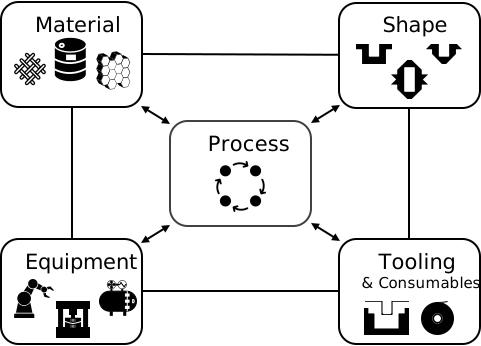
The Knowledge in Practice Centre (KPC) is centered around a structured method of thinking about composite material manufacturing. From the top down, the heirarchy consists of:
- The factory
- Factory cells and/or the factory layout
- Process steps (embodied in the factory process flow) consisting of:
The way that the material, shape, tooling & consumables and equipment (abbreviated as MSTE) interact with each other during a process step is critical to the outcome of the manufacturing step, and ultimately critical to the quality of the finished part. The interactions between MSTE during a process step can be numerous and complex, but the Knowledge in Practice Centre aims to make you aware of these interactions, understand how one parameter affects another, and understand how to analyze the problem using a systems based approach. Using this approach, the factory can then be developed with a complete understanding and control of all interactions.
Interrelationship of Function, Shape, Material & Process
Design for manufacturing is critical to ensuring the producibility of a part. Trouble arises when it is considered too late or not at all in the design process. Conversely, process design (controlling the interactions between shape, material, tooling & consumables and equipment to achieve a desired outcome) must always consider the shape and material of the part. Ashby has developed and popularized the approach linking design (function) to the choice of material and shape, which influence the process selected and vice versa, as shown below:
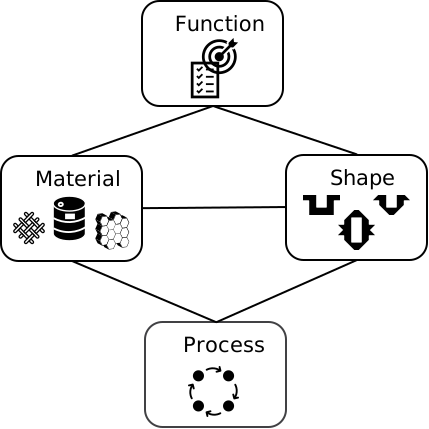
Within the Knowledge in Practice Centre the same methodology is applied but the process is more fully defined by also explicitly calling out the equipment and tooling & consumables. Note that in common usage, a process which consists of many steps can be arbitrarily defined by just one step, e.g. "spray-up". Though convenient, this can be misleading.

Workflows
The KPC's Practice and Case Study volumes consist of three types of workflows:
- Development - Analyzing the interactions between MSTE in the process steps to make decisions on processing parameters and understanding how the process steps and factory cells fit within the factory.
- Troubleshooting - Guiding you to possible causes of processing issues affecting either cost, rate or quality and directing you to the most appropriate development workflow to improve the process
- Optimization - An expansion on the development workflows where a larger number of options are considered to achieve the best mixture of cost, rate & quality for your application.
To use this website, you must agree to our Terms and Conditions and Privacy Policy.
By clicking "I Accept" below, you confirm that you have read, understood, and accepted our Terms and Conditions and Privacy Policy.

