
Ultrasonic welding - A411
| Ultrasonic welding | |
|---|---|
| Document Type | Article |
| Document Identifier | 411 |
| Tags | |
| Prerequisites | |
Introduction[edit | edit source]
Ultrasonic welding is a thermoplastic welding process relying on the application of rapid low-amplitude oscillations to generate heat at the joining interface. It is a very fast and energy-efficient method to join thermoplastic composite parts. The major challenge of the method consists in transmitting the vibrations through the substrate and concentrating the heat dissipation at the joining interface.
Information on more conventional joining methods can be found here: adhesive bonding and bolted joints.
Scope[edit | edit source]
This article provides an overview of the process of ultrasonic welding, the importance of vibration application, the role of energy directors, the heat generation mechanisms, and the pressure application. The main process parameters required to ensure a proper weld are presented and discussed. Finally, the required equipment to perform ultrasonic welding are introduced.
Significance[edit | edit source]
Ultrasonic welding is a fast and energy-efficient thermoplastic welding technique that can be used to simply and quickly join small parts. It excels in static single-point welding, although recent developments demonstrated the ability to weld continuous joints. A weld can be obtained in a few seconds, making ultrasonic welding a promising candidate for rapid assembly and high-rate manufacturing.
Overview[edit | edit source]
Ultrasonic welding fits into the friction welding category,. The heat generation is not caused be the relative movement of two parts with respect with each other, but rather relies on viscoelastic dissipation caused by the intermolecular friction in the polymer [1]. High-frequency mechanical vibrations are applied in the normal direction of the joining surface area, generating the required heat to perform welding. Control of the vibrations’ amplitude and frequency is essential to control the heat generation at the weld line.
Vibration Application[edit | edit source]
The application of mechanical vibrations at ultrasonic frequency is the driving force in ultrasonic welding. A typical ultrasonic setup is schematized in the figure below. A power supply converts the grid line electrical current (50-60 Hz) into a high-frequency signal, in the range of 20 to 40 kHz. This electrical signal is transformed into mechanical vibrations by a piezoelectric or a magneto-strictive transducer. From there, the amplitude of the vibrations is increased by passing through a booster, or amplitude transformer (as schematized in the right-hand side graphs in the figure below). The frequency of the ultrasonic vibrations is maintained, but a larger amplitude is reached, increasing the energy available for welding. The vibrations are then finally applied to the parts to be welded by the sonotrode (also called a horn), which is in direct contact with the upper substrate. The sonotrode is a rigid and flat part that can be round or rectangular [2]. The high-frequency vibrations applied by the sonotrode typically reach an amplitude in the range of 10 to 100 microns. These vibrations are then transmitted through the upper substrate to reach the welding interface, where heat dissipation must be concentrated.

Energy directors[edit | edit source]
If two substrates are simply placed against each other, vibrations will not dissipate favorably at the joining interface, and it will not be possible to perform welding. A small protrusion or a dedicated interlayer must be added between the parts to generate localized heating. This extra material introduced at the welding line is called an energy director, and it can take different forms:
- Small triangular polymer protrusions or asperities (around 0.5 mm) are molded or machined at the surface of the substrate in the welding area. They concentrate the stress and the heat generation at their extremity due to their geometry, which leads to melting at the expected welding interface.
- Thin polymer films of neat thermoplastic can act as the energy directors when placed at the welding line. These flat energy directors are more compatible with fibre-reinforced composites where machining asperities is challenging [3].
- Recent studies showed that polymer woven meshes can also act as flat energy directors [4].
The use of energy directors is essential to localize heating at the interface and promote uniform welding. It is highly recommended to use the same polymer in the energy directors as in the substrate to ensure good compatibility and high mechanical properties.
Heat Generation Mechanisms[edit | edit source]
As presented, heat dissipation favorably occurs in the energy directors. It can occur from different mechanisms. First, interfacial friction at asperities between the energy directors and the substrates occurs in the first milliseconds of the process, before the polymer is molten. This localized friction leads to heating, which is accentuated when using triangular energy directors concentrating the stress and the heat dissipation. Then, most of the subsequent heat generation happens through viscoelastic dissipation, when the high-frequency vibrations are absorbed and damped by the polymer chains, a phenomenon that converts mechanical energy into heat. In the case of a flat neat polymer energy director, heat dissipation relies mostly on the higher cyclic strain in the polymer layer due to its lower stiffness compared to the surrounding fibre-reinforced substrates [3]. Then, the continued vibrations maintain sufficient temperature at the interface until healing is complete.
Pressure Application[edit | edit source]
As in every thermoplastic welding technique, pressure application is applied to ensure intimate contact is reached between the substrates. In ultrasonic welding, it is also required to ensure proper contact between the sonotrode and the upper substrate to transmit the vibrations. The typical welding pressure required in ultrasonic welding ranges between 0.2 and 0.8 MPa. It is usually applied by a pneumatic or hydraulic system, which applies pressure in the normal direction of the welding surface area.
Pressure is maintained during the whole process. Before starting the vibrations, the pre-pressure ensures full contact between the sonotrode and the upper substrate, as well as between both substrates. During the weld formation at high temperature, it ensures the melt flow of the polymer and the development of intimate contact. Finally, holding pressure during cooling after stopping the vibrations guarantees that the solidification of the weld is complete, and that it does not suffer from deconsolidation, which would lead to low mechanical properties.
Important process parameters[edit | edit source]
Ultrasonic welding is controlled by a set of process parameters which are essential to be properly controlled:
- Vibrations amplitude (microns)
- Vibration frequency (kHz)
- Welding time (s)
- Welding pressure (MPa)
- Holding (or cooling) time (s)
The process can be controlled either by fixing the vibration duration, the weld line thickness (welding stops when a target thickness is reached), or by fixing the vibrational energy that is transmitted by the system in the substrates.
Equipment for resistance welding[edit | edit source]
A complete ultrasonic welding setup consists of the following pieces of equipment:
- A generator, or power supply, which converts the line power to high-frequency current. Generators are typically programmable to the desired process control mode.
- A transducer, which is a piezoelectric material that converts the electrical oscillations into mechanical vibrations.
- An amplitude transformer, or booster, can increase the amplitude of the mechanical vibrations to reach a desired target.
- A sonotrode, or horn, which is in contact with the upper substrate and ensures the transmission of the mechanical vibrations
- A pressure system, which maintains a downward force applied to the parts throughout the process
- Fixtures and tooling to hold the substrates in place and of support under the bottom substrate.
References[edit | edit source]
Yousefpour et al., Fusion Bonding/Welding of Thermoplastic Composites, Journal of Thermoplastic Composite Materials, 2004
Brito et al., On improving process efficiency and weld quality in ultrasonic welding of misaligned thermoplastic composite adherends, Composite Structures, n° 304, 2023
Jongbloed et al., A Study on Through-the-Thickness Heating in Continuous Ultrasonic Welding of Thermoplastic Composites, Materials, n°14, 2021
Lévy et al., Modeling of the heating phenomena in ultrasonic welding of thermoplastic composites with flat energy directors, Journal of Materials Processing Technology, vol. 214, n°7, pp. 1361-1371, 2014

Welcome
Welcome to the CKN Knowledge in Practice Centre (KPC). The KPC is a resource for learning and applying scientific knowledge to the practice of composites manufacturing. As you navigate around the KPC, refer back to the information on this right-hand pane as a resource for understanding the intricacies of composites processing and why the KPC is laid out in the way that it is. The following video explains the KPC approach:
Understanding Composites Processing
The Knowledge in Practice Centre (KPC) is centered around a structured method of thinking about composite material manufacturing. From the top down, the heirarchy consists of:
- The factory
- Factory cells and/or the factory layout
- Process steps (embodied in the factory process flow) consisting of:
The way that the material, shape, tooling & consumables and equipment (abbreviated as MSTE) interact with each other during a process step is critical to the outcome of the manufacturing step, and ultimately critical to the quality of the finished part. The interactions between MSTE during a process step can be numerous and complex, but the Knowledge in Practice Centre aims to make you aware of these interactions, understand how one parameter affects another, and understand how to analyze the problem using a systems based approach. Using this approach, the factory can then be developed with a complete understanding and control of all interactions.
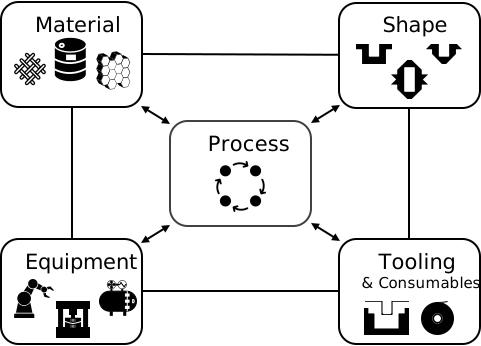
Interrelationship of Function, Shape, Material & Process
Design for manufacturing is critical to ensuring the producibility of a part. Trouble arises when it is considered too late or not at all in the design process. Conversely, process design (controlling the interactions between shape, material, tooling & consumables and equipment to achieve a desired outcome) must always consider the shape and material of the part. Ashby has developed and popularized the approach linking design (function) to the choice of material and shape, which influence the process selected and vice versa, as shown below:
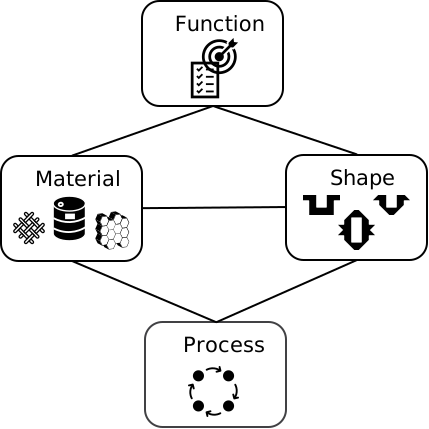
Within the Knowledge in Practice Centre the same methodology is applied but the process is more fully defined by also explicitly calling out the equipment and tooling & consumables. Note that in common usage, a process which consists of many steps can be arbitrarily defined by just one step, e.g. "spray-up". Though convenient, this can be misleading.

Workflows
The KPC's Practice and Case Study volumes consist of three types of workflows:
- Development - Analyzing the interactions between MSTE in the process steps to make decisions on processing parameters and understanding how the process steps and factory cells fit within the factory.
- Troubleshooting - Guiding you to possible causes of processing issues affecting either cost, rate or quality and directing you to the most appropriate development workflow to improve the process
- Optimization - An expansion on the development workflows where a larger number of options are considered to achieve the best mixture of cost, rate & quality for your application.
To use this website, you must agree to our Terms and Conditions and Privacy Policy.
By clicking "I Accept" below, you confirm that you have read, understood, and accepted our Terms and Conditions and Privacy Policy.

