
Induction welding - A409
| Induction welding | |
|---|---|
| Document Type | Article |
| Document Identifier | 409 |
| Tags | |
| Prerequisites | |
Introduction[edit | edit source]
Induction welding is an electromagnetic thermoplastic welding process relying on the application of an alternating magnetic field to generate heat at the joining interface. Heat can be generated directly in the substrates to be welded if they are electrically conductive or if a heating element is placed at the joining interface called a susceptor, which can heat up when subjected to an alternating magnetic field.
Webinars related to this topic have been delivered, including: Introduction to the processing of thermoplastic composites - A322, Introduction to the welding of thermoplastic composites - A323, and Continuous Welding of Thermoplastic Composites - A398.
Scope[edit | edit source]
This article provides an overview of the process of induction welding, starting from the magnetic field application and its interaction with the materials to generate heat. The main process parameters required to ensure a proper weld are presented and discussed.
Significance[edit | edit source]
Induction welding is a fast, contact-less thermoplastic welding method, which can be used to join thermoplastic and thermoplastic composite substrates. A good knowledge of the interactions between the material and the magnetic field is essential to understand the heat generation mechanisms and the development of the degree of welding during the process, which lead to the obtention of high mechanical properties.
Overview[edit | edit source]
Induction welding falls into the electromagnetic welding category, as the heat generation relies on the application of an alternating magnetic field at the welding interface (Ahmed et al., 2005). This magnetic field interacts with the substrates or with a heating element called a susceptor to generate heat at the welding interface. The thermoplastic matrix melts (or softens in the case of an amorphous polymer) and chain mobility is allowed. Pressure is applied to the welding interface to develop the degree of welding.
Magnetic Field Application[edit | edit source]
The magnetic field is generated by an induction coil placed in the vicinity of the welding line. The induction coil is typically a copper tube of circular or square cross-section, in which an alternating current is circulating. The alternating frequency of the current varies from a few tens of kHz to approximately 500 kHz, depending on the selected system.
The coil is actively water-cooled during usage, as it can significantly heat up by the Joule effect, despite the low resistivity of copper.
The distance between the coil and the substrate is often referred to as the coupling distance. As the magnetic field intensity reduces with the cube of this distance, it must be minimised to ensure that enough heat is generated.
Coil Geometry[edit | edit source]
The induction coil geometry directly impacts the magnetic field shape and, therefore, the heat generation. The typical shape of the coil can vary from straight, single-turn (hairpin coil) to rolled, multi-turn (pancake) geometry [1]. It must be adapted to obtain the desired heat affected zone at the welding interface [2].
To locally increase the magnetic field intensity, a magnetic flux concentrator (MFC) can be mounted on the induction coil. This item, typically made of ferrite or soft magnetic material with high magnetic permeability [3], redirects the magnetic field lines to concentrate the field’s intensity in a desired area (where the weld is occurring). This increases the efficiency of the process and can lead to higher, more localized heating.
Susceptor[edit | edit source]
To melt or soften the thermoplastic polymer at the welding interface, the alternating magnetic field must be transformed into heat. The first method is to use a heating element that can absorb the electromagnetic energy and transform it into heat. This type of heating element is called a susceptor and can rely on two different mechanisms to generate heat.
The first mechanism is the generation of eddy currents, which in turn produces heat by resistance. This happens in electrically-conductive materials such as metallic meshes (like the stainless-steel ones used in resistance welding. Induced electrical currents are generated in the susceptor when it is subjected to an alternating magnetic field, and heat is generated through Joule losses (Figure 1 a). This can also be done directly in the substrate if it is electrically-conductive (such as carbon fibre), which removes the need for an extra heating material at the joining interface [4] [2]. This method is often referred to as “susceptor-less” welding (Figure 1 b).
The second mechanism relies on hysteresis losses in a ferromagnetic material. When a ferromagnetic material is subjected to an alternative magnetic field, it will get magnetized in alternating directions, following the direction of the external field. During that process, the magnetization is not linear with the applied field, but it rather forms a specific curve called a hysteresis. This is caused by the residual magnetization in the ferromagnetic material when the external field is removed. During a complete cycle of magnetization (which corresponds to the material being magnetized once in both directions, forming one full hysteresis loop), a fraction of the electromagnetic energy absorbed by the ferromagnetic material is released in the form of heat (Figure 1 c). This heat is used to melt or soften the surrounding thermoplastic polymer and perform induction welding.
Magnetic susceptors relying on hysteresis loop typically take the form of ferromagnetic particles distributed in a film of polymer [5] [6]. Each particle can heat up when the external magnetic field is applied, which makes the heating area more homogeneous than when using electrical susceptors, as edge effects are avoided. But these susceptors typically require higher magnetic field amplitude and/or frequency to heat up and weld thermoplastic substrate, especially high-performance thermoplastics like PEEK or PEI.

Pressure application[edit | edit source]
To obtain a high-strength weld, intimate contact must be reached at the interface between the two substrates to be joined. This is obtained by applying pressure on the joining surface area while the polymer is above its melting point or glass transition temperature. The pressure must then be maintained during cooling to avoid the deconsolidation of the weld and voids formation.
Typical pressure range for thermoplastic welding is around 0.4 to 0.8 MPa [7]. At lower pressure, intimate contact is not complete, and weld strength drops. At higher pressure, there is a risk of polymer being squeezed out of the welding region, fiber misalignment, and loss of dimensional stability, which can lead to lower mechanical properties.
Equipment for welding[edit | edit source]
- A power supply able to deliver alternating currents at the required frequency. A matching circuit (made of a capacitor and a transformer), also called a welding head, is usually present to convert the frequency from the grid frequency (typically 50 or 60Hz). The required power usually ranges from 1 to 10 kW.
- An induction coil, mounted on the welding head, through which the current travels to generate the magnetic field. Its geometry must be adapted to the welding geometry and the desired heat-affected zone. The use of an MFC on the induction coil is not mandatory, but it can improve the efficiency of the process. It must be mounted on the induction coil using a thermally conductive paste to ensure perfect contact and active cooling. As the MFC significantly heats up during the process, it must be cooled by the water circulating in the induction coil to avoid overheating and electrical arc formation.
- A cooling system connected to the coil, ensuring that the induction coil (and the MFC) remains at a low temperature to avoid degradation and damage.
- A pressure application device, which can be a pressure roller or a static pressure piston, delivering the required pressure on the welding area.
References[edit | edit source]

Welcome
Welcome to the CKN Knowledge in Practice Centre (KPC). The KPC is a resource for learning and applying scientific knowledge to the practice of composites manufacturing. As you navigate around the KPC, refer back to the information on this right-hand pane as a resource for understanding the intricacies of composites processing and why the KPC is laid out in the way that it is. The following video explains the KPC approach:
Understanding Composites Processing
The Knowledge in Practice Centre (KPC) is centered around a structured method of thinking about composite material manufacturing. From the top down, the heirarchy consists of:
- The factory
- Factory cells and/or the factory layout
- Process steps (embodied in the factory process flow) consisting of:
The way that the material, shape, tooling & consumables and equipment (abbreviated as MSTE) interact with each other during a process step is critical to the outcome of the manufacturing step, and ultimately critical to the quality of the finished part. The interactions between MSTE during a process step can be numerous and complex, but the Knowledge in Practice Centre aims to make you aware of these interactions, understand how one parameter affects another, and understand how to analyze the problem using a systems based approach. Using this approach, the factory can then be developed with a complete understanding and control of all interactions.
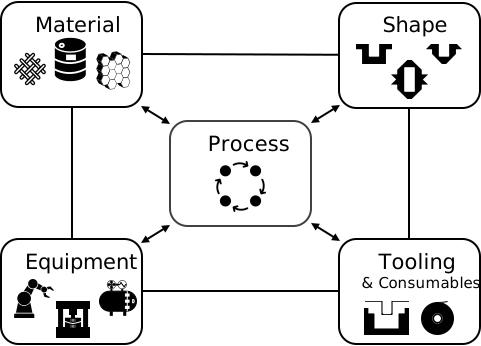
Interrelationship of Function, Shape, Material & Process
Design for manufacturing is critical to ensuring the producibility of a part. Trouble arises when it is considered too late or not at all in the design process. Conversely, process design (controlling the interactions between shape, material, tooling & consumables and equipment to achieve a desired outcome) must always consider the shape and material of the part. Ashby has developed and popularized the approach linking design (function) to the choice of material and shape, which influence the process selected and vice versa, as shown below:
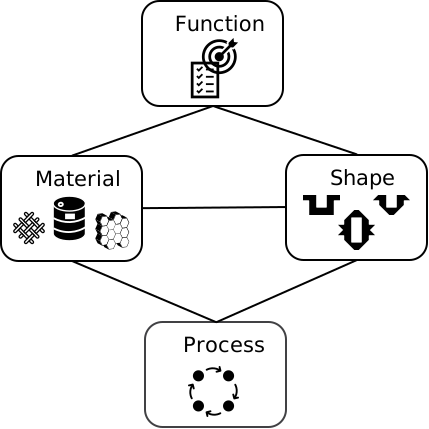
Within the Knowledge in Practice Centre the same methodology is applied but the process is more fully defined by also explicitly calling out the equipment and tooling & consumables. Note that in common usage, a process which consists of many steps can be arbitrarily defined by just one step, e.g. "spray-up". Though convenient, this can be misleading.

Workflows
The KPC's Practice and Case Study volumes consist of three types of workflows:
- Development - Analyzing the interactions between MSTE in the process steps to make decisions on processing parameters and understanding how the process steps and factory cells fit within the factory.
- Troubleshooting - Guiding you to possible causes of processing issues affecting either cost, rate or quality and directing you to the most appropriate development workflow to improve the process
- Optimization - An expansion on the development workflows where a larger number of options are considered to achieve the best mixture of cost, rate & quality for your application.
To use this website, you must agree to our Terms and Conditions and Privacy Policy.
By clicking "I Accept" below, you confirm that you have read, understood, and accepted our Terms and Conditions and Privacy Policy.

