
Case Study of Using Out of Autoclave Processing - C131
| Case Study of Using Out of Autoclave Processing | |||||||
|---|---|---|---|---|---|---|---|
| Case study | |||||||

| |||||||
| Document Type | Case study | ||||||
| Document Identifier | 131 | ||||||
| Objective functions |
| ||||||
| MSTE workflow | Development | ||||||
| Prerequisites |
| ||||||
Inroduction[edit | edit source]
OOA prepregs are preferred against autoclave in multiple programs. There are two well-documented examples of that: coupon-level (NASA) and structural component (Boeing), which illustrate both the equivalence potential and the sensitivities of OOA processing.
NASA Comparative Study[1][edit | edit source]
NASA compared four unidirectional systems processed as quasi-isotropic laminates: autoclave-qualified IM7/8552-1 and IM7/977-3, as well as OOA-qualified IM7/MTM45-1 and T40-800B/5320 (see Figure 1). Panels were produced in “fresh” condition and in “out-life” condition (materials stored beyond vendor recommendations).
- Laminate quality: fresh OOA panels achieved void contents less than 0.1%, equivalent to autoclave systems.
- Out-of-life MTM45-1 panels rose to 8% voids, with reduced fiber volume fraction from 58% to 53%).
- Mechanical performance: under fresh conditions, OOA and autoclave laminates had comparable open-hole compression (OHC) and strength of 335-374 MPa. Out-of-life OOA laminates lost more than 50% of OHC strength, while autoclave systems showed only modest drops.
- Handling & tack: OOA systems displayed shorter tack life of 21 days, while it was 60 days for autoclave resins.
- Implications: OOA can equal autoclave standards when fresh, but it is far more vulnerable to out-time excursions. Processing control is therefore critical (see Porosity in Composites and Prepreg Storage & Handling).

Boeing Structural C-Channel: Configured Part[2][edit | edit source]
Boeing fabricated a structural C-channel using IM7/8552 (autoclave) and CYCOM® 5320/T40-800B (OOA), both cured under representative conditions.
- Laminate quality: cross-sectional inspection showed no voids, wrinkles, or pooling. Resin content was consistent (27-32 wt%), and Tg met target (154°C).
- Mechanical properties: across load cases, SBS, CLC, OHC, tension, and flange bending, the OOA channel was statistically equivalent to its autoclave counterpart. Small deviations, such as flange bending, were within expected scatter.
- Implications: at the component level, OOA prepregs can deliver structural performance equivalent to autoclave systems, provided cure and layup discipline are maintained.
Applications[edit | edit source]
OOA prepreg processing has progressed from laboratory trials to serialised production in multiple sectors. Its appeal lies in eliminating autoclaves while still achieving aerospace-grade laminate quality. In practice, OOA is strongest for thin-to-moderate laminates and large structures, while autoclaves remain preferred for very thick or safety-critical parts.
Conclusion[edit | edit source]
OOA prepreg processing is a viable alternative to autoclave curing when its unique constraints are managed. It lowers cost and removes vessel size limits, enabling broader adoption, but demands strict control of vacuum integrity, cure cycles, and thermal management. In practice, OOA is best suited for thin-to-moderate laminates, while autoclaves remain preferred for thick or highly critical structures.
 |
 |
| About | Help |

Welcome
Welcome to the CKN Knowledge in Practice Centre (KPC). The KPC is a resource for learning and applying scientific knowledge to the practice of composites manufacturing. As you navigate around the KPC, refer back to the information on this right-hand pane as a resource for understanding the intricacies of composites processing and why the KPC is laid out in the way that it is. The following video explains the KPC approach:
Understanding Composites Processing
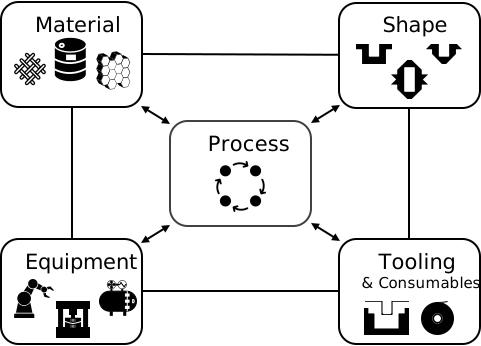
The Knowledge in Practice Centre (KPC) is centered around a structured method of thinking about composite material manufacturing. From the top down, the heirarchy consists of:
- The factory
- Factory cells and/or the factory layout
- Process steps (embodied in the factory process flow) consisting of:
The way that the material, shape, tooling & consumables and equipment (abbreviated as MSTE) interact with each other during a process step is critical to the outcome of the manufacturing step, and ultimately critical to the quality of the finished part. The interactions between MSTE during a process step can be numerous and complex, but the Knowledge in Practice Centre aims to make you aware of these interactions, understand how one parameter affects another, and understand how to analyze the problem using a systems based approach. Using this approach, the factory can then be developed with a complete understanding and control of all interactions.
Interrelationship of Function, Shape, Material & Process
Design for manufacturing is critical to ensuring the producibility of a part. Trouble arises when it is considered too late or not at all in the design process. Conversely, process design (controlling the interactions between shape, material, tooling & consumables and equipment to achieve a desired outcome) must always consider the shape and material of the part. Ashby has developed and popularized the approach linking design (function) to the choice of material and shape, which influence the process selected and vice versa, as shown below:
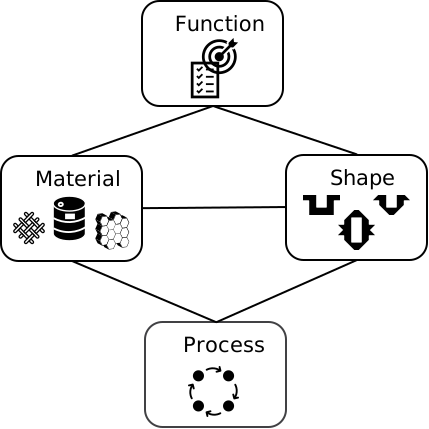
Within the Knowledge in Practice Centre the same methodology is applied but the process is more fully defined by also explicitly calling out the equipment and tooling & consumables. Note that in common usage, a process which consists of many steps can be arbitrarily defined by just one step, e.g. "spray-up". Though convenient, this can be misleading.

Workflows
The KPC's Practice and Case Study volumes consist of three types of workflows:
- Development - Analyzing the interactions between MSTE in the process steps to make decisions on processing parameters and understanding how the process steps and factory cells fit within the factory.
- Troubleshooting - Guiding you to possible causes of processing issues affecting either cost, rate or quality and directing you to the most appropriate development workflow to improve the process
- Optimization - An expansion on the development workflows where a larger number of options are considered to achieve the best mixture of cost, rate & quality for your application.
To use this website, you must agree to our Terms and Conditions and Privacy Policy.
By clicking "I Accept" below, you confirm that you have read, understood, and accepted our Terms and Conditions and Privacy Policy.

