
Tensile Strength, Elastic Modulus and Elongation at Break in Polymers - A434
| Tensile Strength, Elastic Modulus and Elongation at Break in Polymers | |
|---|---|
| Foundational knowledge article | |
| Document Type | Article |
| Document Identifier | 434 |
| Tags | |
| Prerequisites | |
Introduction[edit | edit source]
The mechanical behavior of polymers—characterized by tensile strength, elastic modulus, and elongation at break—is governed by their molecular structure and environmental conditions. Their properties are highly sensitive to strain rate and temperature, although thermoplastic and thermoset properties are affected differently, therefore experimental testing under realistic conditions to capture temperature- and rate-dependent effects is recommended.
Significance[edit | edit source]
Understanding the physical phenomena behind tensile measurement of polymers is essential because they reflect the fundamental deformation and failure mechanisms. Tensile properties — such as modulus, yield strength, and elongation at break — are variously governed by molecular structure, chain entanglement, and intermolecular forces. For thermoplastics, these properties depend on crystallinity and glass transition temperature, while thermosets are influenced by crosslink density. Furthermore, as viscoelastic materials, the mechanical properties of polymers are strain rate and temperature dependent.
Scope[edit | edit source]
This document describes the measurements accessible though tensile testing of coupons (elastic modulus, yield strength, and elongation at break) with a view towards the physical phenomena that impact their value for both thermoplastic and thermoset polymers.
Definitions and Fundamental Material Properties[edit | edit source]
Tensile Strength is the maximum stress a polymer can withstand while being stretched before fracturing. Given that thermal energy increases chain mobility in polymers, in general, tensile strength for ductile materials decreases as temperature increases. Yielding is an onset of permanent deformation: beyond this point, the material undergoes irreversible molecular rearrangement, leading to necking or microcracking[1][2][3].
Elastic Modulus (Young’s Modulus) measures a polymer’s stiffness, representing the ratio of stress to strain within the elastic region. A high modulus indicates rigidity, while a low modulus suggests flexibility[4][5].
Elongation at break measures the polymer's ductility, expressed as the percent increase in length before fracture. Highly ductile polymers can elongate several hundred percent, while brittle materials may break at less than 5% strain[6].
Unlike metals, polymers exhibit viscoelastic behavior, meaning they experience both flow and energy storage phenomena simultaneously, and their mechanical properties are strain rate and temperature dependent. Faster loading increases apparent modulus and tensile strength while elevated temperatures reduce modulus and yield strength by enhancing molecular mobility and relaxation processes[7][8].
Polymers are typically divided into thermoplastics, which can be melted and reshaped, and thermosets, which are infusible. Thermoplastic polymers consist of linear or branched chains held by weak intermolecular forces; they offer recyclability and toughness with generally lower mechanical strength. Thermoset polymers undergo irreversible curing by forming a rigid 3D network though molecular bonds; they offer high thermal and chemical resistance and dimensional stability at the cost of reprocess ability[9][10].
Experimental tensile testing at varying temperatures and strain rates as close as possible to the expected real-world values provides essential data for reliable design, helping predict performance and meet application demands[11].
Thermoplastics[12][13][edit | edit source]
- Tensile Strength: typically exhibit a distinct yield point followed by plastic deformation and necking, which increases with higher crystallinity. Tensile strength for thermoplastics could be in a range of 10-120 MPa.
- Elastic Modulus: generally lower than thermosets but varies widely (e.g., LDPE is flexible, while PEEK is rigid) and increases with the degree of crystallinity. Modulus drops progressively with a sharp drop at glass transition (Tg) or melting (Tm) temperatures.
- Elongation at Break: ductile polymers (e.g., LDPE, plasticized PVC) can stretch 100-1000% before breaking. Semi-crystalline polymers (e.g., HDPE, PP) show moderate elongation (10–600%) depending on crystallinity. Brittle thermoplastics (e.g., PS, PMMA) fracture at low strains (<10%).
- Common thermoplastics: PE, PP, PET, Nylon, PS, PMMA
Thermosets[14][15][edit | edit source]
- Tensile Strength: often brittle failure occurs, with minimal plastic deformation before fracture. Some toughened epoxies may show limited yielding. Tensile strength for thermosets could be in a range of 30-100 MPa.
- Elastic Modulus: higher than most thermoplastics due to rigid 3D networks, providing better dimensional stability. Modulus values are retained up to the glass transition temperature (Tg) with a sharp drop near it.
- Elongation at Break: highly crosslinked thermosets (e.g., standard epoxy) are brittle, elongating only 1-5%. Toughened thermosets (e.g., rubber-modified epoxies) may reach 10–50% elongation due to energy-dissipating mechanisms.
- Common thermosets: Epoxy, Phenolic, Polyurethane
References
- ↑ [Ref] Young, Robert J.; Lovell, Peter A. (2011). "INTRODUCTION TO POLYMERS, Third Edition". CRC Press. doi:10.1201/9781439894156. ISBN 9781439894156. Retrieved 30 March 2026. Cite journal requires
|journal=(help)CS1 maint: uses authors parameter (link) - ↑ [Ref] Landel, Robert F.; Nielsen, Lawrence E. (1993). "Mechanical Properties of Polymers and Composites". CRC Press. doi:10.1201/b16929. Retrieved 30 March 2026. Cite journal requires
|journal=(help)CS1 maint: uses authors parameter (link) - ↑ [Ref] McCrum, N. G. et al. (1997). "PRINCIPLES OF POLYMER ENGINEERING. 2nde edition". arXiv:arXiv:1011.1669v3 Check
|arxiv=value (help). ISBN 0198565267. ISSN 1748-0132. PMID 19351024. Retrieved 30 March 2026. Cite journal requires|journal=(help)CS1 maint: extra punctuation (link) CS1 maint: uses authors parameter (link) - ↑ [Ref] "Test Method for Tensile Properties of Plastics". ASTM International. 2014. doi:10.1520/D0638-14. Retrieved 30 March 2026. Cite journal requires
|journal=(help) - ↑ [Ref] Brinson, Hal F.; Brinson, L. Catherine (2015). "Polymer engineering science and viscoelasticity: An introduction, Second edition". Springer US. doi:10.1007/978-1-4899-7485-3. ISBN 9781489974853. Cite journal requires
|journal=(help);|access-date=requires|url=(help)CS1 maint: uses authors parameter (link) - ↑ [Ref] Frellmann, Wolfgang; Seidler, Sabine (2001). Grellmann, Wolfgang (ed.). "Deformation and Fracture Behaviour of Polymers". Engineering Materials. Springer Berlin Heidelberg. doi:10.1007/978-3-662-04556-5. ISBN 978-3-642-07453-0. Retrieved 30 March 2026. Cite journal requires
|journal=(help)CS1 maint: uses authors parameter (link) - ↑ [Ref] Rubinstein, Michael.; Colby, Ralph H.. (2023). "Polymer physics". Oxford University Press. ISBN 1613449437. Retrieved 30 March 2026. Cite journal requires
|journal=(help)CS1 maint: uses authors parameter (link) - ↑ [Ref] Ward, Ian M.; Sweeney, John (2012). "Mechanical properties of solid polymers: Third edition". wiley. doi:10.1002/9781119967125. ISBN 9781119967125. Retrieved 30 March 2026. Cite journal requires
|journal=(help)CS1 maint: uses authors parameter (link) - ↑ [Ref] Sperling, L. H. (2005). "Introduction to Physical Polymer Science: Fourth Edition". John Wiley and Sons. doi:10.1002/0471757128. ISBN 047170606X. Retrieved 30 March 2026. Cite journal requires
|journal=(help)CS1 maint: uses authors parameter (link) - ↑ [Ref] "May, C.A. (1988) Epoxy Resins, Chemistry and Technology. Second Edition, Marcel Dekker, New York, Basel. - References - Scientific Research Publishing". Retrieved 30 March 2026.
- ↑ [Ref] Hosford, William F.. (2013). "Mechanical behavior of materials". Cambridge University Press. ISBN 0521195691. Retrieved 30 March 2026. Cite journal requires
|journal=(help)CS1 maint: uses authors parameter (link) - ↑ [Ref] "ISO 527-1:2012 - Plastics — Determination of tensile properties — Part 1: General principles". Retrieved 30 March 2026.
- ↑ [Ref] Ehrenstein, Gottfried W..; Theriault, R. P.. (2001). "Polymeric materials : structure, properties, applications". Hanser ; Hanser Gardner Publications. ISBN 1569903107. Retrieved 30 March 2026. Cite journal requires
|journal=(help)CS1 maint: uses authors parameter (link) - ↑ [Ref] Kinloch, A. J. (1987). "Adhesion and Adhesives". Springer Netherlands. doi:10.1007/978-94-015-7764-9. ISBN 978-90-481-4003-9. Retrieved 30 March 2026. Cite journal requires
|journal=(help)CS1 maint: uses authors parameter (link) - ↑ [Ref] "Chemistry and Technology of Epoxy Resins". Springer Netherlands. 1993. doi:10.1007/978-94-011-2932-9. Cite journal requires
|journal=(help);|access-date=requires|url=(help)

Welcome
Welcome to the CKN Knowledge in Practice Centre (KPC). The KPC is a resource for learning and applying scientific knowledge to the practice of composites manufacturing. As you navigate around the KPC, refer back to the information on this right-hand pane as a resource for understanding the intricacies of composites processing and why the KPC is laid out in the way that it is. The following video explains the KPC approach:
Understanding Composites Processing
The Knowledge in Practice Centre (KPC) is centered around a structured method of thinking about composite material manufacturing. From the top down, the heirarchy consists of:
- The factory
- Factory cells and/or the factory layout
- Process steps (embodied in the factory process flow) consisting of:
The way that the material, shape, tooling & consumables and equipment (abbreviated as MSTE) interact with each other during a process step is critical to the outcome of the manufacturing step, and ultimately critical to the quality of the finished part. The interactions between MSTE during a process step can be numerous and complex, but the Knowledge in Practice Centre aims to make you aware of these interactions, understand how one parameter affects another, and understand how to analyze the problem using a systems based approach. Using this approach, the factory can then be developed with a complete understanding and control of all interactions.
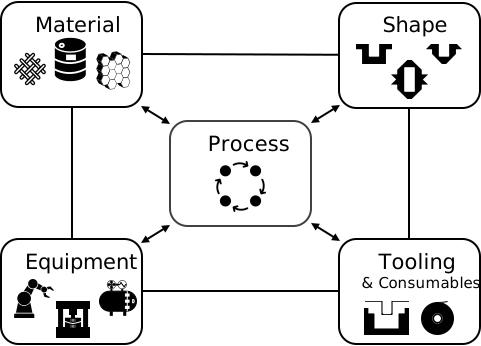
Interrelationship of Function, Shape, Material & Process
Design for manufacturing is critical to ensuring the producibility of a part. Trouble arises when it is considered too late or not at all in the design process. Conversely, process design (controlling the interactions between shape, material, tooling & consumables and equipment to achieve a desired outcome) must always consider the shape and material of the part. Ashby has developed and popularized the approach linking design (function) to the choice of material and shape, which influence the process selected and vice versa, as shown below:
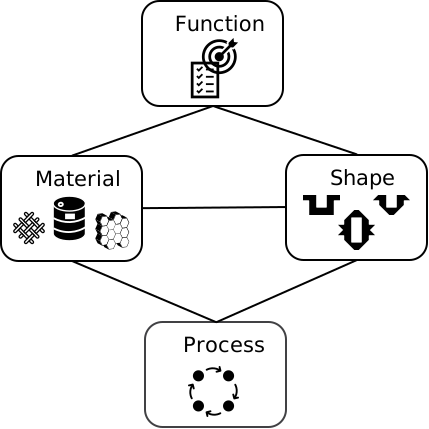
Within the Knowledge in Practice Centre the same methodology is applied but the process is more fully defined by also explicitly calling out the equipment and tooling & consumables. Note that in common usage, a process which consists of many steps can be arbitrarily defined by just one step, e.g. "spray-up". Though convenient, this can be misleading.

Workflows
The KPC's Practice and Case Study volumes consist of three types of workflows:
- Development - Analyzing the interactions between MSTE in the process steps to make decisions on processing parameters and understanding how the process steps and factory cells fit within the factory.
- Troubleshooting - Guiding you to possible causes of processing issues affecting either cost, rate or quality and directing you to the most appropriate development workflow to improve the process
- Optimization - An expansion on the development workflows where a larger number of options are considered to achieve the best mixture of cost, rate & quality for your application.
To use this website, you must agree to our Terms and Conditions and Privacy Policy.
By clicking "I Accept" below, you confirm that you have read, understood, and accepted our Terms and Conditions and Privacy Policy.

