
Reference - Polymeric materials : structure, properties, applications
| Type | Journal |
|---|---|
| Title | Polymeric materials : structure, properties, applications |
| Abstract | This book is intended to fill the knowledge gap between the chemical structure and the related physical characteristics of plastics necessary for appropriate material selection, design, and processing. The entire spectrum of plastics is addressed, including thermoplastics, thermosets, elastomers, and blends. It also contains an in-depth presentation of the structure-property relationships of a wide range of plastics. One of the special features is the extensive discussion and explanation of the impact of relationships on processing and, vice-versa, the effect of processing on structure and properties. The book contains several application-oriented examples and is presented at an intermediate level for both practicing plastic engineers and advanced engineering students. 1. Economic Development -- Market Review and Predictions -- 1.1. Literature -- 2. General Characteristics of Polymeric Materials -- 2.1. Principles of Structure -- 2.2. Material States and Transition Regions -- 2.3. Deformation Behavior -- 2.4. Literature -- 3. Molecular Structure and Synthesis of Polymers -- 3.1. Macromolecular Structure -- 3.2. Primary and Secondary Valence Bonds -- 3.2.1. Primary Valence Bonds (Covalent Bonds) -- 3.2.2. Secondary Valence Bonds -- 3.2.2.1. Dipole-Dipole Forces -- 3.2.2.2. Induction Forces -- 3.2.2.3. Dispersion Forces -- 3.2.2.4. Hydrogen Bonds -- 3.3. Reactions from Monomers to Polymers -- 3.3.1. Chain Polymerization -- 3.3.2. Step Reaction Polymerization -- 3.3.3. Polymerization Processes -- 3.3.4. Comparison between Chain Reaction Polymerization and Step Reaction Polymerization -- 3.3.5. Molecular Weight -- 3.3.5.1. Molecular Weight Distribution -- 3.3.5.2. Molecular Weight Averages -- 3.3.5.3. Influence of Various Factors on Properties -- 3.4. Literature -- 4. Structure of Polymeric Materials -- 4.1. Homogeneous Polymeric Materials -- 4.1.1. The Amorphous State -- 4.1.2. The Crystalline State -- 4.1.2.1. Formation of Crystallization Nuclei -- 4.1.2.2. Crystal Growth -- 4.1.2.3. Crystalline Superstructures -- 4.1.2.4. Melting and Crystallization Temperature -- 4.1.3. Cross-Linked Polymer Materials -- 4.1.3.1. Thermosets -- 4.1.3.2. Elastomers -- 4.2. Heterogeneous Polymeric Materials -- 4.2.1. Rubber-Modified Polystyrene -- 4.2.1.1. Structure -- 4.2.1.2. Craze Formation -- 4.2.1.3. Mechanism of Polymer Toughening -- 4.2.2. Plasticization -- 4.2.2.1. External Plasticization -- 4.2.2.2. Internal Plasticization -- 4.3. Heterogeneous Composites -- 4.3.1. Fiber-Reinforced Composites -- 4.3.2. Fillers and Reinforcing Agents (co-authored by Prof. J. Kabelka) -- 4.3.2.1. Loading of the Composite in the Fiber Direction -- 4.3.2.2. Loading of the Composite Perpendicular to the Fiber Direction -- 4.3.3. Nanocomposites -- 4.3.4. Electrically Conductive Composites -- 4.4. Literature -- 5. Thermomechanical Properties -- 5.1. Glassy or Energy-Elastic Region -- 5.2. Rubbery or Entropy-Elastic Region -- 5.3. Glass Transition Range -- 5.4. Flow Region -- 5.5. Dependence of Softening and Melting Temperatures on Molecular Structure -- 5.6. Literature -- 6. Mechanical Behavior -- 6.1. General Deformation Behavior -- 6.1.1. Mechanical Properties -- 6.1.1.1. Linear Viscoelastic Behavior -- 6.1.1.2. Strength Properties -- 6.1.1.3. Deformation Properties -- 6.1.1.4. Temperature -- 6.1.1.5. Water Absorption -- 6.1.1.6. Toughness -- 6.1.2. Long-Term Deformation Behavior -- 6.1.3. Nonlinear Deformation Behavior -- 6.1.3.1. Amorphous Thermoplastics -- 6.1.3.2. Semi-Crystalline Thermoplastics -- 6.1.4. Multiaxial Loading (co-authored by Prof. J. Kabelka) -- 6.1.4.1. Non-Reinforced Plastics -- 6.1.4.2. Reinforced Plastics -- 6.2. Orientation and Residual Stress -- 6.2.1. Orientation -- 6.2.1.1. Frozen, Irreversible Molecular Orientation -- 6.2.1.2. Shrinkage Forces -- 6.2.1.3. Filler Orientation -- 6.2.2. Residual Stress -- 6.2.2.1. Thermal Residual Stress -- 6.2.2.2. Residual Stress due to Holding Pressure -- 6.2.2.3. Internal-Residual Stress with Inserts -- 6.2.2.4. Structure-Dependent Residual Stress -- 6.3. Literature -- 7. Aging and Stabilization -- 7.1. Aging -- 7.2. Exposure to Heat -- 7.2.1. Heat Distortion Temperature -- 7.2.2. Heat Resistance -- 7.2.3. Temperature-Time Limits -- 7.2.4. Degradation during Processing -- 7.3. Stabilization -- 7.4. Literature -- 8. Overview of Selected Polymeric Materials -- 9. Guide Values of the Physical Properties of Plastics. |
| Accessed | 2026-03-30 |
| Authors |
|
| Date | 2001 |
| Pages | 277 |
| Publisher | Hanser ; Hanser Gardner Publications |
| Websites | |
| ISBN | 1569903107 |

Welcome
Welcome to the CKN Knowledge in Practice Centre (KPC). The KPC is a resource for learning and applying scientific knowledge to the practice of composites manufacturing. As you navigate around the KPC, refer back to the information on this right-hand pane as a resource for understanding the intricacies of composites processing and why the KPC is laid out in the way that it is. The following video explains the KPC approach:
Understanding Composites Processing
The Knowledge in Practice Centre (KPC) is centered around a structured method of thinking about composite material manufacturing. From the top down, the heirarchy consists of:
- The factory
- Factory cells and/or the factory layout
- Process steps (embodied in the factory process flow) consisting of:
The way that the material, shape, tooling & consumables and equipment (abbreviated as MSTE) interact with each other during a process step is critical to the outcome of the manufacturing step, and ultimately critical to the quality of the finished part. The interactions between MSTE during a process step can be numerous and complex, but the Knowledge in Practice Centre aims to make you aware of these interactions, understand how one parameter affects another, and understand how to analyze the problem using a systems based approach. Using this approach, the factory can then be developed with a complete understanding and control of all interactions.
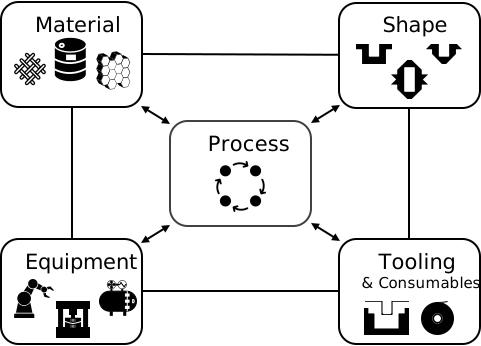
Interrelationship of Function, Shape, Material & Process
Design for manufacturing is critical to ensuring the producibility of a part. Trouble arises when it is considered too late or not at all in the design process. Conversely, process design (controlling the interactions between shape, material, tooling & consumables and equipment to achieve a desired outcome) must always consider the shape and material of the part. Ashby has developed and popularized the approach linking design (function) to the choice of material and shape, which influence the process selected and vice versa, as shown below:
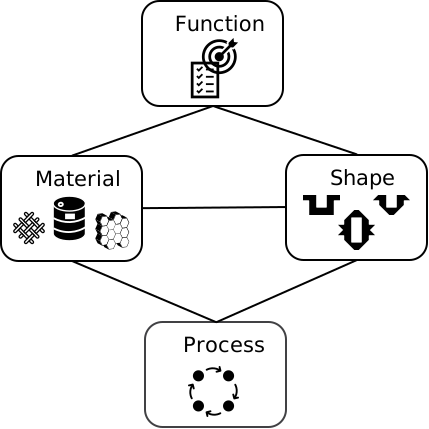
Within the Knowledge in Practice Centre the same methodology is applied but the process is more fully defined by also explicitly calling out the equipment and tooling & consumables. Note that in common usage, a process which consists of many steps can be arbitrarily defined by just one step, e.g. "spray-up". Though convenient, this can be misleading.

Workflows
The KPC's Practice and Case Study volumes consist of three types of workflows:
- Development - Analyzing the interactions between MSTE in the process steps to make decisions on processing parameters and understanding how the process steps and factory cells fit within the factory.
- Troubleshooting - Guiding you to possible causes of processing issues affecting either cost, rate or quality and directing you to the most appropriate development workflow to improve the process
- Optimization - An expansion on the development workflows where a larger number of options are considered to achieve the best mixture of cost, rate & quality for your application.
To use this website, you must agree to our Terms and Conditions and Privacy Policy.
By clicking "I Accept" below, you confirm that you have read, understood, and accepted our Terms and Conditions and Privacy Policy.

