
Aging and Reliability of Composites - A417
| Aging and Reliability of Composites | |
|---|---|
| Perspectives article | |

| |
| Document Type | Article |
| Document Identifier | 417 |
| Themes | |
| Tags | |
|
Webinar Date
Presenter
Dr. Pierre Mertiny
| |
Introduction[edit | edit source]
Fiber-reinforced polymers and polymer-based materials are increasingly used in demanding applications due to their favorable strength-to-weight ratio, corrosion resistance, and design flexibility. However, their long-term performance is strongly influenced by aging processes that occur during service. Exposure to environmental and mechanical stressors can progressively alter material structure and properties, ultimately affecting reliability, durability, and safety.
This presentation provides an overview of the principal aging mechanisms affecting fibers, polymers, and their composites. Thermal aging can lead to chain scission, oxidation, softening, and loss of mechanical strength, particularly at temperatures approaching or exceeding the glass transition temperature. Moisture and fluid exposure may induce swelling, plasticization, and hydrolysis, while oils and solvents can further compromise material integrity. Chemical aging resulting from oxidation, ultraviolet radiation, and exposure to aggressive environments can cause discoloration, surface cracking, embrittlement, and premature failure. In addition, sustained and cyclic mechanical loading contribute to creep, fatigue damage, stress relaxation, and the formation of microcracks.
The presentation will discuss how these aging mechanisms interact and influence long-term material behavior. Understanding these processes is essential for informed material selection, product design, life prediction, maintenance planning, and failure mitigation in engineering applications.
References to the Knowledge in Practice will be provided during the webinar, allowing users to access this and other content in a consistent and coherent manner.
Presenter[edit | edit source]
Pierre Mertiny, PhD
Professor, Mechanical Engineering
University of Alberta
Webinar[edit | edit source]
Webinar slides[edit | edit source]
Webinar slides available by clicking on the icon below

Additional information for select chapters[edit | edit source]
| Chapter | Chapter Title | Links to related information in the Knowledge in Practice Centre |
|---|---|---|
| 1 | Welcome & introductions | N/A |
| 2 | Knowledge in Practice Centre | |
| 3 | Outline | N/A |
| 4 | Aging Mechanisms in Fibers and Polymer Materials | |
| 5 | Influence of Aging on Material Properties | |
| 6 | Experimental Characterization & Design Integration | |
| 7 | Hydrothermal Aging Case Studies | N/A |
| 8 | Conclusion | N/A |
| 9 | Q&A | N/A |
 |
 |
| About | Help |

Welcome
Welcome to the CKN Knowledge in Practice Centre (KPC). The KPC is a resource for learning and applying scientific knowledge to the practice of composites manufacturing. As you navigate around the KPC, refer back to the information on this right-hand pane as a resource for understanding the intricacies of composites processing and why the KPC is laid out in the way that it is. The following video explains the KPC approach:
Understanding Composites Processing
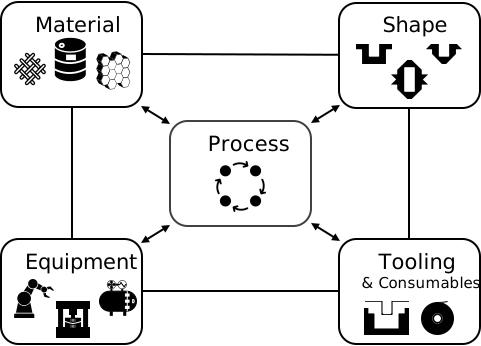
The Knowledge in Practice Centre (KPC) is centered around a structured method of thinking about composite material manufacturing. From the top down, the heirarchy consists of:
- The factory
- Factory cells and/or the factory layout
- Process steps (embodied in the factory process flow) consisting of:
The way that the material, shape, tooling & consumables and equipment (abbreviated as MSTE) interact with each other during a process step is critical to the outcome of the manufacturing step, and ultimately critical to the quality of the finished part. The interactions between MSTE during a process step can be numerous and complex, but the Knowledge in Practice Centre aims to make you aware of these interactions, understand how one parameter affects another, and understand how to analyze the problem using a systems based approach. Using this approach, the factory can then be developed with a complete understanding and control of all interactions.
Interrelationship of Function, Shape, Material & Process
Design for manufacturing is critical to ensuring the producibility of a part. Trouble arises when it is considered too late or not at all in the design process. Conversely, process design (controlling the interactions between shape, material, tooling & consumables and equipment to achieve a desired outcome) must always consider the shape and material of the part. Ashby has developed and popularized the approach linking design (function) to the choice of material and shape, which influence the process selected and vice versa, as shown below:
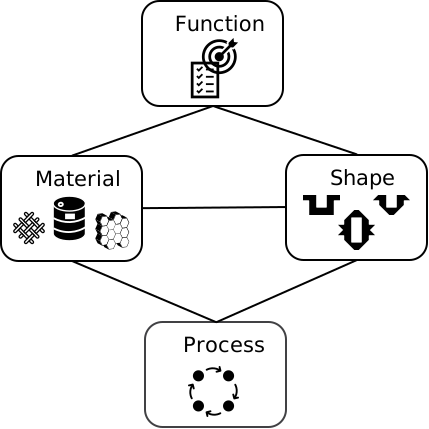
Within the Knowledge in Practice Centre the same methodology is applied but the process is more fully defined by also explicitly calling out the equipment and tooling & consumables. Note that in common usage, a process which consists of many steps can be arbitrarily defined by just one step, e.g. "spray-up". Though convenient, this can be misleading.

Workflows
The KPC's Practice and Case Study volumes consist of three types of workflows:
- Development - Analyzing the interactions between MSTE in the process steps to make decisions on processing parameters and understanding how the process steps and factory cells fit within the factory.
- Troubleshooting - Guiding you to possible causes of processing issues affecting either cost, rate or quality and directing you to the most appropriate development workflow to improve the process
- Optimization - An expansion on the development workflows where a larger number of options are considered to achieve the best mixture of cost, rate & quality for your application.
To use this website, you must agree to our Terms and Conditions and Privacy Policy.
By clicking "I Accept" below, you confirm that you have read, understood, and accepted our Terms and Conditions and Privacy Policy.

