
A/B Testing - A372
| A/B Testing | |
|---|---|
| Foundational knowledge article | |

| |
| Document Type | Article |
| Document Identifier | 372 |
| Themes | |
| Tags | |
| Prerequisites | |
Introduction[edit | edit source]
A and B-Basis testing is a statistical approach used to characterize material properties across various industries. This method involves testing a substantial number of specimens and applying statistical analysis to derive A or B-Basis values (also referred to as allowables). These allowables account for batch-to-batch and part-level variability, which is often inherent in material and component manufacturing. Incorporating these statistical limits supports quality assurance, process control, and design as it allows users to set more reasonable tolerance limits. This could mean reduced part scraping, design optimization for reduced weight, and processing optimization for reduced time without compromising product performance.
Definition[edit | edit source]
A-Basis and B-Basis values (often referred to as allowables) are statistically derived property limits used to ensure the reliability and safety of structural components. The A-Basis value is defined as the material property below which no more than 1% of the population is expected to fall, with a 95% confidence level. Similarly, a B-Basis is a property value below which no more than 10% of the population is expected to fall, also with 95% confidence [1]. The 95% confidence level means there is a 5% chance that the actual value could be lower than the reported allowable. Basis value determination occurs at level 1 of the building block approach, where mechanical testing is performed on coupons - small, standardized specimens designed to represent the material used in the final part. Once a sufficient number of test results is collected, the data for each group can be analyzed. This is done through first evaluating which probability distribution best matches the result, and then following the analysis recommended by CMH-17 [2] to calculate the desired basis values. Although this method is most commonly used to determine the material strength properties, the process can be applied to any measurable property at the coupon or component level.
More on the building block approach can be found here: Composites design
Analysis[edit | edit source]
The procedures for identifying the appropriate statistical distribution and computing A and B-Basis values are outlined in CMH-17 [2]. It is recommended that the user create a histogram of their data to visually assess the underlying distribution.

As seen in Figure 1, the example histogram is skewed to the left, meaning that the Weibull Distribution method may be suitable for this data set. With a limited number of specimens, it can be challenging to confidently determine the most appropriate distribution model. Below are some examples of commonly used distributions for strength-based allowables and the equations used to calculate the B-Basis value from the corresponding distribution [1][2].
Weibull Distribution[edit | edit source]
The Weibull distribution is a highly versatile, unimodal, continuous probability function that is marked by its unique ability to model heavily skewed data. The ability to represent skewed data is especially an asset when analyzing strength-based allowables, where the data is frequently skewed due to multiple failure modes [2]. It can also model both normal and exponential distributions. The equation for the B-Basis value using a two-parameter Weibull distribution is as follows [2]:
\( B = \alpha \left(0.10536\right)^{\frac{1}{\beta}} \exp\!\left(\frac{-V}{\beta \sqrt{n}}\right) \)
Where \(\alpha\) and \(\beta\) are maximum-likelihood estimates (see respective calculations in MIL-HDBK-17 [2]), and \(V\) is a tolerance factor which is dependent on the sample size \(n\) [1].

Normal Distribution[edit | edit source]
The normal distribution is a unimodal, continuous probability function. This distribution follows the shape of the common bell curve. The equation for the B-Basis value under a normal distribution is as follows [2]:
\( B = \bar{x}-k_bs \)
Where \(\bar{x}\) is the arithmetic mean, \(k_b\) , is the tolerance factor (a constnat which can be found in the table of) MIL-HDBK-17 [2]), and s is the standard deviation.

Lognormal Distribution[edit | edit source]
The lognormal distribution is a continuous probability function capable of handling skewed data. Though less flexible than the Weibull distribution, the lognormal distribution is commonly used for analysis of strength, especially when the data spans over several orders of magnitude. To calculate the B-Basis value using a lognormal distribution, one simply takes the log of the dataset and calculates the B-Basis value using the same formula as the Normal Distribution [2].

Advantages[edit | edit source]
A and B-Basis testing offers several advantages over traditional material characterization methods, such as reduced cost, improved reliability of data, and improved opportunities for variable isolation. As testing is performed at a lower level (coupon and sometimes component level), samples are cheaper and easier to make. This allows the user to test larger sample sizes more efficiently. Data collected at a lower level can be analyzed and used to predict performance at the subcomponent or full-structure level, supporting a multiscale modelling and certification strategy.
Variable Isolation[edit | edit source]
An important advantage of basis testing is the ability to isolate the effects of individual variables on material behaviour. Following the MSTEP approach, there is an iterative process of selecting the ideal material, shape, tooling, and equipment parameters. These parameters influence the manufacturing process of the part, which involves more parameter selection, especially surrounding the cure cycle. Decisions made using MSTEP will have large effects on the final component’s properties. For example, decisions made on part material will have a great effect on the component's strength, as well as how it performs under different environmental conditions, such as high temperature and high humidity. To best predict behaviour at a higher structural level, it is recommended to gather data on any parameters influencing the response of the final part. This includes but is not limited to processing parameters, tooling geometry, and temperature and humidity of the final part. To analyze the effect of each variable, a control group, with fixed processing and test conditions, must first be created to establish a baseline. Additional groups can then be fabricated with only one variable modified at a time. By comparing the calculated basis values of each group, the impact of individual parameters can be assessed. This approach allows for faster iteration, improved root-cause identification, and increased confidence in the structural response of the final part when supplemented with additional non-destructive testing and monitoring.
Statistical Significance and Reproducibility[edit | edit source]
Many composite materials exhibit inherent variability due to their manufacturing processes, material anisotropy, and sensitivity to environmental and process-induced effects. Basis testing helps distinguish statistically significant variations from expected scatter. Variability between specimens may arise from processing defects in manufacturing or variations in the processing parameters or properties of the constituent materials [3]. Whether the source of variations is known or unknown, A and B-Basis testing accounts for this variability and helps identify the outliers. With a sufficient sample size, distributions can reveal meaningful trends, even in the presence of high variance. This leads to improved reproducibility. In small-batch testing, there are frequently too few data points to determine whether observed variance is due to process noise or defects. With a large number of data points, the expected range becomes clearer, and the performance metrics will be more consistent.
Decision Making[edit | edit source]
A/B-Basis testing provides valuable data for informed decision-making in design, process optimization, and part validation. When combined with other tools such as risk assessments and FEA, it allows engineers to define the manufacturing process and part designs to ensure robust performance under expected service conditions.
Limitations[edit | edit source]
While A and B-Basis testing reduces the need for full-scale structural testing, it remains a resource-intensive process. The statistical rigour required by standards such as CMH-17 demands a large number of specimens, even at the coupon level, which can be costly and time-consuming. With the rapid development of new composite materials, the cost and time required to generate sufficient data to meet the robust testing requirements specified by CMH-17 can be prohibitive. In such cases, manufacturers may opt for reduced testing protocols, which typically yield more conservative basis values, leading to less efficient material use. To address these challenges, various research groups have begun exploring virtual testing and machine learning techniques to process this data [4]. Notably, the Society for Advancements in Materials Processing Engineering (SAMPE) has developed a framework combining reduced physical testing with simulation-based validation, adhering to the CMH-17 guidelines for reduced testing [2][3]. This data is used to verify simulations of the behaviour at a higher level. This is in combination with Finite Element Analysis (FEA) to model behaviour from lamina to laminate level.
Best Practices[edit | edit source]
As described in [5], A and B-Basis testing should begin at the coupon level. Testing should be conducted using controlled groups following the robust testing guidelines set by CMH-17 [2] for each desired variable. Following the building block approach, specimens should incrementally be made more complex until they have reached the level of complexity required to accurately represent the final component. For example, specimens would begin as flat test coupons, then would have added geometry changes and gradually become more similar to their final assembly.
Test Design[edit | edit source]
Specimens should closely match the manufacturing method, thermal history, and post-processing conditions of the final part. A test matrix to cover all relevant environmental conditions, load cases, and manufacturing process parameters must be considered. For each variable under investigation, a dedicated sample group should be analyzed with only the condition under test being varied relative to an established baseline. To create the baseline, a batch of samples should be created using the nominal (recommended) processing parameters and testing conditions.
Selection of Basis Values[edit | edit source]
The selection between A and B-Basis values is typically based on the load path after part failure [3]:
- The A-Basis value is used as an allowable when part failure would result in the critical failure of a larger part or assembly [3]. Since the A-Basis value is set at the 1st percentile with 95% confidence, it is also appropriate for applications where tight tolerances are required.
- The B-Basis value is more commonly used due to its higher acceptance rate, representing the 10th percentile with 95% confidence. This allowable is typically applied to parts where failure will not result in the critical failure of a larger component or assembly and still has a safe load distribution after failure [3]. The selection of which Basis value best suits an application is up to the user and the risk assessments they have performed for the parts under test.
Applications In Composites[edit | edit source]
Composites are particularly well-suited for basis testing due to their orthotropic nature, process sensitivity, and batch-to-batch variability. The properties of composite materials are highly sensitive to variability due to the orthotropic nature of the material, effects of the manufacturing process (tooling, layup method, curing), temperature, humidity and pressure effects (both during manufacturing and during the operation of the final part), as well as composition and geometry. Each of these parameters, as well as the constituent materials themselves, causes the final parts to have a high degree of batch-to-batch variability. A and B-Basis testing is a useful tool for analyzing this variability. In the MSTEP approach, where the goal is the select the best parameters while analyzing manufacturing feasibility, data on the causes of batch-to-batch variability is crucial. Through performing robust testing over many batches, trends can be identified, and the expected range of variability becomes much clearer. This then influences parameter selection, which in turn influences the process, leading to improved part quality and more optimal manufacturing.
Case Study[edit | edit source]
An application of this testing is to study the effects of processing conditions. A common study in composites is the effect of pressure on the porosity of a laminate. With all other conditions maintained constant (test environment, processing temperature, tooling, etc), only the pressure is varied. A test matrix is then created with a range of pressures to be tested, along with the number of repeat tests to be conducted for each pressure. Porosity is then measured for each specimen and plotted on a histogram. The most appropriate distribution (see analysis section) is found, and the corresponding equation is used to find the A or B-Basis value depending on the part requirements.
References
- ↑ 1.0 1.1 1.2 [Ref] Nettles, Alan T (2004). Allowables for structural composites.CS1 maint: uses authors parameter (link) CS1 maint: date and year (link)
- ↑ 2.0 2.1 2.2 2.3 2.4 2.5 2.6 [Ref] Composite Materials Handbook 17 - Polymer Matrix Composites; Guidelines for Characterization of Structural Materials. 1. SAE International on behalf of CMH-17, a division of Wichita State University. 2012. ISBN 978-0-7680-7811-4.CS1 maint: date and year (link)
- ↑ 3.0 3.1 3.2 3.3 3.4 [Ref] G. Abumeri et al. (2011). "Determination of Composites A- and B-basis Allowables with Reduced Testing". Retrieved 2 March 2026.CS1 maint: extra punctuation (link) CS1 maint: uses authors parameter (link) CS1 maint: date and year (link)
- ↑ [Ref] Cardoso, Roberto A.S. et al. (2025). "A-basis and B-basis buckling allowables for an aircraft composite wing". 22 (12). Marcílio Alves. doi:10.1590/1679-7825/e8284. ISSN 1679-7825. Retrieved 13 March 2026. Cite journal requires
|journal=(help)CS1 maint: extra punctuation (link) CS1 maint: uses authors parameter (link) - ↑ [Ref] Federal Aviation Administration (FAA) (2009). AC 20-107B - Composite Aircraft Structure (Report). Retrieved 13 March 2026.CS1 maint: uses authors parameter (link)
 |
 |
| About | Help |

Welcome
Welcome to the CKN Knowledge in Practice Centre (KPC). The KPC is a resource for learning and applying scientific knowledge to the practice of composites manufacturing. As you navigate around the KPC, refer back to the information on this right-hand pane as a resource for understanding the intricacies of composites processing and why the KPC is laid out in the way that it is. The following video explains the KPC approach:
Understanding Composites Processing
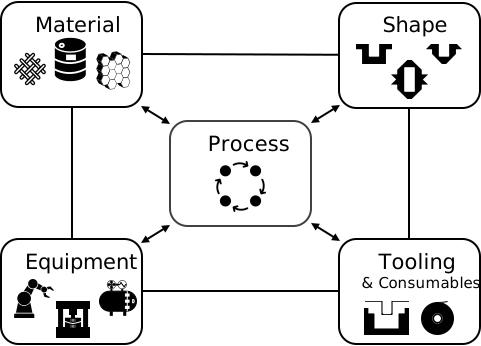
The Knowledge in Practice Centre (KPC) is centered around a structured method of thinking about composite material manufacturing. From the top down, the heirarchy consists of:
- The factory
- Factory cells and/or the factory layout
- Process steps (embodied in the factory process flow) consisting of:
The way that the material, shape, tooling & consumables and equipment (abbreviated as MSTE) interact with each other during a process step is critical to the outcome of the manufacturing step, and ultimately critical to the quality of the finished part. The interactions between MSTE during a process step can be numerous and complex, but the Knowledge in Practice Centre aims to make you aware of these interactions, understand how one parameter affects another, and understand how to analyze the problem using a systems based approach. Using this approach, the factory can then be developed with a complete understanding and control of all interactions.
Interrelationship of Function, Shape, Material & Process
Design for manufacturing is critical to ensuring the producibility of a part. Trouble arises when it is considered too late or not at all in the design process. Conversely, process design (controlling the interactions between shape, material, tooling & consumables and equipment to achieve a desired outcome) must always consider the shape and material of the part. Ashby has developed and popularized the approach linking design (function) to the choice of material and shape, which influence the process selected and vice versa, as shown below:
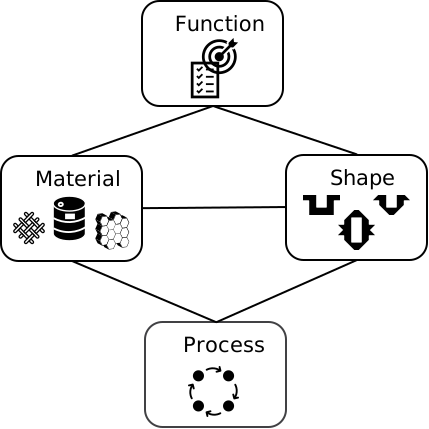
Within the Knowledge in Practice Centre the same methodology is applied but the process is more fully defined by also explicitly calling out the equipment and tooling & consumables. Note that in common usage, a process which consists of many steps can be arbitrarily defined by just one step, e.g. "spray-up". Though convenient, this can be misleading.

Workflows
The KPC's Practice and Case Study volumes consist of three types of workflows:
- Development - Analyzing the interactions between MSTE in the process steps to make decisions on processing parameters and understanding how the process steps and factory cells fit within the factory.
- Troubleshooting - Guiding you to possible causes of processing issues affecting either cost, rate or quality and directing you to the most appropriate development workflow to improve the process
- Optimization - An expansion on the development workflows where a larger number of options are considered to achieve the best mixture of cost, rate & quality for your application.
To use this website, you must agree to our Terms and Conditions and Privacy Policy.
By clicking "I Accept" below, you confirm that you have read, understood, and accepted our Terms and Conditions and Privacy Policy.

