
Tensile testing at elevated temperature example and dependence on coupon preparation method - A433
| Tensile testing at elevated temperature example and dependence on coupon preparation method | |
|---|---|
| Foundational knowledge article | |
| Document Type | Article |
| Document Identifier | 433 |
| Prerequisites | |
Introduction[edit | edit source]
Tensile testing serves as a fundamental mechanical evaluation for plastic materials, providing essential data on elasticity, strength, and ductility under uniaxial loading. By stretching a standardized specimen to failure, this test generates a stress-strain curve that reveals key properties: Young’s modulus (stiffness), tensile strength (maximum stress), elongation at break (fracture strain), and yield strength (onset of plastic deformation in ductile materials). Globally, two principal standards govern these tests—ISO 527 and ASTM D638 — which despite methodological variations, both aim to ensure reproducible data for material selection and design. Reliable tensile testing hinges on three critical factors: specimen preparation, controlled conditions, and precise instrumentation. Additional challenges are encountered when testing at elevated temperatures due to both test frame effects and material effects as thermal energy overrides microstructure-driven properties.
Significance[edit | edit source]
Tensile testing of polymers is essential for understanding their mechanical behavior under real-world operating conditions; however, thermal effects significantly influence performance. As temperature increases, polymers typically exhibit reduced stiffness, lower yield strength, and enhanced ductility due to increased molecular chain mobility. Standard tensile tests conducted at room temperature may not accurately predict material behavior in higher-temperature environments, such as automotive under-the-hood components, aerospace structures, or industrial applications. By performing tensile tests across the range of temperatures expected during operation, the change in under thermal stress can be measured aiding in material selection and design optimization.
Scope[edit | edit source]
This paper provides an overview of tensile testing methodologies for plastics, highlighting the key differences between ASTM D638 and ISO 527 standards. It examines the challenges associated with elevated temperature tensile testing. The discussion then narrows to a demonstration of these effects on PERT (polyethylene of raised temperature resistance), presenting comparative tensile data across three temperatures (23°C, 60°C, and 95°C) and three preparation methods (injection molding, compression molding, and extrusion).
Tensile Testing[edit | edit source]
Tensile testing is a fundamental mechanical test used to characterize the behavior of plastic materials under axial stretching forces. It provides critical data on elasticity, strength, ductility, and failure modes, which are used for material selection, quality control, and product design. It involves applying a uniaxial load to a standardized specimen until fracture occurs. A stress-strain curve is then generated from the force displacement curve and is used to determine properties of the material.
The properties that are commonly extracted from the test are[1][2]:
- Young’s modulus: stiffness of the material in its elastic deformation region.
- Tensile strength: maximum stress the material can withstand before breaking or yielding.
- Elongation at break: percent strain at which the material fractures.
- Yield strength: stress at which plastic deformation begins in ductile samples.
- Curve shape: reveals whether a material is brittle (e.g., polystyrene) or ductile (e.g., polyethylene).
Two primary standards govern tensile testing of plastics, namely ISO 527[3][4] and ASTM D638[5], providing similar data for engineering applications despite having different methodologies (see Figure 1).

The accuracy and reliability of tensile testing results for plastic materials fundamentally depend on three critical factors:
- Proper specimen preparation
- Controlled testing conditions
- Precise equipment calibration
Specimen preparation covers the standardized geometry (dog bone-shaped samples are universally employed to ensure failure occurs within the gauge length not the grips), method of preparation (injection, compression, extrusion, etc.) and orientation (if anisotropy is expected). These specimens must then undergo proper environmental conditioning, with tests typically conducted under controlled laboratory conditions of 23°C and 50% relative humidity to ensure consistency and comparability of results across different testing sessions and laboratories[6]. The testing equipment itself plays an equally vital role, requiring the use of a properly calibrated universal testing machine (UTM) equipped with precise load cells and crosshead control systems to apply and measure forces and displacement accurately throughout the duration of the test.
Beyond these fundamental requirements, several material-specific factors significantly influence test outcomes and must be carefully considered. Plastics inherently exhibit viscoelastic behavior, meaning their mechanical properties demonstrate pronounced strain rate sensitivity, where the speed of deformation directly affects the measured properties. Temperature represents another critical variable, as elevated temperatures generally reduce plastic's stiffness and tensile strength while simultaneously increasing its ductility and elongation at break, highlighting the importance of maintaining consistent thermal conditions during testing. Furthermore, many engineered plastics display anisotropic behavior, particularly fiber-reinforced or oriented polymers, where mechanical properties vary significantly depending on the direction of testing relative to the material's internal structure or fiber alignment. This directional dependence requires careful specimen orientation during preparation and testing to obtain meaningful, representative data[1][2].
Conducting tensile tests at elevated temperatures introduces several complications, from the device point of view:
- Difficulty in handling: leads to low throughput and/or extended testing times.
- Thermal expansion of fixtures and specimens: can artificially inflate strain measurements if not corrected.
- Softening at high temperatures: may lead to specimen slippage or premature failure at the clamping points.
- Temperature gradients across the specimen: can cause non-uniform deformation.
Additionally, from a material perspective, several factors must be considered[7][8][9]:
- Oxidative degradation in air: can alter material properties during prolonged testing
- Viscoelastic creep: becomes significant at elevated temperatures and may introduce time-dependent artifacts
- Sensitivity of amorphous polymers near their glass transition temperature: even minor temperature fluctuations can produce disproportionate responses and therefore require very tight thermal control
- Presence of overlapping thermal transitions: can further complicate data interpretation.
An example of a tensile testing set-up is shown in Figure 2 where notably an optical extensometer is employed to bypass the influence of temperature drift of contact extensometers and minimize expansion effect on measurement. In Figure 3 an example of the typical curves for an injection molded PERT material is provided demonstrating the decrease in elastic slope, the reduction of tensile strength and the transition from ductile failure at 23°C, through cold-drawing at 60°C into a more rubber-like behaviour at 95°C.


Processing methods also influence the mechanical behavior of polymers. Semi-crystalline polymers exhibit crystallinity-dependent mechanical properties. In a recent study a polymer was prepared in three different manners; the compression-molded samples showed 63.5% crystallinity, followed by extruded samples at 58.0% and the injection-molded variant at 55.0%. These crystallinity differences are directly manifested in mechanical performance. At 23°C, compression-molded specimens exhibited 19% higher tensile yield strength and 36% greater modulus than the injection-molded counterpart, the elevated temperature testing (60°C and 95°C) demonstrated progressive property convergence, where compression-molded samples showed just 5% higher yield strength at 95°C versus 19% at 23°C. These mechanical results across processing methods and service temperatures agree with established structure-property relationships[10][11][12][13][14][15] and summarized in Figure 4.

References
- ↑ 1.0 1.1 [Ref] Shafiqul Islam, Md. et al. (2021). "A Supervised Machine Learning Approach Towards Accelerating the Development of High-Performance Non-Pb Perovskite Solar Devices". ISBN 9781119721772. Retrieved 27 March 2026. Cite journal requires
|journal=(help)CS1 maint: extra punctuation (link) CS1 maint: uses authors parameter (link) - ↑ 2.0 2.1 [Ref] Crawford, R. J.; Martin, P. J. (2020). "Plastics Engineering, fourth edition". Elsevier. doi:10.1016/C2015-0-00550-0. ISBN 9780081007099. Cite journal requires
|journal=(help);|access-date=requires|url=(help)CS1 maint: uses authors parameter (link) - ↑ [Ref] "ISO 527-1:2019 - Plastics — Determination of tensile properties — Part 1: General principles". Retrieved 27 March 2026.
- ↑ [Ref] "ISO 527-2:2025 - Plastics — Determination of tensile properties — Part 2: Test conditions for moulding and extrusion plastics". Retrieved 27 March 2026.
- ↑ [Ref] "Test Method for Tensile Properties of Plastics". ASTM International. 2014. doi:10.1520/D0638-14. Retrieved 27 March 2026. Cite journal requires
|journal=(help) - ↑ [Ref] "Practice for Conditioning Plastics for Testing". ASTM International. 2021. doi:10.1520/D0618-21. Retrieved 27 March 2026. Cite journal requires
|journal=(help) - ↑ [Ref] McCrum, N. G. et al. (1997). "PRINCIPLES OF POLYMER ENGINEERING. 2nde edition". arXiv:arXiv:1011.1669v3 Check
|arxiv=value (help). ISBN 0198565267. ISSN 1748-0132. PMID 19351024. Retrieved 27 March 2026. Cite journal requires|journal=(help)CS1 maint: extra punctuation (link) CS1 maint: uses authors parameter (link) - ↑ [Ref] Menard, Kevin P.; Menard, Noah R. (2020). "An Introduction to Dynamic Mechanical Analysis". CRC Press. doi:10.1201/9780429190308-1. Cite journal requires
|journal=(help);|access-date=requires|url=(help)CS1 maint: uses authors parameter (link) - ↑ [Ref] Ward, Ian M.; Sweeney, John (2012). "Mechanical properties of solid polymers: Third edition". wiley. doi:10.1002/9781119967125. ISBN 9781119967125. Retrieved 27 March 2026. Cite journal requires
|journal=(help)CS1 maint: uses authors parameter (link) - ↑ [Ref] Dusunceli, Necmi; Colak, Ozgen U. (2008). "Modelling effects of degree of crystallinity on mechanical behavior of semicrystalline polymers". 24 (7). doi:10.1016/j.ijplas.2007.09.003. ISSN 0749-6419. Retrieved 30 March 2026. Cite journal requires
|journal=(help)CS1 maint: uses authors parameter (link) - ↑ [Ref] Felder, S. et al. (2020). "Modeling the effect of temperature and degree of crystallinity on the mechanical response of Polyamide 6". 148. Elsevier. doi:10.1016/j.mechmat.2020.103476. ISSN 0167-6636. Retrieved 27 March 2026. Cite journal requires
|journal=(help)CS1 maint: extra punctuation (link) CS1 maint: uses authors parameter (link) - ↑ [Ref] Humbert, S. et al. (2009). "Polyethylene yielding behaviour: What is behind the correlation between yield stress and crystallinity?". 50 (15). Elsevier. doi:10.1016/j.polymer.2009.05.017. ISSN 0032-3861. Retrieved 27 March 2026. Cite journal requires
|journal=(help)CS1 maint: extra punctuation (link) CS1 maint: uses authors parameter (link) - ↑ [Ref] Amjadi, Mohammad; Fatemi, Ali (2020). "Tensile Behavior of High-Density Polyethylene Including the Effects of Processing Technique, Thickness, Temperature, and Strain Rate". 12 (9). Multidisciplinary Digital Publishing Institute. doi:10.3390/POLYM12091857. ISSN 2073-4360. PMID 32824990. Retrieved 27 March 2026. Cite journal requires
|journal=(help)CS1 maint: uses authors parameter (link) - ↑ [Ref] Yang, Huaguang et al. (2023). "Thermal, rheological, and mechanical characterization of compression and injection molded ultra-high molecular weight polyethylene, high density polyethylene, and their blends". 140 (7). John Wiley and Sons Inc. doi:10.1002/app.53484. ISSN 1097-4628. Retrieved 27 March 2026. Cite journal requires
|journal=(help)CS1 maint: extra punctuation (link) CS1 maint: uses authors parameter (link) - ↑ [Ref] Mejia, Edgar et al. (2021). "Effect of Processing Techniques on the Microstructure and Mechanical Performance of High-Density Polyethylene". 13 (19). Multidisciplinary Digital Publishing Institute. doi:10.3390/polym13193346. ISSN 2073-4360. Retrieved 27 March 2026. Cite journal requires
|journal=(help)CS1 maint: extra punctuation (link) CS1 maint: uses authors parameter (link)

Welcome
Welcome to the CKN Knowledge in Practice Centre (KPC). The KPC is a resource for learning and applying scientific knowledge to the practice of composites manufacturing. As you navigate around the KPC, refer back to the information on this right-hand pane as a resource for understanding the intricacies of composites processing and why the KPC is laid out in the way that it is. The following video explains the KPC approach:
Understanding Composites Processing
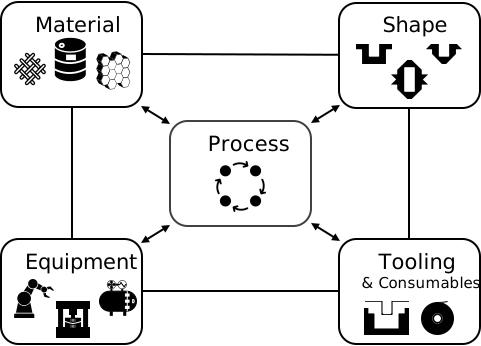
The Knowledge in Practice Centre (KPC) is centered around a structured method of thinking about composite material manufacturing. From the top down, the heirarchy consists of:
- The factory
- Factory cells and/or the factory layout
- Process steps (embodied in the factory process flow) consisting of:
The way that the material, shape, tooling & consumables and equipment (abbreviated as MSTE) interact with each other during a process step is critical to the outcome of the manufacturing step, and ultimately critical to the quality of the finished part. The interactions between MSTE during a process step can be numerous and complex, but the Knowledge in Practice Centre aims to make you aware of these interactions, understand how one parameter affects another, and understand how to analyze the problem using a systems based approach. Using this approach, the factory can then be developed with a complete understanding and control of all interactions.
Interrelationship of Function, Shape, Material & Process
Design for manufacturing is critical to ensuring the producibility of a part. Trouble arises when it is considered too late or not at all in the design process. Conversely, process design (controlling the interactions between shape, material, tooling & consumables and equipment to achieve a desired outcome) must always consider the shape and material of the part. Ashby has developed and popularized the approach linking design (function) to the choice of material and shape, which influence the process selected and vice versa, as shown below:
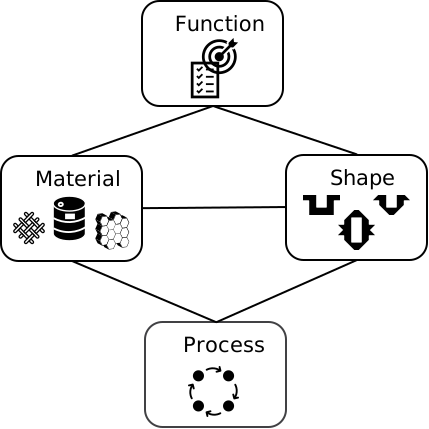
Within the Knowledge in Practice Centre the same methodology is applied but the process is more fully defined by also explicitly calling out the equipment and tooling & consumables. Note that in common usage, a process which consists of many steps can be arbitrarily defined by just one step, e.g. "spray-up". Though convenient, this can be misleading.

Workflows
The KPC's Practice and Case Study volumes consist of three types of workflows:
- Development - Analyzing the interactions between MSTE in the process steps to make decisions on processing parameters and understanding how the process steps and factory cells fit within the factory.
- Troubleshooting - Guiding you to possible causes of processing issues affecting either cost, rate or quality and directing you to the most appropriate development workflow to improve the process
- Optimization - An expansion on the development workflows where a larger number of options are considered to achieve the best mixture of cost, rate & quality for your application.
To use this website, you must agree to our Terms and Conditions and Privacy Policy.
By clicking "I Accept" below, you confirm that you have read, understood, and accepted our Terms and Conditions and Privacy Policy.

