
Capstan grips for yarn testing - A432
| Capstan grips for yarn testing | |
|---|---|
| Foundational knowledge article | |
| Document Type | Article |
| Document Identifier | A432 |
| Prerequisites | |
"A" can not be assigned to a declared number type with value 432.
Introduction[edit | edit source]
Capstan grips are essential for yarn tensile testing because they prevent premature breakage at the grip points by distributing tension via friction along multiple wraps, rather than crushing the specimen like tabbed or clamped methods. This is critical for fine, delicate, or high-strength yarns that might slip or snap under direct clamping. Tabbed methods (where yarn is glued or clamped between tabs) work well for composites or fabrics but can introduce stress concentrations in single yarns. Capstan grips ensure failures occur in the test region, not near the grips, providing more accurate strength and elongation measurements for textile fibers.
Significance[edit | edit source]
Capstan grips enable accurate tensile characterization of reinforcing fibers (e.g., carbon, glass, or aramid tows) without introducing grip-induced defects that could compromise data integrity. Unlike conventional clamps, capstan grips prevent premature fiber breakage at clamping points, ensuring failures occur within the gauge length. While alternative grips (e.g., tabbed methods) suit laminated composites, capstan grips are preferred for testing individual fibers or tows and the information obtained may be used to inform performance predictions and perform quality control in composites.
Scope[edit | edit source]
This document describes capstan grips used in yarn tensile testing, detailing their design and function, and presenting their advantages, limitations, and applications in testing. An example is presented illustrating grip geometry, wrap configuration, and failure of specimen with a final mention of alternative grips available.
Design and Function[edit | edit source]
A capstan grip is a friction-based gripping mechanism used in tensile testing machines to hold yarns, filaments, or fibers without causing premature breakage at the clamping point. Instead of crushing the specimen like mechanical or pneumatic grips, the capstan grip distributes the tension along a wrapped section of the yarn, reducing stress concentrations[1][2][3].
The yarn is wrapped multiple times around a rotating cylindrical drum (capstan) relying on the friction between the yarn and the capstan’s surface to prevent slippage as tension increases. The efficiency of the grip is affected by the number of turns and surface texture (smooth or grooved) of the drum and rely on Euler’s law of belt friction where increased tension enhances the grip force.
Advantages and limitations[edit | edit source]
Unlike direct clamping, which can crush delicate yarns, the capstan grip avoids localized stress which minimizes specimen damage; furthermore, because multiple wraps increase friction and holding force, they provide an effective means to mount fine and slippery yarns.
The capstan grip requires sufficient length for multiple wraps making it problematic for specimens where supply may be limited. Additionally, variability might arise as friction depends on the yarn-capstan interface, which is subject to coatings and texture, plus misalignment or wrapping patterns can cause uneven tension distribution.
Yarn Testing Applications[edit | edit source]
Capstan grips can be used to perform tensile strength testing to measure breaking force and elongation[4][5]. Because they maintain consistent tension over time, they are useful for creep and stress relaxation tests[6][7] and in fatigue testing where repeated loading could cause slippage in conventional grips[8][9].
In addition to capstan grips, other common gripping methods for yarn tensile testing include mechanical clamps (serrated or rubber-faced jaws), which apply direct pressure but risk crushing delicate fibers; pneumatic grips, which use air pressure for uniform clamping but may still cause stress concentrations; and adhesive or tabbed grips, where yarns are bonded between stiff tabs to distribute load, though this method is more suited to composites or fabrics. Additionally, wrap-and-pin grips secure yarns by winding them around pins, offering a balance between friction and minimal damage. Each method has trade-offs in precision, specimen protection, and suitability for different fiber types[10].
Case Study[edit | edit source]
The following example outlines the standard procedure for preparing test samples and conducting tensile tests using a universal testing machine in accordance with ASTM D2256[4]. Due to the machine's weight, the installation of the grips requires safety belts; the faces are correctly aligned and levels to prevent introducing twisting motion.
There are a few critical points to consider when mounting the fiber to the grips. The tows must be mounted first onto the top grip carefully, avoiding any twist and their ends fixed securely where a small piece of 180 grit sandpaper. After locking the tow ends, wrap the tow onto the grips without twisting at least two times being careful to avoid overlapping and pin the capstan. Repeat the same steps for the bottom grips again, ensuring sure there are no twists or overlaps in the tow. Refer to Video 1 to see the process.
Once the sample is mounted on the capstan grips, the gauge length of the fiber tow must be adjusted (see Figure 1) and a small preload (between 5 to 10 N) maintained before proceeding with testing. An example of typical data output showing the breaking load and extension at break is displayed in Figure 2.


Capstan grips application[edit | edit source]
Capstan grips utility in evaluating the mechanical degradation of fibers under humidity-exposure and hydrothermal aging, has been demonstrated in studies by Sunny et al[11][12]. In these works, carbon, basalt, and E-glass fibers were subjected to accelerated aging conditions to assess their durability and predict service life. While conventional clamps could compromise results precluding precise characterization of aging effects on fiber properties (by introducing additional damage to already degraded samples displaying surface damage or increased brittleness), capstan grips supported the validation of Arrhenius-based lifetime prediction models. These studies highlight the capstan grip’s importance in advancing the understanding of fiber-reinforced composite longevity under environmental stressors.
References
- ↑ [Ref] Hu, Jinlian. (2008). "Fabric testing". CRC Press ; Woodhead. ISBN 9781845695064. Retrieved 26 March 2026. Cite journal requires
|journal=(help)CS1 maint: uses authors parameter (link) - ↑ [Ref] Saville, B. P.. (2002). "Physical testing of textiles". Woodhead Publishing Limited : CRC Press. ISBN 9781845690151. Retrieved 26 March 2026. Cite journal requires
|journal=(help)CS1 maint: uses authors parameter (link) - ↑ [Ref] Morton, W. E.; Hearle, J. W. S. (2008). "An introduction to fibre structure, physical properties of textile fibres". CRC Press. ISBN 9781845694425. Retrieved 26 March 2026. Cite journal requires
|journal=(help)CS1 maint: uses authors parameter (link) - ↑ 4.0 4.1 [Ref] "Test Method for Tensile Properties of Yarns by the Single-Strand Method". ASTM International. 2021. doi:10.1520/D2256 D2256M-21 Check
|doi=value (help). Retrieved 26 March 2026. Cite journal requires|journal=(help) - ↑ [Ref] "ISO 2062:2009 - Textiles — Yarns from packages — Determination of single-end breaking force and elongation at break using constant rate of extension (CRE) tester". Retrieved 26 March 2026.
- ↑ [Ref] "D1774 Standard Test Methods for Elastic Properties of Textile Fibers (Withdrawn 2000)". Retrieved 26 March 2026.
- ↑ [Ref] "ISO 13934-1:2013 - Textiles — Tensile properties of fabrics — Part 1: Determination of maximum force and elongation at maximum force using the strip method". Retrieved 26 March 2026.
- ↑ [Ref] "Textile Standards - Standards Products - Standards & Publications - Products & Services". Retrieved 26 March 2026.
- ↑ [Ref] "ISO 13485:2016 - Medical devices — Quality management systems — Requirements for regulatory purposes". Retrieved 26 March 2026.
- ↑ [Ref] Sunny, John et al. (2024). "Hydrothermal Aging and Humidity Exposure of Carbon and Basalt Fibers and Life Time Prediction". 12 (7). Multidisciplinary Digital Publishing Institute. doi:10.3390/fib12070058. ISSN 2079-6439. Retrieved 26 March 2026. Cite journal requires
|journal=(help)CS1 maint: extra punctuation (link) CS1 maint: uses authors parameter (link) - ↑ [Ref] Sunny, John et al. (2023). "Accelerated Zero-Stress Hydrothermal Aging of Dry E-Glass Fibers and Service Life Prediction Using Arrhenius Model". 11 (8). Multidisciplinary Digital Publishing Institute. doi:10.3390/fib11080070. ISSN 2079-6439. Retrieved 26 March 2026. Cite journal requires
|journal=(help)CS1 maint: extra punctuation (link) CS1 maint: uses authors parameter (link) - ↑ [Ref] "Advanced Textile Testing Techniques - Google Books". Retrieved 26 March 2026.
 |
 |
| About | Help |

Welcome
Welcome to the CKN Knowledge in Practice Centre (KPC). The KPC is a resource for learning and applying scientific knowledge to the practice of composites manufacturing. As you navigate around the KPC, refer back to the information on this right-hand pane as a resource for understanding the intricacies of composites processing and why the KPC is laid out in the way that it is. The following video explains the KPC approach:
Understanding Composites Processing
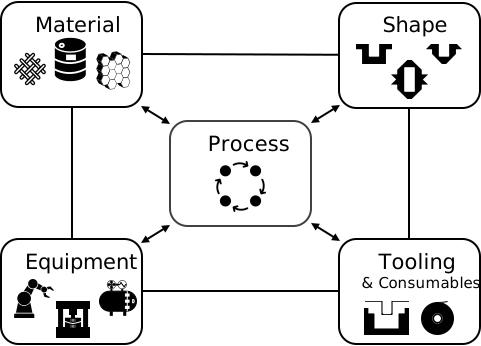
The Knowledge in Practice Centre (KPC) is centered around a structured method of thinking about composite material manufacturing. From the top down, the heirarchy consists of:
- The factory
- Factory cells and/or the factory layout
- Process steps (embodied in the factory process flow) consisting of:
The way that the material, shape, tooling & consumables and equipment (abbreviated as MSTE) interact with each other during a process step is critical to the outcome of the manufacturing step, and ultimately critical to the quality of the finished part. The interactions between MSTE during a process step can be numerous and complex, but the Knowledge in Practice Centre aims to make you aware of these interactions, understand how one parameter affects another, and understand how to analyze the problem using a systems based approach. Using this approach, the factory can then be developed with a complete understanding and control of all interactions.
Interrelationship of Function, Shape, Material & Process
Design for manufacturing is critical to ensuring the producibility of a part. Trouble arises when it is considered too late or not at all in the design process. Conversely, process design (controlling the interactions between shape, material, tooling & consumables and equipment to achieve a desired outcome) must always consider the shape and material of the part. Ashby has developed and popularized the approach linking design (function) to the choice of material and shape, which influence the process selected and vice versa, as shown below:
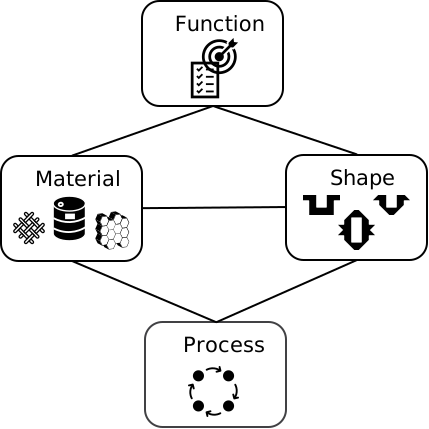
Within the Knowledge in Practice Centre the same methodology is applied but the process is more fully defined by also explicitly calling out the equipment and tooling & consumables. Note that in common usage, a process which consists of many steps can be arbitrarily defined by just one step, e.g. "spray-up". Though convenient, this can be misleading.

Workflows
The KPC's Practice and Case Study volumes consist of three types of workflows:
- Development - Analyzing the interactions between MSTE in the process steps to make decisions on processing parameters and understanding how the process steps and factory cells fit within the factory.
- Troubleshooting - Guiding you to possible causes of processing issues affecting either cost, rate or quality and directing you to the most appropriate development workflow to improve the process
- Optimization - An expansion on the development workflows where a larger number of options are considered to achieve the best mixture of cost, rate & quality for your application.
To use this website, you must agree to our Terms and Conditions and Privacy Policy.
By clicking "I Accept" below, you confirm that you have read, understood, and accepted our Terms and Conditions and Privacy Policy.

