
Thermal Camera - A413
| Thermal Camera | |
|---|---|
| Document Type | Article |
| Document Identifier | 413 |
| Tags | |
Introduction[edit | edit source]
A thermal camera is a device that can be used for temperature monitoring. It relies on the infrared radiation emitted by a body to measure its temperature without contact. The emissivity of the measured material must be known to obtain accurate measurements. The influence of the environment must also be minimized to avoid impacting the temperature reading.
Scope[edit | edit source]
This article provides an overview of the working principle, advantages, and limitations of a thermal camera.
Significance[edit | edit source]
Thermal cameras are widely used to monitor parts temperature during manufacturing. They are an alternative and complementary measurement to thermocouples, by offering a full-field, non-contact temperature measurement of a visible surface. However, some important parameters, such as the material’s emissivity, must be well-known to obtain reliable results. More information on alternative temperature sensors can be found here.
Overview[edit | edit source]
A thermal camera works in a similar way to a regular camera, except that it reacts to the infrared wavelengths of the light spectrum. These wavelengths are longer than the visible light spectrum (typically between 1 µm and 1 mm), making them invisible to the human eye. Every object emits infrared radiation at an amplitude that depends on its temperature and its surface properties. The thermal camera can measure the amplitude of radiation emitted from a given point in space and calculate its temperature. Long-wave infrared wavelengths are typically used for thermal imaging.

Working Principle[edit | edit source]
All objects emit radiation when they have a temperature higher than absolute zero, due to the molecular agitation. The intensity of the emitted electromagnetic radiation depends on the material of the object and its temperature, as stated in the Stefan-Boltzmann law. This radiation is detected by the thermal camera, and its intensity is converted to a temperature value.
Important Parameters[edit | edit source]
The most important parameter to know to obtain reliable temperature measurements with a thermal camera is the emissivity of the observed material. This property defines the amount of radiation emitted at a given temperature; it varies between 0 and 1 and has no unit. An emissivity of 1 corresponds to a perfect black body.
The emissivity depends not only on the material itself, but also on its surface roughness. In fibre-reinforced polymer composites, the polymer is directly visible to the thermal camera, and its emissivity is around 0.9 to 0.95. However, every material should be characterized beforehand to validate the value of emissivity. It must also be noted that emissivity varies with temperature, especially when the polymer is melting, which can also impact the temperature measurement.
Another important parameter is to limit reflection on the material by removing external heat sources in close proximity. Infrared radiation from a secondary body can be reflected on the surface of the sample and be detected by the thermal camera, affecting the reading. The angle of observation is also critical to limit reflection. The camera should be ideally placed in a position to observe the part in a normal direction to its surface. Also, thermal camera measurements are more accurate with opaque material, as transmitted radiation coming from heat sources located behind the samples can also be detected. Heat sources in the background or behind the sample should therefore be avoided.

Data analysis[edit | edit source]
The data acquired by the thermal camera is analyzed in dedicated software. Different results can be obtained:
- Thermograms: Spatial temperature distribution on a surface at a given time. They are useful for detecting the heat concentration points or the general heating behaviour of a part.
- Time-temperature curves: the user defines one or multiple regions of interest (ROIs) on the thermal image, and the software produces a time-temperature curve for that location. ROIs can be points, lines, or surfaces, with the temperature on the curve representing either the average, the maximum, or the minimum value observed in the corresponding ROI.
Equipment[edit | edit source]
Various thermal cameras are available on the market. For temperature monitoring in composite materials processing, temperature typically varies between room temperature and a maximum of 400-450 °C. The lens of a thermal camera can typically be changed to offer a wider or narrower field of view, depending on the part size.
Entry-level long-wave infrared thermal cameras are the most common. These cameras target a spectral range between 8 and 14 µm, and their resolution is typically relatively low (320 x 240 to 640 x4 80), with a frame rate below 60 Hz. They are affordable and easy to integrate solutions for general process monitoring and temperature monitoring, in both industry and research/academia. Some examples are the FLIR A400 and A700 series, the Optris PI-series, or the DIAS Infrared Pyroview entry models.
For applications requiring a more detailed temperature acquisition, high-performance infrared cameras are also available on the market, such as the FLIR X8580 series, the Telops FAST-IR series, or the InfraTec ImageIR high-end cameras. These are typically larger and more expensive, but they offer higher resolution (up to 5 megapixels) and higher frame rate (up to 1 kHz). Their applications are fast heating processes and high-resolution thermal imaging to identify local temperature variations.
Thermal cameras can also be coupled with external heat sources to offer NDT thermography systems. These non-destructive methods allow for to detection of delamination, barely visible impact damage (BVID), porosity mapping, and quality inspection of welded joints. Some examples of thermography systems are Dantec Dynamics ThermoScope, MoviTHERM NDT solutions, Automation Technologies, Telops TESTD series, and Infratec active thermography setups.
Finally, a few compact thermal cameras are available on the market, such as the FLIR Boson series and the Teledyne Calibir. These light and small cameras can be easily integrated into an automated system or mounted on a robotic arm. They can be used for inline inspection during the AFP/ATL process, for example, or any other automated process. These cameras offer limited resolution and frame rate due to their small size.
Comparison with Thermocouples[edit | edit source]
Thermocouples offer point measurements, whereas the thermal camera allows to get a complete full-field measurement. In addition, thermocouples are invasive, while thermal cameras are a non-contact method to measure temperature. However, thermocouples are typically more accurate, and their use does not require knowledge of the material’s property (such as the emissivity). They can also be embedded in the part to obtain inner temperature evolution, which is impossible with a thermal camera that can only record the temperature on the outer surface. In conclusion, thermocouples and thermal cameras should be used jointly as they offer complementary results.

Welcome
Welcome to the CKN Knowledge in Practice Centre (KPC). The KPC is a resource for learning and applying scientific knowledge to the practice of composites manufacturing. As you navigate around the KPC, refer back to the information on this right-hand pane as a resource for understanding the intricacies of composites processing and why the KPC is laid out in the way that it is. The following video explains the KPC approach:
Understanding Composites Processing
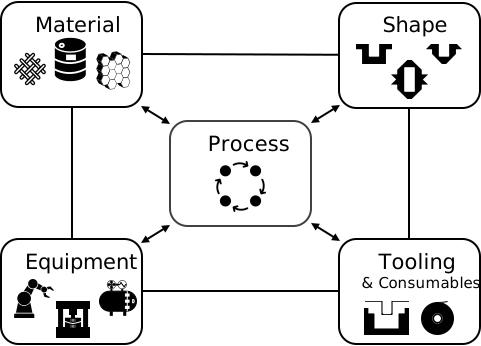
The Knowledge in Practice Centre (KPC) is centered around a structured method of thinking about composite material manufacturing. From the top down, the heirarchy consists of:
- The factory
- Factory cells and/or the factory layout
- Process steps (embodied in the factory process flow) consisting of:
The way that the material, shape, tooling & consumables and equipment (abbreviated as MSTE) interact with each other during a process step is critical to the outcome of the manufacturing step, and ultimately critical to the quality of the finished part. The interactions between MSTE during a process step can be numerous and complex, but the Knowledge in Practice Centre aims to make you aware of these interactions, understand how one parameter affects another, and understand how to analyze the problem using a systems based approach. Using this approach, the factory can then be developed with a complete understanding and control of all interactions.
Interrelationship of Function, Shape, Material & Process
Design for manufacturing is critical to ensuring the producibility of a part. Trouble arises when it is considered too late or not at all in the design process. Conversely, process design (controlling the interactions between shape, material, tooling & consumables and equipment to achieve a desired outcome) must always consider the shape and material of the part. Ashby has developed and popularized the approach linking design (function) to the choice of material and shape, which influence the process selected and vice versa, as shown below:
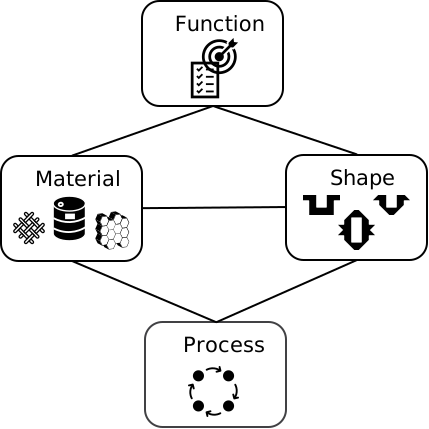
Within the Knowledge in Practice Centre the same methodology is applied but the process is more fully defined by also explicitly calling out the equipment and tooling & consumables. Note that in common usage, a process which consists of many steps can be arbitrarily defined by just one step, e.g. "spray-up". Though convenient, this can be misleading.

Workflows
The KPC's Practice and Case Study volumes consist of three types of workflows:
- Development - Analyzing the interactions between MSTE in the process steps to make decisions on processing parameters and understanding how the process steps and factory cells fit within the factory.
- Troubleshooting - Guiding you to possible causes of processing issues affecting either cost, rate or quality and directing you to the most appropriate development workflow to improve the process
- Optimization - An expansion on the development workflows where a larger number of options are considered to achieve the best mixture of cost, rate & quality for your application.
To use this website, you must agree to our Terms and Conditions and Privacy Policy.
By clicking "I Accept" below, you confirm that you have read, understood, and accepted our Terms and Conditions and Privacy Policy.

