
NGen White Paper: Sustainable Composites Manufacturing: Driving Innovation for a Circular, Low-Carbon Future - A423
| NGen White Paper: Sustainable Composites Manufacturing: Driving Innovation for a Circular, Low-Carbon Future | |
|---|---|
| Perspectives article | |
| Document Type | Article |
| Document Identifier | 404 |
| Tags | |
Background[edit | edit source]
In 2025 the Composites Research Network (CRN), sister organization to the Composites Knowledge Network was tasked with helping Next Generation Manufacturing (NGen) fulfil its mandate to deliver step-change improvements in environmental sustainability in Canada’s critical advanced manufacturing sector by providing support to small and medium sized enterprises (SMEs) in exploring sustainable manufacturing solutions. As part of this project, a white paper was written that describes the current challenges facing the industry, present strategies and best practices to help SMEs consider more sustainable materials and processes. A PDF of this white paper can be downloaded by clicking on the icon below. The full text is presented after that.

Summary[edit | edit source]
The composites industry is entering a pivotal phase where sustainability is no longer optional—it is an imperative driven by regulatory pressure, corporate responsibility, and market demand. Composite materials, while offering high performance, light weighting, and durability, have historically faced criticism for their reliance on energy-intensive processes, petroleum-based resins, and end-of-life challenges. This whitepaper explores pathways toward sustainable composites manufacturing, highlighting innovations in raw materials, production processes, recycling technologies, and supply chain strategies that can enable a circular, low-carbon future.
1. Introduction[edit | edit source]
Sustainability is a broad term and can be defined in many ways. The ISO definition of sustainability is ‘the state of the global system, which includes environmental, social and economic subsystems, in which the needs of the present are met without compromising the ability of future generations to meet their own needs’. When applied to composites this means reducing their impact across all categories without limiting their ability to deliver current needs, especially where they can be enablers for sustainable technologies.
Composite materials—combinations of fibers (glass, carbon, natural) with polymer matrices—are integral to industries such as aerospace, automotive, wind energy, marine, and construction. Their performance advantages are clear: reduced weight, enhanced mechanical properties, and extended durability. However, the environmental footprint of composites manufacturing has raised concerns, particularly:
- High embodied energy in carbon fiber production.
- Dependence on virgin, fossil-derived resins.
- Limited recyclability and lack of scalable end-of-life solutions.
Sustainability is measured using indicators and frameworks across environmental, social, and economic domains, involving metrics like carbon footprint, water usage, and waste, as well as social factors like labor practices and community impact. Common methods include the Triple Bottom Line (TBL), Life Cycle Assessments (LCAs), and standards like the Global Reporting Initiative (GRI), which provide structured ways to collect data and report on performance over time.
Sustainable fiber-reinforced polymer (FRP) composites from renewable and biodegradable fibrous materials and polymer matrices are of great interest, as they can potentially reduce environmental impacts. However, the overall properties of such composites are still far from the high-performance conventional glass or carbon FRP composites. Therefore, a balance between composite performance and biodegradability is required with approaches to what one might call an eco-friendly composite.
2. Drivers of Sustainability in Composites[edit | edit source]
Key drivers of sustainability in Canada’s composites sector include government-backed decarbonization efforts, the adoption of bio-based and recycled materials, the development of sustainable manufacturing processes, and a focus on end-of-life management including recyclability and biodegradability. The demand for lightweight, lower-carbon materials in sectors such as transportation also pushes sustainability, supported by a strong national innovation ecosystem and increased consumer and industry awareness [1][2].
2.1 Regulatory & Government Influence[edit | edit source]
Canada’s government-backed decarbonization efforts include national climate plans, such as the 2030 Emissions Reduction Plan and the Net-Zero Emissions Accountability Act, which set legally binding emissions targets and promote investments in clean technologies [3][4]. Specific initiatives, such as the Strategic Innovation Fund – Net Zero Accelerator and the Canada Growth Fund, support industrial decarbonization and clean technology projects [5]. Provincial measures also contribute; for example, British Columbia’s revenue-neutral carbon tax continues to serve as a core policy instrument for economy-wide emission reductions [6]. Federal policy direction additionally prioritizes the transformation of the electricity grid, reduction of oil and gas emissions, and the phase-out of coal-fired power generation [7].
2.2 Market Forces[edit | edit source]
Sustainability trends are driving demand for lightweight “green” materials across transportation, construction, aerospace, and clean-energy sectors. Market growth is influenced by consumer preference, evolving regulatory expectations, and corporate commitments to net-zero emissions [8][9]. For example, the transportation industry’s shift to low-carbon and electric propulsion systems increases requirements for vehicle light weighting to offset battery mass and improve efficiency [10]. Weight reduction directly affects energy consumption, manufacturing costs, and range performance, making advanced composites a critical enabler for next-generation vehicle design [11].
2.3 Econmic Incentives[edit | edit source]
Sustainability trends in Canada’s composites industry are also shaped by economic incentives supporting a transition toward a circular economy. Key drivers include federal programs such as Canada’s Circular Plastics Initiative under the Canadian Plastics Pact and the Advancing a Circular Plastics Economy strategy, which aim to improve recycling, reduce waste, and increase the use of bio-based or recyclable materials [12][13]. Growing public environmental awareness and industry recognition of the economic value of waste reduction, material recirculation, and new recycling technologies further reinforce this transition [10]. Circularity-driven innovation creates opportunities for job growth, reduced material costs, and lower environmental impacts while enabling the development of next-generation sustainable composite materials [14].
3. Strategies for Improving Sustainability in the Composite Industry[edit | edit source]
3.1 Sustainable Materials Innovation[edit | edit source]
Bio-Based and Sustainable Resin[edit | edit source]
Conventional thermoset resin synthesis often requires prolonged reaction times, high temperatures, and large energy inputs, which contradicts global efforts to reduce greenhouse gas emissions and dependence on fossil-based raw materials applications [15]. The urgency to develop sustainable, energy-efficient, and environmentally responsible polymeric materials has led to significant research interest in resins derived from renewable resources, replacing permanent networks of conventional resins with dynamic bonds and reactive polymer systems.
Biobased polymers (or bio-resins) are polymer resins derived partly or entirely from renewable biomass such as plants, animals, fungi, or microorganisms. Their sustainability is typically assessed by the biogenic carbon content (fraction of carbon originating from renewable resources) [16]. The main goal of bio-resins is to serve as sustainable alternatives to petroleum-based resins, especially when combined with natural or recyclable fibers to produce truly “green composites.” To be environmentally viable though, bio-resins should not compete with food resources and, ideally, should also be biodegradable [17].
Bio-resins can be obtained through three main pathways:
- Directly from biomass - cellulose, starch, lignin, and bacterial polymers.
- Polymerization of biobased building blocks, produced by biotechnology from agricultural crops, forestry residues, or microalgae (e.g., lactic acid → PLA, succinic acid → polyesters).
- Chemical modification of existing biopolymers - vegetable oils (e.g. soybean, linseed, canola, sunflower, Karanja), where unsaturated triglyceride chains allow epoxidation or functionalization into resin precursors.
Vitrimers are another subset of sustainable resins slowly creeping into the center stage. They are a relatively new class of materials involving dynamic bonds, which provide polymer materials with new properties such as re-processability, healability, and recyclability. Among the large research themes of dealing with dynamic materials, vitrimers appear as a promising alternative, joining the advantages of thermosets with initial low viscous flow and good mechanical characteristics with the re-processability of thermoplastics. Vitrimer properties are induced by an associative exchange mechanism in the polymer network, which maintains the cross-link density constant during thermal activation with an unchanged number of chemical bonds through the reprocessing procedure. Specifically, they are made of atoms that are covalently bonded to form a network, and the design principle is based on reversible network topology freezing. When the network is able to change its topology through bond exchange reactions, the material relaxes stresses and flows, even though the total number of bonds stays constant in time and does not fluctuate. Upon heating, the dynamic linkages of vitrimers can be redistributed through the network, while maintaining the crosslink density constant, thus resulting in a viscosity decrease and ultimately malleability of the network highlight a major advantage over conventional systems [18][19].
Reactive thermoplastic resins (RTPs) are one of the current attractive materials for sustainable composite manufacturing. Unlike conventional thermoplastics that must be melted and reformed, RTPs start as low-viscosity fluids and are therefore suitable for liquid composite molding technologies like resin transfer molding (RTM) and vacuum-assisted RTM (VARTM). They are cyclic esters, methyl methacrylate, and cyclic butylene terephthalate oligomers-based, which undergo in-situ polymerization in the tool/mold. Their processing is comparable to that of thermosets: they first appear as low-viscosity fluids that can easily impregnate fiber reinforcements. However, unlike thermosets, they do not produce a permanent crosslinked network. Instead, they retain their thermoplastic nature, which is a prime advantage; they are recyclable, repairable (healable), and weldable or thermoformable after their initial processing. This offers maximum processability combined with long-term sustainability, a factor of increasing importance in industries starting to impose strict environmental laws. In practice, RTP systems are made up of monomers and/or oligomers mixed with a catalyst, and in some cases, an activator. The mixture is injected into a mold containing the reinforcement, and polymerization is carried out in a one-step synthesis to form the end thermoplastic matrix. Ultimately, reactive thermoplastic composites are better than thermosets when toughness, recyclability, or post-processing flexibility are required. With their combination of low-viscosity processability, high performance, and recyclability at end-of-life, one of the most appealing paths to truly sustainable, next-generation structural composites [20][21].
Natural Fibers and Hybrid composites[edit | edit source]
Natural fibers are steadily gaining attention as sustainable reinforcements in polymer composites due to their low cost, low density, biodegradability and reduced environmental impacts as compared to synthetic petroleum-based fibers that require extremely high energy intensive processes to be manufactured. Many natural fibers such as jute, flax, hemp, sisal, kenaf and bamboo are being studied with each showing favorable specific strength and stiffness. However, their inherent hygroscopic nature leading to poor interfacial adhesion between matrix and said reinforcements and reduced long term durability poses a major problem for wider adoption [22]. Hence the reason why most research is skewered towards chemical and mechanical treatments for fiber surface modification to enhance compatibility and increase mechanical properties of the composite.
Hybridization is another promising approach where the natural fibers are mixed with synthetic fibers (carbon and glass fibers). This strategy leverages the biodegradability of the natural fibers and the mechanical advantages of the synthetics. Studies have shown that optimized fiber stacking sequences and fiber ratios have been seen to improve fatigue resistance, impact tolerance and reduce voids in tested laminate [23]. This balance produces a sustainable eco-friendly alternative particularly attractive to the automotive and construction industries.
3.2 Manufacturuing Process Imporvements[edit | edit source]
Energy Efficiency[edit | edit source]
Thermal curing remains essential for achieving full polymer crosslinking in many composite systems. However, traditional curing approaches—particularly oven and autoclave processes—require long heating cycles, high temperatures, and large thermal masses, resulting in substantial energy consumption [24]. Reducing cure temperature or shortening dwell times through improved resin chemistry offers a direct pathway to lowering the energy footprint.
Some of the approaches that can mitigate this are the development of fast-curing resins, low-temperature curing resins, and alternate curing methods such as UV or microwave radiation [25]. While UV-curable structural systems remain less commercially mature than thermal-cure epoxies, hybrid thermo-UV formulations have been developed that enable partial curing under UV followed by thermal completion [26].
Autoclave curing, a high-energy process, is integral to many composite manufacturing processes by applying heat and pressure throughout the cure. Moving to out-of-autoclave processes that use a vacuum bag and an oven could significantly reduce energy consumption. Vacuum bag-only cure has also had success with sustainable fibers such as flax/epoxy composites [27]. However, the benefits of an autoclave, such as mitigating human error in layup, wrinkles, and faults, are not easily transferred to out-of-autoclave curing. Furthermore, many aerospace resins have been qualified for flight based on specific manufacturing processes, and requalification can be expensive and time-intensive [28].
Material out-life is another major factor influencing sustainability. Refrigerated storage of prepregs incurs significant operational energy demand. Research into ambient-stable prepregs promises to alleviate this burden [29]. UV-curable prepregs further reduce storage requirements, provided that UV exposure is avoided during handling.
Low-Waste Manufacturing[edit | edit source]
The manufacturing of composites is renowned for having a relatively high amount of waste or scrap. In part, this is down to its in-process consumables and waste, but also any manufacturing inconsistencies or faults. Both waste and consumables add to the embodied carbon of the part.
Consumables are used in nearly every composite manufacturing process, which are traditionally single-use and not designed with sustainability in mind. These include vacuum bags, breather, peel ply, inlet, and outlet pipes. Many are not able to be recycled due to being contaminated with raw materials and resins. Carbon-neutral consumables, natural fiber breathers, and reusable vacuum bags offer more sustainable and reusable options during manufacture. However, until these become a viable option across the industry, thousands of tons of consumables will continue to end up in landfill [30].
Processes that reduce the waste or use the least amount of material necessary are beneficial for sustainable production. Automated fiber placement (AFP) is a highly accurate automated process that results in low waste; fibers are only deposited where required and impregnated with resins before deposition. Various studies show the possibilities of 3D printing continuous fibers, and the opportunities to use low-waste processes for manufacturing complex geometries that require structural properties. AFP and 3D printing have also been proven with natural or sustainable materials such as flax and thermoplastics. The main limitation of these processes is that the high mechanical properties of conventional processing do not always follow [31]. For the right application, these processes will provide a more sustainable option.
Digitalization & Smart Manufacturing[edit | edit source]
The manufacturing sector is continuously evolving with the integration of artificial intelligence (AI), Machine learning (ML), digital twins (DTs), and the Internet of Things (IoT). These newly adopted technologies are changing conventional composite manufacturing by providing data-centric, adaptive, and more sustainable operations. Digital twins are basically virtual replicas of physical assets that are continuously updated with Big Data. This allows for the real-time simulation of processes of resin-transfer molding (RTM) and automated-fiber placement (AFP) processes. This synchronization supports not only dynamic decision-making, early fault detection, and optimization of process parameters, but it ultimately reduces overall material waste and energy used [32].
When AI is used together with the digital-twins, it complements the ecosystem by automating pattern recognition, defect predictions, and process controls. ML models take in multi-modal data to forecast observed deviations in part quality and output corrective steps before production even begins, saving time, energy, and material. Convolutional neural networks are an advanced algorithm that is currently being used to identify defects. Predictive-maintenance models are also used to extend the lifetimes of equipment by anticipating failures [33].
Physics-informed AI is a growing area of focus that combines the strengths of data-driven models with laws of physics. This is another hybrid approach that addresses one of manufacturing’s biggest challenges - the scarcity of labeled datasets and the extreme costs attached to them [34]. By integrating physical laws into virtual processing models, manufacturers are able to generate reliable synthetic data, limit predictions, and improve the development of accurate digital twins without the need for excessive experimentation to create data points.
Beyond optimizing the processes, they contribute to broader sustainability and circular-economy goals by simulating the entire product life-cycle from raw-material selection to its end-of-life. They actively provide actionable insights into carbon footprints, recyclability, and design trade-offs. These insights position scientific and smart digital manufacturing not only as a tool for efficiency but also as a driver of innovation [35].
Ultimately, AI and digital twins together enable a closed-loop smart manufacturing system, a system where real-world data, predictive models, physical laws, and constraints work hand-in-hand. For composite manufacturing, this translates into fewer defects, lower costs, reduced environmental impact, less wasted materials, and greater production yields.
3.3 Circular Economy Approaches[edit | edit source]
Increasing composite lifetime – Durability and Repair[edit | edit source]
An important part of increasing the sustainability of composite systems is to make current and emerging materials more durable to a wide variety of environmental and in-service factors. This, in turn, will lead to an increase in the in-service lifetime of the composite structures and a reduction in the need to renew and replace.
Factors that affect the long-term effectiveness of composite materials include temperature, chemical exposure, radiation, exposure to water/humidity, and weathering. Degradation is exacerbated when components are under constant or cyclic loads, and when these factors act in combination, such as in offshore marine, space, and high-temperature propulsion environments. It is important to understand the behavior of composites and protect them when exposed to short-term, highly damaging events. Composite durability and lifetime can be enhanced by ensuring the right materials (fiber and polymer) are selected, and protective treatments/additives are used, keeping performance and cost in mind. The resulting increase in composite lifetime could result in a reduction in the amount of repair and replacement required.
The waste hierarchy prioritizes repair and reuse of composite parts over recycling to maximize the value of materials. If damage is detected, repairing parts is a sustainable way of extending the lifetime of composite parts. The objective of any structural repair is to restore the original mechanical performance and ideally restore any further functionality. Some of the repair strategies include patching and liquid resin injection. Much of the modern research into alternative composite repair methods concerns self-healing technology. Composites are ideal candidates for using self-healing systems because they are easily damaged, and their repair can be both complex and expensive.
Design for Disassembly and Reuse[edit | edit source]
Many reuse options involve using a part in a different application than its original purpose. Consequently, the disassembly of large, complex structures into the desired components is complicated by the range of bonding methodologies employed both at composite-composite and composite-metal joints. To reduce machining burdens, designed disassembly may be beneficial when dealing with large composite structures at end of life [36]. Modular structures comprising several smaller units/components attached together, either by reversible adhesives or mechanical joints that can be unfastened. This gives engineers more flexibility when it comes to extending the lifetime. Components that remain in good condition can be reassembled into new iterations of the superstructure they were originally designed for, whereas components that are damaged, defective, or otherwise worn parts can be assessed for repair viability or be fed into the most appropriate recycling process.
Recycling Technologies[edit | edit source]
As composites are made of at least two distinct materials, recycling techniques need to be capable of recovering multiple distinct materials. This makes their recycling more complex than conventional materials like plastic packaging and metals, leading to many composite parts ending up in landfills. Significant research has been carried out to assess and develop the capability to recycle composite materials. This has largely been focused on the recovery of carbon fiber from FRPs, which is driven by economics [37]. These economic drivers do not exist for the recovery of lower-value fibers like glass or for the polymer matrix itself, and therefore, less progress has been made.
The key processes currently used in composite recycling are:
- Mechanical recycling is a low-energy technique where a downsized form of composite is produced (typically shredded, granulated, or powdered) for use as fillers.
- Thermal recycling involves pyrolysis to recover carbon fibers. Fibers may be subject to post-processing and treatment to manage contamination and damage during the recycling process.
- Chemical recycling involves solvolysis, in which a chemical solvent is used to degrade the resin and provides the opportunity to recover fibers with minimal performance drop, as well as the possibility of collecting the resin for re-use, depending on the type.
4. Adopting Sustainability - Implementation Roadmap for Industry[edit | edit source]
- Material Transition
- Adopt bio-based and recyclable resin systems.
- Increase the use of recycled fiber content in non-critical applications.
- Process Optimization
- Transition from autoclave to out-of-autoclave or liquid molding where feasible.
- Integrate real-time cure and consolidation monitoring.
- Optimize cycle times using thermal modelling and digital twins.
- Waste Minimization
- Employ automated nesting and precision cutting to reduce offcuts.
- Reuse consumables and promote solvent-free cleaning methods.
- Circularity and End-of-Life Planning
- Adopt recycling-friendly design rules.
- Establish partnerships with recyclers to secure fiber recovery streams.
- Data-Driven Sustainability Governance
- Implement LCA-based decision frameworks.
- Publish sustainability performance metrics internally and externally.
5. Conclusion[edit | edit source]
Sustainable composites manufacturing is entering a transition phase driven by regulatory pressure, corporate sustainability commitments, and the need for resilient supply chains. Current manufacturing practices—reliant on high-energy curing, petroleum feedstocks, and limited recycling—are no longer aligned with long-term environmental or economic objectives. A shift toward sustainable operations requires simultaneous progress in materials, processing, and circular end-of-life systems.
Advances in low-carbon resins, recyclable thermosets, natural and recycled fibers, and low-energy precursor technologies provide a pathway to reduce embodied energy while maintaining mechanical performance. These material innovations must be paired with energy-efficient processing methods. Out-of-autoclave routes, liquid molding, and composite additive manufacturing offer significant reductions in energy use and material waste. Digitalization—including sensor-based cure monitoring, predictive models, and digital twins—enables precise control of manufacturing variables, improved part quality, and minimized scrap.
Sustainability cannot be achieved without addressing end-of-life. Recycling technologies such as pyrolysis and solvolysis continue to mature and can recover high-value fibers with reduced environmental impact. However, technical feasibility alone is insufficient. Design-for-disassembly approaches, standardized recyclability guidelines, and stable secondary markets for recovered materials are essential to support a circular economy. Integrating lifecycle assessment into early-stage design enables informed trade-offs, supports transparent reporting, and ensures that sustainability decisions are grounded in measurable data rather than assumptions.
Achieving sustainable composites manufacturing will require collaboration between material suppliers, manufacturers, designers, end-users, and policymakers. Shared data standards, harmonized testing protocols, and coordinated investment in recycling infrastructure will accelerate adoption. Organizations that implement these practices early will gain strategic advantages through reduced operational costs, improved regulatory compliance, and strengthened supply-chain resilience.
In summary, moving towards sustainable composites manufacturing is technically achievable and economically justified. Progress will depend on continuous innovation, cross-sector cooperation, and consistent evaluation using lifecycle-based metrics. With deliberate action, the composite materials industry can transition from a linear model to a circular, low-carbon system that supports long-term environmental and industrial objectives.
Related pages[edit | edit source]
- See Webinar on An Introduction to Composites Sustainability
- See Webinar on Progress on Implementing Sustainable Practices in Composites
References
- ↑ [Ref] "2022 Cleantech Industry Survey Results - Natural Resources Canada". 2022. Retrieved 4 March 2026.CS1 maint: date and year (link)
- ↑ [Ref] "Report from Canada's Economic Strategy Tables: Clean Technology". 2021. Retrieved 4 March 2026.CS1 maint: date and year (link)
- ↑ [Ref] "2030 Emissions Reduction Plan: Clean Air, Strong Economy - Canada.ca". 2022. Retrieved 4 March 2026.CS1 maint: date and year (link)
- ↑ [Ref] "Canadian Net-Zero Emissions Accountability Act". 2021. Retrieved 4 March 2026.CS1 maint: date and year (link)
- ↑ [Ref] "Net Zero Accelerator Initiative - Strategic Response Fund". 2023. Retrieved 4 March 2026.CS1 maint: date and year (link)
- ↑ [Ref] "Canada / British Columbia". 2023. Retrieved 4 March 2026.CS1 maint: date and year (link)
- ↑ [Ref] "A healthy environment and a healthy economy - Canada.ca". 2021. Retrieved 4 March 2026.CS1 maint: date and year (link)
- ↑ [Ref] "Building sustainability in manufacturing operations". 2020. Retrieved 4 March 2026.CS1 maint: date and year (link)
- ↑ [Ref] "2023 Manufacturing Industry Outlook". 2023. Retrieved 4 March 2026.CS1 maint: date and year (link)
- ↑ 10.0 10.1 [Ref] "Global EV Outlook 2022 – Analysis - IEA". 2022. Retrieved 4 March 2026.CS1 maint: date and year (link)
- ↑ [Ref] "21AUTP09 : Automotive Engineering: September 2021 - SAE International". 2021. Retrieved 4 March 2026.CS1 maint: date and year (link)
- ↑ [Ref] "Departmental Results Report 2023-24, Horizontal initiatives: Advancing a Circular Plastics Economy for Canada - Canada.ca". 2024. Retrieved 4 March 2026.CS1 maint: date and year (link)
- ↑ [Ref] "Canada Plastics Pact Roadmap to 2025". 2021. Retrieved 4 March 2026.CS1 maint: date and year (link)
- ↑ [Ref] "The Circular Economy". 2021. Retrieved 4 March 2026.CS1 maint: date and year (link)
- ↑ [Ref] Mohanty, Amar K. et al. (2022). "Sustainable polymers". 2 (1). Nature Publishing Group. doi:10.1038/s43586-022-00124-8. ISSN 2662-8449. Retrieved 4 March 2026. Cite journal requires
|journal=(help)CS1 maint: extra punctuation (link) CS1 maint: uses authors parameter (link) - ↑ [Ref] Mohanty, A. et al. (2018). "Handbook of Sustainable Polymers: Processing and Applications". Retrieved 4 March 2026.CS1 maint: extra punctuation (link) CS1 maint: uses authors parameter (link) CS1 maint: date and year (link)
- ↑ [Ref] Hottle, Troy A. et al. (2013). "Sustainability assessments of bio-based polymers". 98 (9). Elsevier. doi:10.1016/j.polymdegradstab.2013.06.016. ISSN 0141-3910. Retrieved 4 March 2026. Cite journal requires
|journal=(help)CS1 maint: extra punctuation (link) CS1 maint: uses authors parameter (link) - ↑ [Ref] Schenk, Vincent et al. (2022). "Vitrimer composites: current status and future challenges". 3 (22). Royal Society of Chemistry. doi:10.1039/d2ma00654e. ISSN 2633-5409. Retrieved 4 March 2026. Cite journal requires
|journal=(help)CS1 maint: extra punctuation (link) CS1 maint: uses authors parameter (link) - ↑ [Ref] Denissen, Wim et al. (2015). "Vitrimers: permanent organic networks with glass-like fluidity". 7 (1). Royal Society of Chemistry. doi:10.1039/c5sc02223a. ISSN 2041-6539. PMID 28757995. Retrieved 4 March 2026. Cite journal requires
|journal=(help)CS1 maint: extra punctuation (link) CS1 maint: uses authors parameter (link) - ↑ [Ref] Robert, Colin et al. (2021). "Interlayer bonding between thermoplastic composites and metals by in-situ polymerization technique". 138 (40). John Wiley and Sons Inc. doi:10.1002/app.51188. ISSN 1097-4628. Retrieved 4 March 2026. Cite journal requires
|journal=(help)CS1 maint: extra punctuation (link) CS1 maint: uses authors parameter (link) - ↑ [Ref] Bodaghi, Masoud et al. (2022). [www.frontiersin.org "Reactive Processing of Acrylic-Based Thermoplastic Composites: A Mini-Review"] Check
|url=value (help). 9. Frontiers Media S.A. doi:10.3389/fmats.2022.931338. ISSN 2296-8016. Retrieved 4 March 2026. Cite journal requires|journal=(help)CS1 maint: extra punctuation (link) CS1 maint: uses authors parameter (link) - ↑ [Ref] Pickering, K. L. et al. (2016). "A review of recent developments in natural fibre composites and their mechanical performance". 83 (1 SUPPL.). Elsevier. doi:10.1016/j.compositesa.2015.08.038. ISSN 1359-835X. Retrieved 4 March 2026. Cite journal requires
|journal=(help)CS1 maint: extra punctuation (link) CS1 maint: uses authors parameter (link) - ↑ [Ref] Azmah Hanim, M. A. et al. (2018). "Voids in biocomposites and their hybrids". Elsevier. doi:10.1016/B978-0-08-102292-4.00011-4. ISBN 9780081022924. Retrieved 4 March 2026. Cite journal requires
|journal=(help)CS1 maint: extra punctuation (link) CS1 maint: uses authors parameter (link) - ↑ [Ref] Collinson, M. G. et al. (2022). "Novel composite curing methods for sustainable manufacture: A review". 9. Elsevier. doi:10.1016/j.jcomc.2022.100293. ISSN 2666-6820. Retrieved 4 March 2026. Cite journal requires
|journal=(help)CS1 maint: extra punctuation (link) CS1 maint: uses authors parameter (link) - ↑ [Ref] Abliz, Dilmurat et al. (2013). "Curing methods for advanced polymer composites-a review". 21 (6). Smithers Rapra. doi:10.1177/096739111302100602. ISSN 1478-2391. Retrieved 4 March 2026. Cite journal requires
|journal=(help)CS1 maint: extra punctuation (link) CS1 maint: uses authors parameter (link) - ↑ [Ref] Chen, C. F. et al. (2017). "High performance UV and thermal cure hybrid epoxy adhesive". 213 (1). IOP Publishing. doi:10.1088/1757-899X/213/1/012032. ISSN 1757-899X. Retrieved 4 March 2026. Cite journal requires
|journal=(help)CS1 maint: extra punctuation (link) CS1 maint: uses authors parameter (link) - ↑ [Ref] Ekuase, Okunzuwa Austine et al. (2022). "A Review on the Out-of-Autoclave Process for Composite Manufacturing". 6 (6). Multidisciplinary Digital Publishing Institute. doi:10.3390/jcs6060172. ISSN 2504-477X. Retrieved 4 March 2026. Cite journal requires
|journal=(help)CS1 maint: extra punctuation (link) CS1 maint: uses authors parameter (link) - ↑ [Ref] Razali, N et al. (2021). "Out-of-autoclave as a sustainable composites manufacturing process for aerospace applications". Retrieved 4 March 2026. Cite journal requires
|journal=(help)CS1 maint: extra punctuation (link) CS1 maint: uses authors parameter (link) - ↑ [Ref] Smith, AW; Hubert, P (2023). "Benchmarking of potential rapid inspection methods for quantitative tracking of thermoset prepreg state evolution with prolonged ambient ageing". Retrieved 4 March 2026. Cite journal requires
|journal=(help)CS1 maint: uses authors parameter (link) - ↑ [Ref] Maiti, Saptarshi et al. (2022). "Sustainable Fiber-Reinforced Composites: A Review". 6 (11). John Wiley and Sons Inc. doi:10.1002/adsu.202200258. ISSN 2366-7486. Retrieved 4 March 2026. Cite journal requires
|journal=(help)CS1 maint: extra punctuation (link) CS1 maint: uses authors parameter (link) - ↑ [Ref] Raspall, Felix et al. (2019). "Fabrication of complex 3D composites by fusing automated fiber placement (AFP) and additive manufacturing (AM) technologies". 5 (1). Taylor and Francis Ltd. doi:10.1080/20550340.2018.1557397. ISSN 2055-0359. Retrieved 4 March 2026. Cite journal requires
|journal=(help)CS1 maint: extra punctuation (link) CS1 maint: uses authors parameter (link) - ↑ [Ref] Polini, Wilma; Corrado, Andrea (2020). "Digital twin of composite assembly manufacturing process". 58 (17). Taylor & Francis. doi:10.1080/00207543.2020.1714091. ISSN 1366-588X. Retrieved 4 March 2026. Cite journal requires
|journal=(help)CS1 maint: uses authors parameter (link) - ↑ [Ref] Wang, X et al. (2023). "DA-CNN-based similar terahertz signal identification for intelligent characterization of internal debonding defects of composites under high-resolution mode". Retrieved 4 March 2026. Cite journal requires
|journal=(help)CS1 maint: extra punctuation (link) CS1 maint: uses authors parameter (link) - ↑ [Ref] Karniadakis, George Em et al. (2021). "Physics-informed machine learning". 3 (6). Nature Publishing Group. doi:10.1038/s42254-021-00314-5. ISSN 2522-5820. Retrieved 4 March 2026. Cite journal requires
|journal=(help)CS1 maint: extra punctuation (link) CS1 maint: uses authors parameter (link) - ↑ [Ref] Ribeiro, J et al. (2021). "Robotic process automation and artificial intelligence in industry 4.0–a literature review". Retrieved 4 March 2026. Cite journal requires
|journal=(help)CS1 maint: extra punctuation (link) CS1 maint: uses authors parameter (link) - ↑ [Ref] Harper, L; Clifford, M (2022). Design and manufacture of structural composites. Retrieved 4 March 2026.CS1 maint: uses authors parameter (link) CS1 maint: date and year (link)
- ↑ [Ref] Hadigheh, S. A. et al. (2021). "Optimisation of CFRP composite recycling process based on energy consumption, kinetic behaviour and thermal degradation mechanism of recycled carbon fibre". 292. Elsevier. doi:10.1016/j.jclepro.2021.125994. ISSN 0959-6526. Retrieved 4 March 2026. Cite journal requires
|journal=(help)CS1 maint: extra punctuation (link) CS1 maint: uses authors parameter (link)
 |
 |
| About | Help |

Welcome
Welcome to the CKN Knowledge in Practice Centre (KPC). The KPC is a resource for learning and applying scientific knowledge to the practice of composites manufacturing. As you navigate around the KPC, refer back to the information on this right-hand pane as a resource for understanding the intricacies of composites processing and why the KPC is laid out in the way that it is. The following video explains the KPC approach:
Understanding Composites Processing
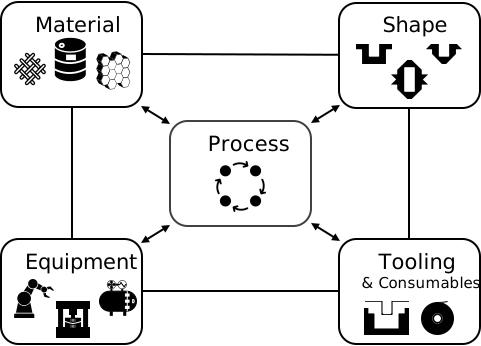
The Knowledge in Practice Centre (KPC) is centered around a structured method of thinking about composite material manufacturing. From the top down, the heirarchy consists of:
- The factory
- Factory cells and/or the factory layout
- Process steps (embodied in the factory process flow) consisting of:
The way that the material, shape, tooling & consumables and equipment (abbreviated as MSTE) interact with each other during a process step is critical to the outcome of the manufacturing step, and ultimately critical to the quality of the finished part. The interactions between MSTE during a process step can be numerous and complex, but the Knowledge in Practice Centre aims to make you aware of these interactions, understand how one parameter affects another, and understand how to analyze the problem using a systems based approach. Using this approach, the factory can then be developed with a complete understanding and control of all interactions.
Interrelationship of Function, Shape, Material & Process
Design for manufacturing is critical to ensuring the producibility of a part. Trouble arises when it is considered too late or not at all in the design process. Conversely, process design (controlling the interactions between shape, material, tooling & consumables and equipment to achieve a desired outcome) must always consider the shape and material of the part. Ashby has developed and popularized the approach linking design (function) to the choice of material and shape, which influence the process selected and vice versa, as shown below:
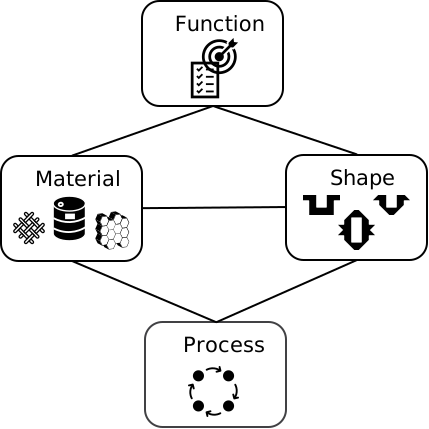
Within the Knowledge in Practice Centre the same methodology is applied but the process is more fully defined by also explicitly calling out the equipment and tooling & consumables. Note that in common usage, a process which consists of many steps can be arbitrarily defined by just one step, e.g. "spray-up". Though convenient, this can be misleading.

Workflows
The KPC's Practice and Case Study volumes consist of three types of workflows:
- Development - Analyzing the interactions between MSTE in the process steps to make decisions on processing parameters and understanding how the process steps and factory cells fit within the factory.
- Troubleshooting - Guiding you to possible causes of processing issues affecting either cost, rate or quality and directing you to the most appropriate development workflow to improve the process
- Optimization - An expansion on the development workflows where a larger number of options are considered to achieve the best mixture of cost, rate & quality for your application.
To use this website, you must agree to our Terms and Conditions and Privacy Policy.
By clicking "I Accept" below, you confirm that you have read, understood, and accepted our Terms and Conditions and Privacy Policy.

