
Storage - A180
| Storage | |
|---|---|
| Document Type | Article |
| Document Identifier | 180 |
| Tags | |
Introduction[edit | edit source]
Storage and Inventory management are critical to running a profitable composites manufacturing business.
The storage step is the action of storing raw materials and parts prior to processing in order to preserve them. This page links to the individual equipment found within the storage cell. Examples include, freezers, shelving, and environmental monitoring equipment.
It is important to keep all areas clean, organized and to know where everything is stored via an MRP (material requirements planning), ERP (enterprise resource planning) or other (logistics, tracking, warehouse management) system.
Significance[edit | edit source]
Supply chain issues plague manufacturing from a global issue down to a local issue. Understanding the storage requirements for these materials is key to ensure manufacturing timelines, part quality and efficiency are maintained. Some discussion of storage needs throughout the factory are also discussed here.
Scope[edit | edit source]
Storage requirements run throughout the factory, where WIP must be stored or held, pending the next step in the process, or where consumables and hand tools are needed locally. This article deals primarily with the dedicated storage areas in the factory.
Overview[edit | edit source]
Materials should be stored in controlled areas and managed carefully for inventory management, including asset management, cost control, avoiding shortages in the factory, shrinkage and wasted time locating the right item. Materials are usually entered into the ERP or MRP system in the receiving area and consumption is controlled through the storage system. The consumption point can be managed at a stores facility, by distributed “vending machines” (for tools, PPE typically) that the operator can remove by bar code on employee passes or program cards, min/max distribution to workstations for general consumables. A private company such as the Fastenal™ FastVEND™ system can take on the responsibility for end point use with a variety of vending style distribution machines that they replenish, freeing up labour, cash flow, ongoing inventory control for more off the shelf consumables.
Concentrating storage of similar use products and of similar environmental controls is important to manage inventory. Some of the separate areas include:
- Receiving and Shipping
- Prepreg Freezer Storage
- Consumables, Hand Tools, and special part storage
- Part Tool, Fixture and Handling Fixture Storage
Prepreg Freezer Storage[edit | edit source]
Prepreg materials typically need to remain at sub zero temperatures unless actively being prepared or used to make a part.
Prepreg materials and certain chemicals require freezing (typically <-18° C) to minimize the degradation of the material’s shelf Life. Rolls of prepreg as well as cut prepreg “kits” are also stored in freezers to prolong overall material life. Careful tracking and logging of material time in and out of the freezer is required to track the material's out-time due to the limited shelf life of certain materials (typically prepreg). Prepreg has a defined “lifetime” with a maximum “due date” for use.
Mechanical Life:
- Out Time (Mechanical Life)-Maximum time allowed from freezer to part cure
- Once cured, prepreg is set and no longer dependent on life management
Shop Life:
- Shop Life (Work Life)-Maximum time until part is bagged for cure
- Freezer time allows the life to be extended (analogous to fresh produce)
- Production control, supervisors and operators must check remaining life to ensure there is enough mechanical life remaining until completion of the Cure cycle (precisely the achievement of the gelation temperature and period).

Good material management is required for the following reasons:
- Minimize the material that must be scrapped due to out of life.
- Material recertification that can be used to extend material life, however it is a situation to be avoided if possible and typically requires customer approvals.
- Tight material life timing can affect autoclave and/or oven planning and can impact overall production schedules.
- Make sure materials that will be close to remain within shop and mechanical life are expedited as a priority. Place a visible note (bright sticker or other) highlighting the priority.
- A tool such as JETCAM’s CrossTrack with RFID or barcode tracking can greatly improve the traceability, material usage and material scrap rate.
Prepreg Fibre Material Rolls[edit | edit source]
- Prepreg glass, aramid (Kevlar), carbon fibre are typically stored in freezers at-18 C (to avoid life depletion).
- Prepreg is typically shipped on a centre roll, bagged, with the roll suspended on the ends to avoid/minimize any interaction/bonding/sticking or crushing of the material by resting on its own weight.

- Materials often come in 1 m (42”) wide rolls. Other widths are available, however shelving that is 1 m plus ~ 10 cm (42” plus ~4”) for the box housing is recommended.
- Boxes can typically be stacked only up to the material supplier’s allowable limit, so height between shelves should be sized according to typical materials
- Box identification on the exposed end improves retrieval and minimizes errors in material selection.
- Per above section on shop and mechanical life, freezer stored materials with life requirements must have life management system.
- Material life starts at manufacture and must be tracked as to frozen and thawed life. The material life should be tracked as of entry in the factory, adding in the existing life from manufacture to arrival at the factory. Similar to food it has an expiry and an out of freezer time limit.
- In a worse case scenario, a 're-lifeing' of the material may be performed to see if an out of date material can be used. This process would require testing to re-certify a new life time for the material.
Prepreg Fibre Material Rolls[edit | edit source]
Kits are the plies and other components of a part or work package that are grouped and typically set in a pre-determined reverse order of assembly, ready to send to assembly. More information on kitting can be found here. Plies are pre-cut, stacked and stored in a sealed bag. Depending on production methods and needs, it is often beneficial to cut multiple kits at the same time. The unused kits should be hermetically bagged and returned to the freezer as quickly as possible. Careful identification and tracking of the kits should be taken to enable quick retrieval. Loss of kits in a freezer is a common issue that results in delays or recutting and kitting. The freezer should consider the following:
- Room to store kits that are bagged should be provided for.
- Prepreg kits should not be stacked or only as high as the material supplier permits. Care must be taken to keep the plies flat. The risk is that the prepreg starts to adhere to the backing plies if stacked too high.
- Kits should be well marked as to their content.
- Their location in the freezer should be well marked and in an organized and documented location to avoid lost time (a common occurrence) due to misplacement and time spent searching for kits.

Freezers should be controlled and monitored as to access and to ensure the freezer door is closed and conditions such as temperature and humidity, are maintained. Thawing warning alarms should be use to ensure the known thawed life of a part is known.
Non-Freezer Storage[edit | edit source]
Part Materials[edit | edit source]
Part material is any material that will be built into a composite part (hardware). Part materials pre cure include:
- Honeycomb core (Nomex or metals among others)
- Lightning strike
- Dry fibre (tow, UD, weave, braid)
- Adhesives (Film, Foam)
- Other build materials (Tedlar)
- Potting compounds
- Inserts
Most materials including dry glass fibre, aramid and carbon rovings, woven and braided materials can typically be stored at room temperature. Note: best practice is to store dry fabric by suspending it on a rack with a pole through the centre of the material. Standing a roll of dry fibre on end can lead to the fibre sagging under gravity and damage the weave, potentially rendering it unusable.
Honeycomb materials should be carefully stored per the supplier/ manufacturer’s recommendations. Storage should be temperature and cleanliness controlled. Post cure materials, such as paint and other finishing coating, should also be stored following the manufacturing standards.
Consumables, Hand Tools and Special Part Storage[edit | edit source]
Consumable materials are materials used in the manufacturing of composite parts that are discarded or consumed in/after the process. Some may be re-used a few times depending on requirements. Some may be recycled. Some examples and uses of consumables used in the manufacturing processes include:
- Vacuum bag and bagging material
- Tape (Tacky tape, and other tape type)
- Peel ply
- Release film
- Mould release
- Thermocouples
- Parchment and other papers
- Tedlar
- Breather material
- Flow mesh
- String bleeders
- Dam material
Consumables and hand tools that are used in the post-cure processes include:
- Plastic or wood wedges (to separate the part from the tool)
- Rubber or other hammer/mallet
- Machine tools for trimming, drills
- Abrasives for tool cleaning and part finish
- Tool cleaning fluids
Part Tool, Fixture and Handling Fixture Storage[edit | edit source]
| Hand Tools | Calibrated Tools | Personal protective equipment (PPE) |
|---|---|---|
| Razor knives (Olfa and Exacto), Scissors, Spatulas / scrapers, Tape Dispenser, Sharpies | Lasers, Vacuum gauges, Timers, Heat guns, Vernier Calipers | Hairnet, Protective Safety Glasses, Breathing apparatus (where required), Lab coats |
PPE is an ideal item to automate through the use of vending machines distributed near to their end use.
Tool and Fixture Storage[edit | edit source]
Tool storage can be broken down into several parts. Tools are often made of Invar, steel, or aluminum, resulting in heavy tools. Tooling can quickly consume large amounts of floor space. Tool storage should consider shelving systems and inventory management systems to store and pick tools from shelving. The moving of tools in the factory should be considered, either by the use of wheels that are autoclave survivable, forklifts or Automated Ground Vehicles (AGVs).
Part Tooling (Moulds)[edit | edit source]
Part tools are high precision tooling to build parts against. The surface provides a part surface and must be of the highest quality finish. The tool must also be built, transported and stored in the final shape, such that no distortion such as twist or sag is input to the tool to result in an incorrect part.
Caul Plates[edit | edit source]
A caul plate is a separate piece of tooling to provide a second finished surface for the part external to the main mould tooling. It typically requires alignment tooling to ensure the finished surface provides the desired finish at the desired location.
Fixture Tooling[edit | edit source]
Part tooling (Moulds) can be large and heavy. In order to move the tools from storage to layup to the autoclave then to demould, cleaning, prep and back to storage, tool specific tooling and fixtures are often required to ensure the tool is not damaged or distorted in its activities. The support structure, in addition to the forklift lift points, or dedicated wheels are of critical importance and must be designed to not input any stresses that might distort the mould surface over the use cycle of the tool. This includes thermal cycling.

 |
 |
| About | Help |

Welcome
Welcome to the CKN Knowledge in Practice Centre (KPC). The KPC is a resource for learning and applying scientific knowledge to the practice of composites manufacturing. As you navigate around the KPC, refer back to the information on this right-hand pane as a resource for understanding the intricacies of composites processing and why the KPC is laid out in the way that it is. The following video explains the KPC approach:
Understanding Composites Processing
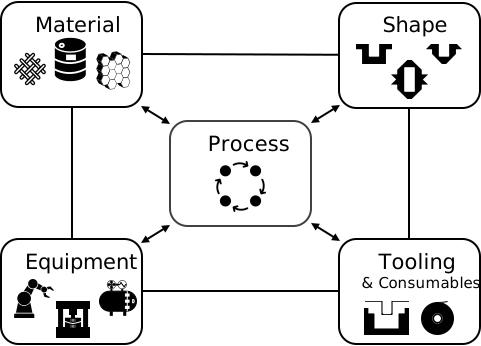
The Knowledge in Practice Centre (KPC) is centered around a structured method of thinking about composite material manufacturing. From the top down, the heirarchy consists of:
- The factory
- Factory cells and/or the factory layout
- Process steps (embodied in the factory process flow) consisting of:
The way that the material, shape, tooling & consumables and equipment (abbreviated as MSTE) interact with each other during a process step is critical to the outcome of the manufacturing step, and ultimately critical to the quality of the finished part. The interactions between MSTE during a process step can be numerous and complex, but the Knowledge in Practice Centre aims to make you aware of these interactions, understand how one parameter affects another, and understand how to analyze the problem using a systems based approach. Using this approach, the factory can then be developed with a complete understanding and control of all interactions.
Interrelationship of Function, Shape, Material & Process
Design for manufacturing is critical to ensuring the producibility of a part. Trouble arises when it is considered too late or not at all in the design process. Conversely, process design (controlling the interactions between shape, material, tooling & consumables and equipment to achieve a desired outcome) must always consider the shape and material of the part. Ashby has developed and popularized the approach linking design (function) to the choice of material and shape, which influence the process selected and vice versa, as shown below:
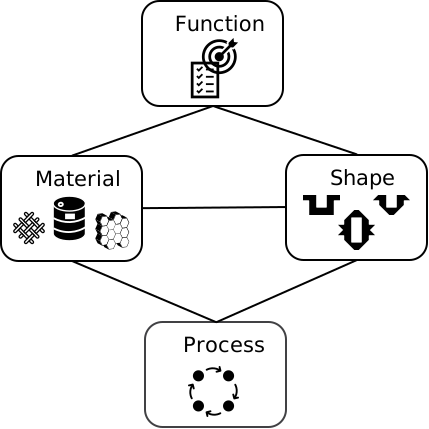
Within the Knowledge in Practice Centre the same methodology is applied but the process is more fully defined by also explicitly calling out the equipment and tooling & consumables. Note that in common usage, a process which consists of many steps can be arbitrarily defined by just one step, e.g. "spray-up". Though convenient, this can be misleading.

Workflows
The KPC's Practice and Case Study volumes consist of three types of workflows:
- Development - Analyzing the interactions between MSTE in the process steps to make decisions on processing parameters and understanding how the process steps and factory cells fit within the factory.
- Troubleshooting - Guiding you to possible causes of processing issues affecting either cost, rate or quality and directing you to the most appropriate development workflow to improve the process
- Optimization - An expansion on the development workflows where a larger number of options are considered to achieve the best mixture of cost, rate & quality for your application.
To use this website, you must agree to our Terms and Conditions and Privacy Policy.
By clicking "I Accept" below, you confirm that you have read, understood, and accepted our Terms and Conditions and Privacy Policy.

