
BCCA Cradle Project - C123
| BCCA Cradle Project | |||||||
|---|---|---|---|---|---|---|---|
| Case study | |||||||

| |||||||
| Document Type | Case study | ||||||
| Document Identifier | 123 | ||||||
| Objective functions |
| ||||||
| MSTE workflow | Development | ||||||
| Prerequisites | |||||||
Challenge[edit | edit source]
The CARA cradle is a patient positioning system used during cancer treatment, developed through a collaboration between the Composites Research Network at the University of British Columbia and the British Columbia Cancer Agency (BCCA). Early prototypes confirmed that a composite cradle was feasible, but they also revealed significant design and manufacturability challenges. Issues such as foam cracking during thermoforming, difficulties with prepreg layup, and excessive labour requirements limited consistency and scalability were identified. The goal across this project became to iteratively refine the cradle’s design to achieve better clinical fit, stronger structural performance, and a repeatable, cost-effective manufacturing process.
Video[edit | edit source]
Approach[edit | edit source]
The project evolved over multiple design and manufacturing phases following the MSTEP approach:
Phase 1[edit | edit source]
The primary objective of Phase 1 was to develop a baseline prototype that could serve as a reference for future iterations and suitable for use in clinical trials.
Materials Selection[edit | edit source]
The most significant change in the first iteration was the switch from a monolithic carbon fibre composite part to a sandwich panel construction. To enhance the radio transparency of the cradle and reduce weight, thin-ply NTPT prepreg was applied over a Rohacell 31HF foam core. The cradle was formed using a two-piece machined foam tool, which is bonded together after the layup process. This sandwich construction provided increased stiffness while lowering overall density. The driving factors for material selection were high relative strength, low density, bond quality between the core and fibres, and fibre formability. The choice of core material and prepreg thickness was based on finite element analysis (shown in Figure 1) and mechanical testing (shown in Figure 2) to ensure the cradle could safely withstand anticipated load. Various layup schedules, fibre types, core materials, and thicknesses were evaluated, ultimately selecting 2 mm Rohacell 31HF as the core with custom thin-ply prepreg as the skin. Two separate prepreg rolls were used, with the tool-side material incorporating an additional resin film layer to improve surface finish.

Geometry Simplification[edit | edit source]
The pyramid mounting section (used to hang the cradle in Figure 2) quickly emerged as a major manufacturing challenge. Mechanical testing revealed stress concentrations at the transition between the pyramid section and the rest of the cradle.
File:Cradle in a highly deformed state qqDHInQApCp4.png

Its complex curvature made fibre placement and cutting difficult, even with the use of templates, and the process was time-consuming and hard to scale for higher production volumes. To accommodate the curvature, darts were added to the fabric to reduce wrinkling, but this often led to inconsistent composite coverage and foam defects. Forming the foam over this geometry was also challenging, creating additional imperfections.
The complex geometry of the initial prototype required a specialized vacuum bag with custom inserts to maintain adequate compression. While a well-defined process allowed these bags to be produced consistently without leaks, it was labor-intensive and still prone to defects such as wrinkling, bridging, and incomplete consolidation around the pyramid. Additional simulations in Abaqus FEA software (Figure 3) were performed to evaluate alternative geometries and ensure the structural performance of the revised design matched the original pyramid mounting feature.

Cure Cycle[edit | edit source]
The next step involved analyzing the cure cycle to ensure it was optimized and aligned with the manufacturer’s recommended cure cycle. Heat surveys were conducted by placing thermocouples throughout the part, tooling, and oven. These measurements revealed that the part’s large thermal mass prevented it from reaching the desired cure temperature, even with extended temperature holds. This led to a redesign of the tooling to reduce thermal mass. During curing, it was also observed that the prepreg shifted over the foam core, resulting in suboptimal positioning over the foam core. This issue was resolved by shortening the first temperature hold, minimizing the time the resin remained at low viscosity and reducing prepreg movement.
Defects of Phase 1[edit | edit source]
While the process produced functional parts, several challenges remained. The geometry had been improved but still included complex double curvature, which complicated foam forming and limited scalability for higher-volume production. Additionally, finishing the edges proved labor-intensive and inconsistent, making it unsuitable for routine manufacturing.
Phase 2[edit | edit source]
Phase 2 focused on refining tool geometry, the layup process, and foam forming, though the remaining double-curvature design continued to present challenges for both foam formability and prepreg drapability.
Foam Forming[edit | edit source]
Producing the foam section required testing the cutting of the foam and the formability over both the L-shaped and pyramid sections (before they were removed). Rohacell foam proved particularly tricky to form, as it needed to be precisely at its glass transition temperature (Tg) to bend without snapping. The manufacturer’s recommended approach, placing the foam and tool in the oven to reach thermal equilibrium at Tg, then forming it quickly, proved difficult in practice. When the oven doors were opened, the foam temperature dropped too quickly, causing snapping during forming. Attempts to compensate by reheating the foam between bends had limited success.

The most effective method involved heating the oven above Tg and placing the tool, foam, and thermocouple inside before the oven reached the target temperature. A thin rubber sheet was placed on top to hold the foam edges down, and a small metal weight applied over the curved region. The system was allowed to equilibrate until the thermocouple reached Tg, after which the tool was quickly removed, and the foam bent to shape and held until cooled to 80 °C. This approach successfully produced the part shown in Figure 5. Despite this success, the complex geometry of the tooling continued to cause defects in the foam, including unevenness, wrinkling, cracking, and incomplete translation of the curvature into the final composite part, highlighting the ongoing challenges of producing high-quality components from such intricate designs.

Several techniques were explored to form the foam, including pre-shaping with a heat gun, applying vacuum in the oven, and using a silicone male tool. While some methods showed promise, none produced a consistent thermoforming process. Once formed, the foam needed precise cutting to remove excess material, as shown in Figure 5. A 3D-printed tool and razor blade were used to achieve a clean surface finish.
Layup[edit | edit source]
Building on Phase 1 simulations, the cradle was designed as a sandwich panel, with low-density foam at the core and unidirectional prepreg on the outside. Layup schedules were chosen based on simulations and mechanical testing to maximize strength while minimizing weight. Initially, a thinner foam core met density requirements, but increasing the thickness to 5 mm improved stiffness and allowed for carbon removal around the edges. A monolithic mounting section was also added to strengthen the attachment area and improve quality around drilled holes. During prototyping, challenges arose with prepreg sliding on the mold and difficulty forming it over the foam. To limit the movement of the fibre during the layup, a spray adhesive was used to keep it in place. Twelve prototypes were produced to test different wrapping techniques and surface finish improvements. While layup time could be reduced, edge finish remained a challenge, leading to the decision to increase foam thickness to simplify the design.
Monolithic Mounting Section[edit | edit source]
To further improve strength and eliminate potential failure points, the mounting section was switched to monolithic carbon fiber. This change added a non-crushable area for attaching the mounting fixture. As this area lies outside the radiation zone, density reduction was not critical. The change improved part quality, preventing exposed foam around drilled holes and ensuring the carbon finish met sanitation standards. Finally, joining the monolithic section with the sandwich panel required design optimization. Initially, the carbon layer faced the patient side with foam underneath, but this was later reversed, as shown in Figure 6. Placing the stronger carbon material on the underside of the curve improved part strength, as this region experiences compression, reducing the risk of buckling and prepreg surface wrinkling.

Phase 3[edit | edit source]
A structured effort was made to redesign the cradle for manufacturability following the MSTEP approach.
Geometry Optimization[edit | edit source]
Over the course of the project, the geometry of the cradle evolved significantly. Figure 7 illustrates this progression, from the first version with a pyramid mounting section, to the second with complex double-curvature, and finally to the third, which could be reliably produced in large quantities. As the design matured, it became simpler. This is a common theme in prototyping and design iteration.

The most substantial geometric changes occurred during Phase 3, when ten different part geometries were tested to optimize manufacturability, radiation zone clearance, and support placement. Adjustments included altering curvature angles to position supports further from the mounting section and reducing the size of the mounting area. The final design, shown in Figure 8, is fully symmetric and represents the simplest and most practical geometry.
_l3hTXdCVn7Yg.png)
This simplified shape eliminated the need for cross-sectional changes other than rounding of the corners, allowing higher-volume production from larger sheets. Achieving this simplification required several considerations: the layup had to withstand expected forces without the pyramid mounting section, the monolithic edge needed sufficient strength to prevent buckling, and mounting holes were repositioned to minimize stress concentrations at the foam-carbon transition. The new shape of the part required new tooling to be machined. With this new tool design, larger panels could be made and cut into multiple parts, with the limitation being the size of the oven. This approach required rethinking edge processing, as layup could no longer fully encapsulate the edges, prompting the development of improved edge-finishing techniques.
Edge Finishing[edit | edit source]
Edge finishing is critical for both patient safety and sanitation. Sharp edges can cause injury, and exposed foam is porous and difficult to clean. Initially, edges were covered with a monolithic carbon section from the layup, but this approach produced sharp, labor-intensive edges and occasional exposed foam. Flat-panel tests explored alternative geometries and filler materials, which provided smooth finishes but failed to meet radio-transparency requirements. The option of wrapping the entire cradle with shrink-tubing was explored but quickly abandoned as this method resulted in heavy wrinkling around curved sections and was unable to accommodate any changes in cross-section. Ultimately, it was found that vinyl-wrapping the edge and coating it with Cerakote paint produced the most desirable result. The vinyl was effective for covering any sharp edges produced by the carbon fibre, and the Cerakote provided a good seal to make the transition of carbon to vinyl more robust and easier to sanitize. This method also yielded an aesthetically pleasing finish, making it ideal for commercialization.
Tooling Innovation[edit | edit source]
With an improved edge finishing technique and simplified part geometry, more opportunities for tooling improvement became clear. As the edges no longer needed to be covered during the layup, it became possible to shift the design for higher-volume production. As seen in Figure 9, a single continuous layup could now produce multiple parts with simple and limited post-processing. Reducing the number of layups,the most labor, and time-intensive step, greatly improved overall manufacturability.

The new single-curvature tool simplified and accelerated the layup process, as the prepreg no longer had to navigate complex curves or endure excessive shear stress. This reduced wrinkling and other layup defects, improving overall part quality. Post-processing was also enhanced, with dedicated tools and fixtures developed to consistently cut cradles to precise dimensions and accurately drill mounting holes in the monolithic section. With these improvements, the cradle design became suitable for clinical trials and higher-volume production.

Outcomes[edit | edit source]
- Manufacturability Improvements: Simplified geometry and wide-panel layup reduced production time and improved part consistency.
- Final Geometry: The final model adopted for clinical use is symmetrical, less curved, and easier to form.
- Edge Safety: Vinyl wrapping replaced labour-intensive monolithic edge layups.
- Repeatability: New cutting jigs and manufacturing guides supported consistent cradle trimming and drilling.
Impact[edit | edit source]
Across three phases, CRN’s iterative design-build-test workflow significantly advanced the clinical readiness of the CARA cradle. The evolution from early, highly curved prototypes to streamlined, manufacturable designs illustrate the value of integrating design for manufacturability from the outset. These learnings support future scale-up and potential production automation for composite medical devices.
Key Techniques[edit | edit source]
- Thin-ply prepreg layup (NTPT CF1) on thermoformed Rohacell foam
- Geometry refinement via CAD-based design iteration
- Vacuum bagging with semi-rigid rail-based thermoforming setup
- Prototype validation via structural testing and clinical feedback
- Wide-panel layup and cutout strategy for efficiency and edge quality
 |
 |
| About | Help |

Welcome
Welcome to the CKN Knowledge in Practice Centre (KPC). The KPC is a resource for learning and applying scientific knowledge to the practice of composites manufacturing. As you navigate around the KPC, refer back to the information on this right-hand pane as a resource for understanding the intricacies of composites processing and why the KPC is laid out in the way that it is. The following video explains the KPC approach:
Understanding Composites Processing
The Knowledge in Practice Centre (KPC) is centered around a structured method of thinking about composite material manufacturing. From the top down, the heirarchy consists of:
- The factory
- Factory cells and/or the factory layout
- Process steps (embodied in the factory process flow) consisting of:
The way that the material, shape, tooling & consumables and equipment (abbreviated as MSTE) interact with each other during a process step is critical to the outcome of the manufacturing step, and ultimately critical to the quality of the finished part. The interactions between MSTE during a process step can be numerous and complex, but the Knowledge in Practice Centre aims to make you aware of these interactions, understand how one parameter affects another, and understand how to analyze the problem using a systems based approach. Using this approach, the factory can then be developed with a complete understanding and control of all interactions.
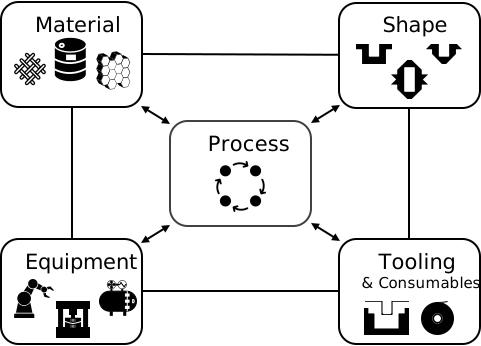
Interrelationship of Function, Shape, Material & Process
Design for manufacturing is critical to ensuring the producibility of a part. Trouble arises when it is considered too late or not at all in the design process. Conversely, process design (controlling the interactions between shape, material, tooling & consumables and equipment to achieve a desired outcome) must always consider the shape and material of the part. Ashby has developed and popularized the approach linking design (function) to the choice of material and shape, which influence the process selected and vice versa, as shown below:
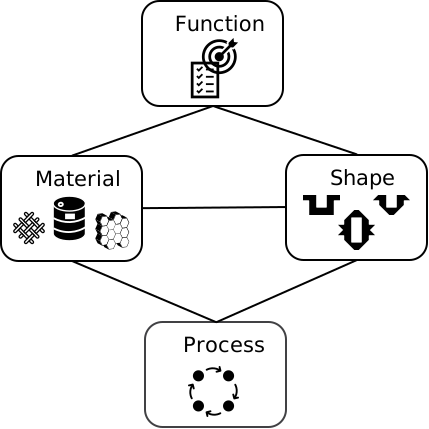
Within the Knowledge in Practice Centre the same methodology is applied but the process is more fully defined by also explicitly calling out the equipment and tooling & consumables. Note that in common usage, a process which consists of many steps can be arbitrarily defined by just one step, e.g. "spray-up". Though convenient, this can be misleading.

Workflows
The KPC's Practice and Case Study volumes consist of three types of workflows:
- Development - Analyzing the interactions between MSTE in the process steps to make decisions on processing parameters and understanding how the process steps and factory cells fit within the factory.
- Troubleshooting - Guiding you to possible causes of processing issues affecting either cost, rate or quality and directing you to the most appropriate development workflow to improve the process
- Optimization - An expansion on the development workflows where a larger number of options are considered to achieve the best mixture of cost, rate & quality for your application.
To use this website, you must agree to our Terms and Conditions and Privacy Policy.
By clicking "I Accept" below, you confirm that you have read, understood, and accepted our Terms and Conditions and Privacy Policy.

